The coin everybody calls the Mercury dime is officially the Winged Liberty Head dime, struck from 1916 to 1945. Two things decide almost everything about collecting it. One is a single coin, the 1916-D, struck in a fraction of the numbers of any other date in the series. The other is a three-letter strike designation, FB, which separates sharply struck uncirculated examples from the rest. Understand those two and the rest of the series is straightforward.
A complete basic set is 77 coins, according to PCGS. Seventy-six of them are collectable steadily over time. The seventy-seventh is a decision.
What a Mercury dime is
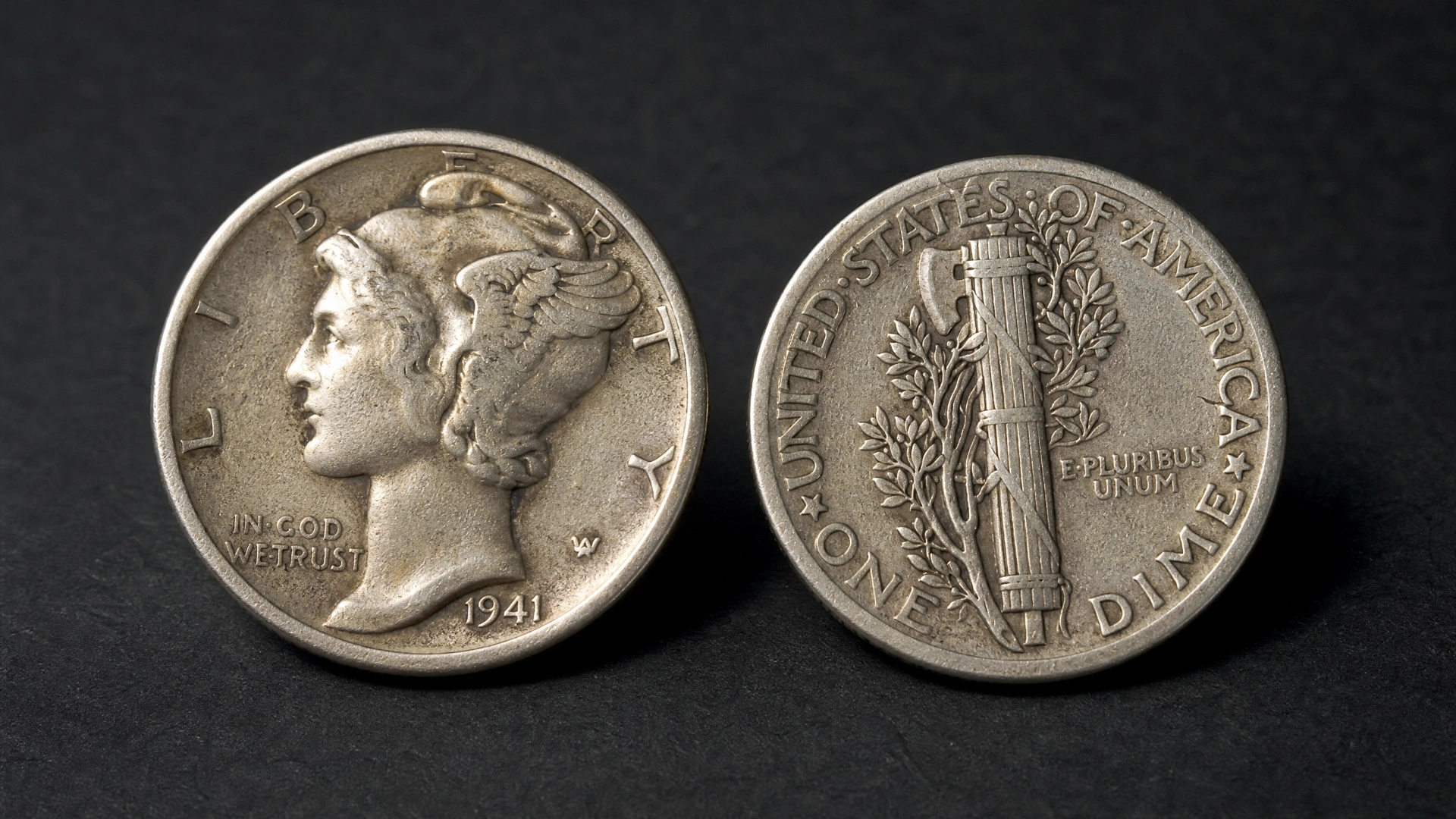
Adolph A. Weinman designed it. The obverse is Liberty in a winged cap — the resemblance to the Roman god is where the nickname came from, and it is a nickname, not the coin's name. The reverse carries a Roman fasces and an olive branch, which the United States Mint describes as "symbolizing America's military readiness and desire for peace". Those bundled rods are where the Full Bands designation lives.
The specifications, per PCGS CoinFacts, are 90 per cent silver and 10 per cent copper, 2.50 grams, 17.90 millimetres, reeded edge. That gives 2.25 grams of fine silver, or 0.0723 of a troy ounce — the same fineness as every other pre-1965 US silver dime, quarter and half. How that figure turns into a melt value, and when melt is the relevant number at all, is worked through in what a coin's melt value is.
The 1916-D, and why it is the set's gate
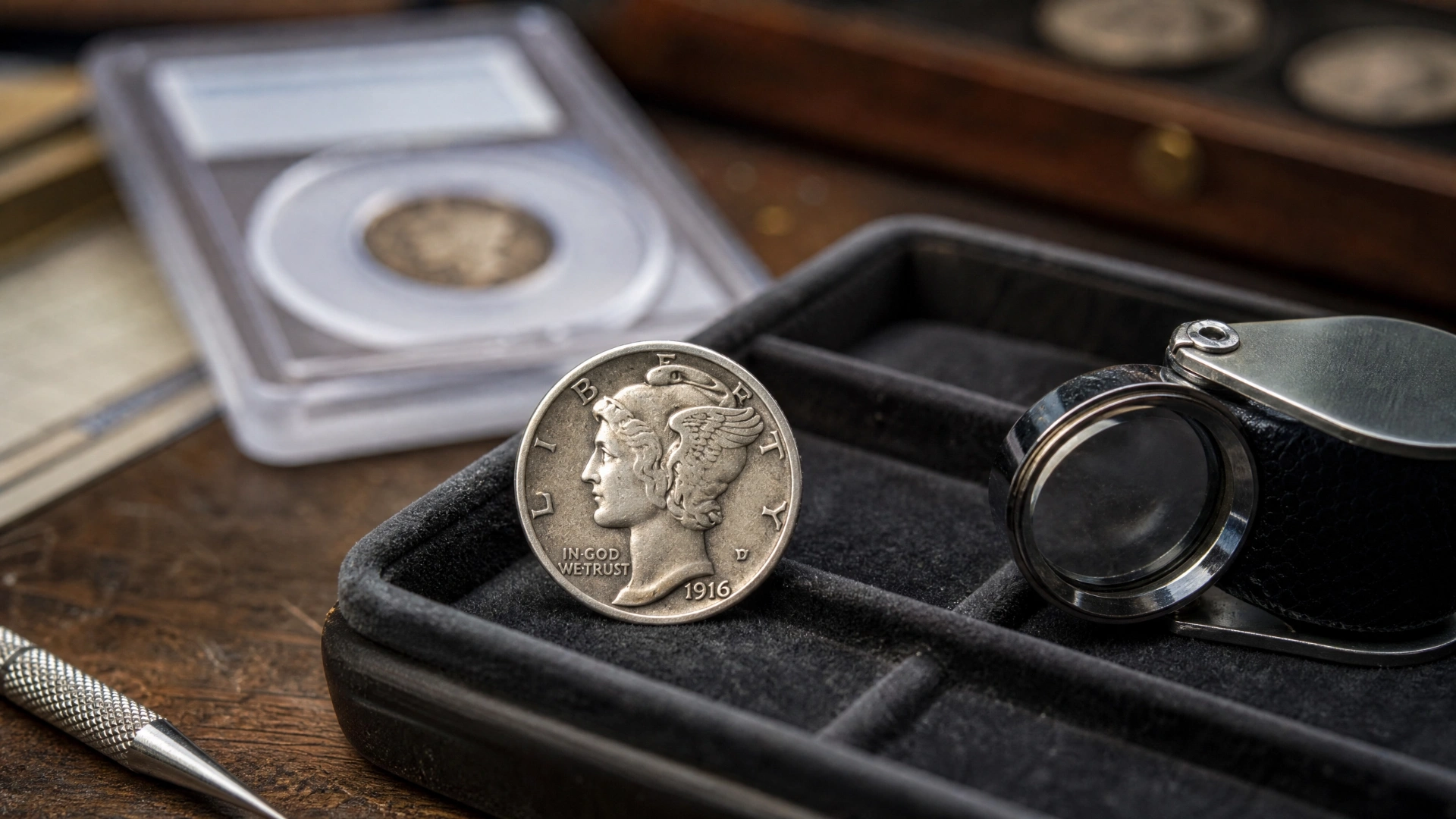
Denver struck 264,000 dimes in 1916, the first year of the design, and never struck so few again. Philadelphia struck 22,180,080. The gap is the whole reason the series has a reputation for difficulty, because the other scarce dates are scarce in a much milder way.
The rare Mercury dime dates are few, and they are rare for one reason: how many were struck. PCGS names six classic key dates and rarities in the series:
| Issue | Mintage | Note |
|---|---|---|
| 1916-D | 264,000 | The key date of the series |
| 1921-D | 1,080,000 | Post-war production collapse |
| 1921 | 1,230,000 | Same cause, Philadelphia |
| 1926-S | 1,520,000 | Scarce, and often weakly struck |
| 1942/1 | No published figure | Overdate variety |
| 1942/1-D | No published figure | Overdate variety |
"Scarce" and "rare" are doing different work in that table. A 1926-S at a million and a half struck is a coin you can find at a show; Ron Guth's summary of the series on PCGS CoinFacts is that "apart from the 1916-D and 1942 overdates, most dates can be obtained with little difficulty". The 1916-D is a different order of problem, and no amount of patience substitutes for the budget it requires.
Added mintmarks: why the 1916-D is bought certified
Because the coin differs from a common 1916 Philadelphia dime by one letter, that letter gets added. On PCGS CoinFacts, David Hall writes that "the bad guys add a 'D' to a 1916 Philadelphia" and that PCGS "sees an average of 5 to 10 counterfeits a week", calling it one of the most counterfeited of all US rare coins. On the same page Charles Morgan describes it as one of the most widely counterfeited US coins and recommends that collectors "only purchase third-party certified examples, even in grades as low as AG3".
That advice is from PCGS's own experts, and we pass it on rather than improving on it. What it means in practice is that for this one issue the certification is not an upgrade to the purchase — it is the purchase. At the volume PCGS reports, an uncertified 1916-D offered at a tempting figure carries a real risk of being one of them. Mintmark style, position and the surface around it are the diagnostics, and they are a specialist's judgement on a genuine-looking coin.
That argument is specific to this issue and does not generalise. For the other seventy-six dates, buying raw is normal, cheaper and perfectly sensible: certification costs a fee and weeks of turnaround, and on common dates in circulated grades it usually is an optional extra. The 1916-D and the overdates are the exception precisely because they are the coins worth faking.
The two 1942 overdates carry a version of the same problem for the opposite reason: they are genuine mint products, and the question is whether the coin in front of you is one of them or an ordinary 1942 with damage or die wear that resembles an underdate.
Full Bands: what it means, and where PCGS and NGC differ
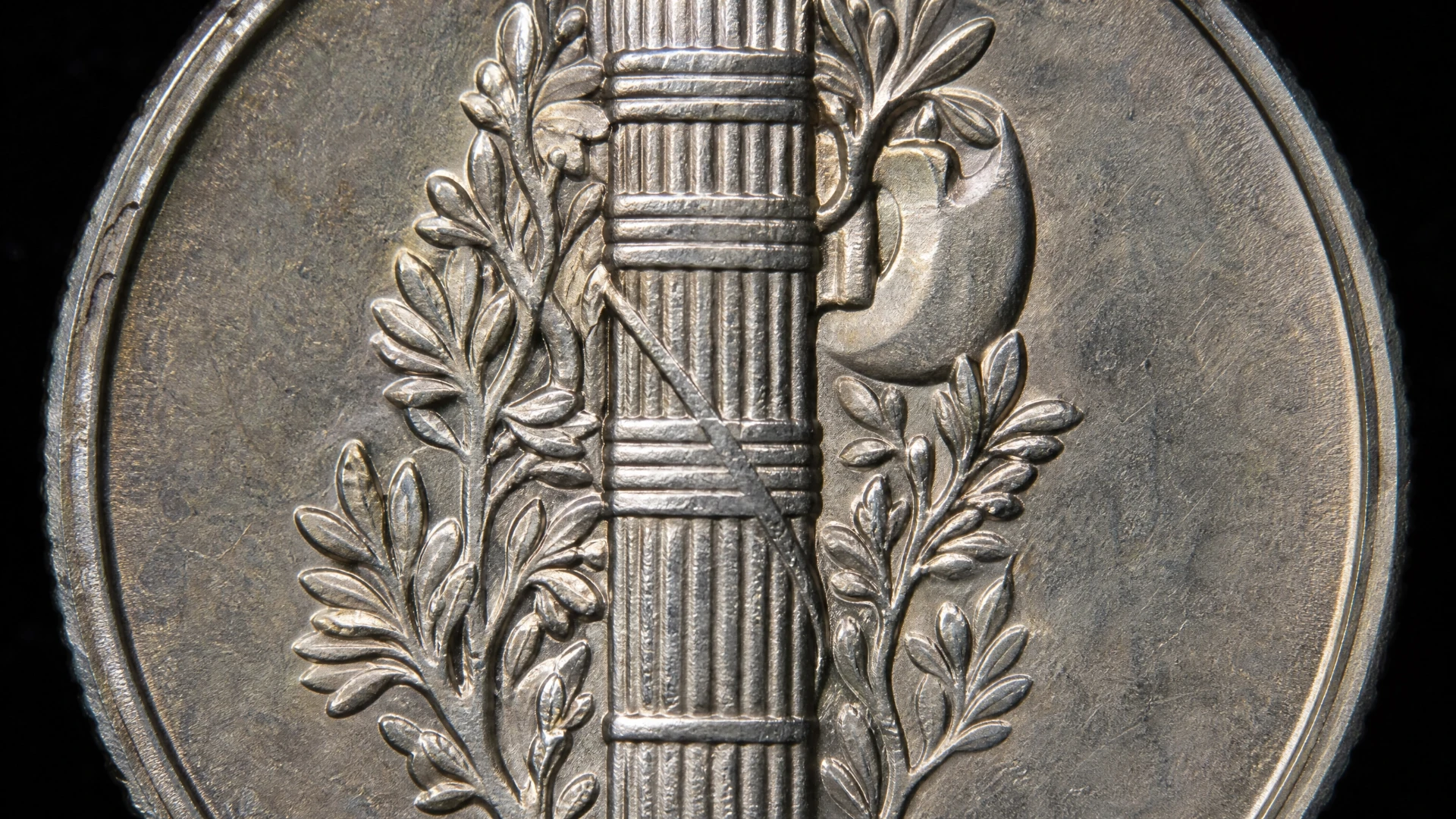
Full Bands describes strike, not wear and not grade — the same distinction we set out for Full Head on the Standing Liberty quarter. The bands are the horizontal ties around the fasces on the reverse. A weakly struck dime shows them merging; a sharply struck one shows them separated. A coin can be Mint State and lack Full Bands. PCGS states that the designation normally goes only to dimes grading MS60 or better. The same page adds: "However, there are exceptions made for the rare 1916-D Mercury Dime as well as the 1942/1 and 1942/1-D overdates, which can receive a Full Bands designation on a qualifying coin grading as low as AU50." Those are the three coins most collectors of this series are actually shopping for, so the exception is worth knowing.
The interesting part is that the two services describe the requirement differently, and the difference is on the record.
| Service | Published requirement |
|---|---|
| PCGS (FB) | "The central (middle) set of bands shows a complete split in the middle." |
| NGC (FB) | "The two central bands (seen at the center of the coin) must show full separation (with a recessed area between them). The top and bottom groups of bands must also show separation." |
Read them side by side: PCGS's published definition turns on the central bands, while NGC's additionally requires separation in the top and bottom groups. So the designation is not a single industry standard with two labels, and a coin's FB status is a statement by the service that graded it. That also means an FB population figure from one service is not interchangeable with the other's — which is one of several reasons the two reports cannot be added together, explained in what a population report tells you.
Two practical consequences. On common dates, FB matters mainly at the top of the grade range. On the dates that were chronically weakly struck — the 1926-S is the standard example — a Full Bands coin is a genuinely harder thing to find than the mintage alone suggests, and the mintage will not tell you that.
The 1942/1 and 1942/1-D overdates
These are die-making accidents, and the mechanism is worth knowing because it explains why there are exactly two of them. In the final months of 1941, according to PCGS, two Mercury dime obverse working dies were impressed with a 1941-dated hub and then with a 1942-dated hub. One of those dies stayed in Philadelphia and produced the 1942/1; the other went to Denver and produced the 1942/1-D. PCGS attributes the error to wartime pressure on the engraving department or simply to human error.
On the coin, the underlying 1941 shows through beneath the 1942 date. Because die wear, damage and grease-filled dies can all produce something that resembles an underdate, both varieties are ones to buy attributed by a grading service rather than assessed from a photograph.
Three ways to build the set
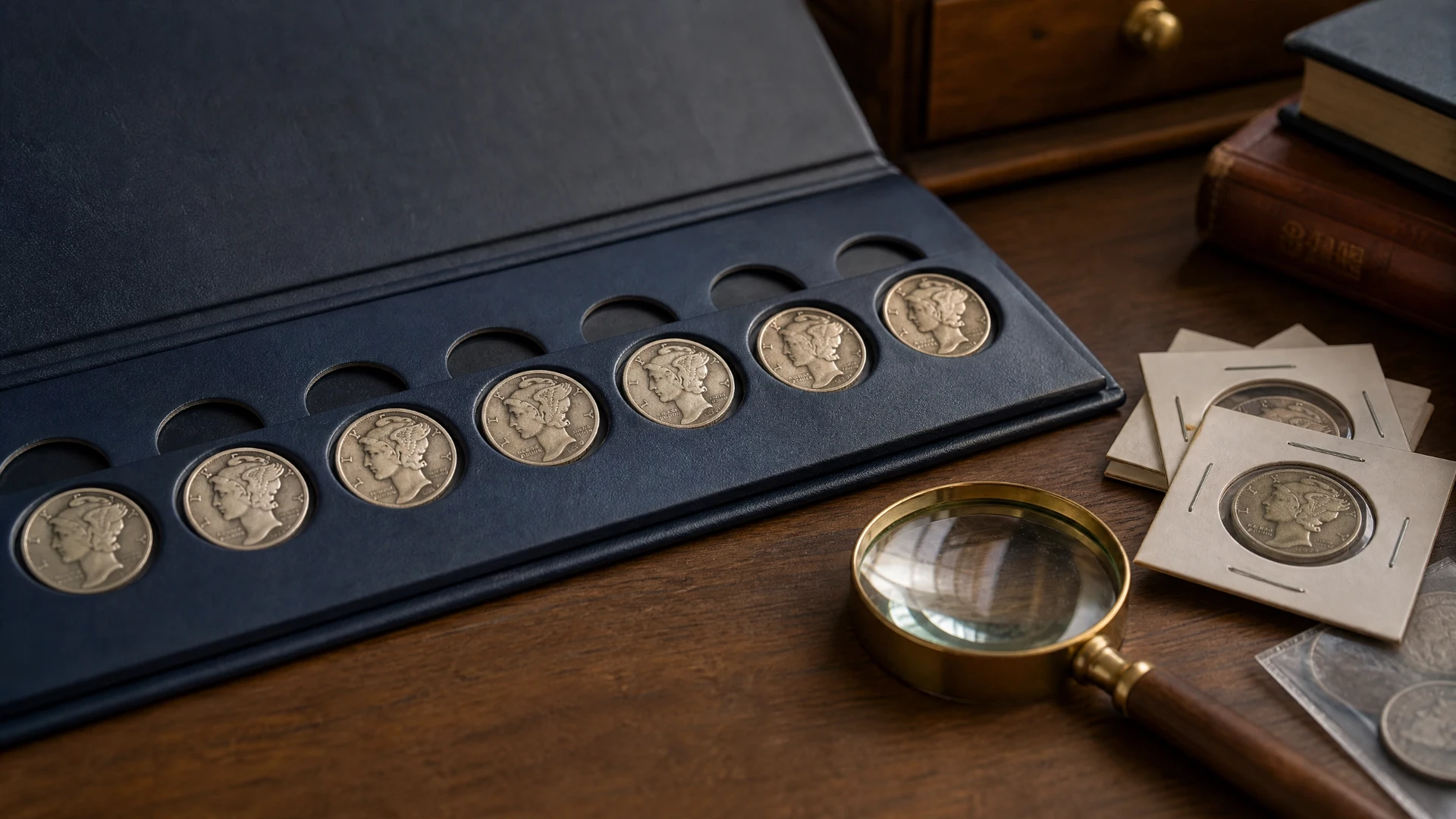
Decide on the 1916-D first. It will affect the budget more than the other seventy-six coins together, and the decision is a scoping decision, not a purchase you defer indefinitely.
The 77-coin basic set. Every date and mintmark in circulation strikes, which is what PCGS counts. It is a long project, and the usual approach is to work through the affordable dates in a consistent grade first so the gaps are visible, then address the keys.
The short set. PCGS puts this at 1940 to 1945: eighteen coins — six years across all three mints — all readily available, and the years in which strikes are generally at their best. It is a complete-looking set of a beautiful design without the 1916-D question in it at all, and it is the most common entry point into the series.
A set with the keys deliberately excluded. Some collectors build 1916 to 1945 minus the 1916-D and the two overdates, treating those three as a separate, later project. It is an honest way to own the series rather than a compromised version of the full set, provided the gaps are a choice and are described as one when the collection is eventually sold.
Whichever route, pick a grade band and hold to it. A run of matched Very Fine coins reads as a collection; the same dates in grades scattered from Good to Mint State reads as an accumulation. Dealers and auction cataloguers generally find a matched-grade run easier to describe and to sell as a group.
What we look at across the counter
Mercury dimes come across a coin shop counter three ways: as a set someone is building, as a roll or a jar from an estate, and as a single coin somebody hopes is a 1916-D. All three get the same first pass — date and mintmark, then strike, then surfaces — because that order decides whether a coin is being handled as a collectible or by weight. Mercury dime value is set by those three readings together against the market on the day, never by the date alone.
The submission question is sharper on a series like this one than on a series of larger coins, because grading fees do not scale down with the coin. On a common Mercury dime in a circulated grade the fee can be a large share of what the coin is worth, which is why most of a 77-coin set is collected raw; on a candidate 1916-D or a possible overdate the same fee buys an authentication that decides whether the coin is what it appears to be. We submit coins to PCGS and NGC and will tell you honestly which side of that line a coin sits on.
Appraisal for sellers is complimentary. Written documentation for insurance purposes is a separate, chargeable service, and the two are not the same thing: one tells you what we would pay, the other is a document for your insurer. If you are filling a specific hole in a set, our want-list service is how we go looking for it — ask the shop about how it works, including fees, deposits and how long a list stays active.
A dime sale is also handled differently from a scrap sale under Arizona law, because A.R.S. § 44-1601 excludes coins from the definition of a "precious item" — see why an Arizona shop asks for your ID and pays by check.
This article is educational and reflects general information about precious metals and collectible coins. It is not investment, tax or legal advice, and Copper State Coin & Bullion is not a registered investment adviser, broker-dealer or tax professional. Metal prices fluctuate and past performance does not indicate future results. Consult a qualified professional about your own situation.
Frequently asked questions
What makes the 1916-D Mercury dime the key date?
Mintage, and the size of the gap. Every other scarce date in the run was produced in the millions or the high hundreds of thousands, while Denver's 1916 output was a fraction of that and was never repeated. That is why the 1916-D, rather than any of the other keys, sets what a complete set costs and why it is the coin the fakers target.
Which Mercury dime dates are genuinely rare?
PCGS names six: the 1916-D at 264,000, the 1921-D at 1,080,000, the 1921 at 1,230,000, the 1926-S at 1,520,000, and the 1942/1 and 1942/1-D overdates, for which no mintage is published. PCGS's own view of the rest of the series is that most dates can be obtained without much difficulty.
What does Full Bands mean on a Mercury dime?
It means the horizontal bands on the reverse fasces are fully separated, which reflects how sharply the coin was struck rather than how little it has worn. It is a designation rather than a grade, and it normally applies only to uncirculated coins — PCGS makes a stated exception for the 1916-D and the two 1942 overdates down to AU50.
Do PCGS and NGC use the same Full Bands standard?
Their published definitions are not identical. NGC's wording requires separation in the top and bottom band groups in addition to the two central bands, where PCGS's turns on the central set. In practice this means FB is a statement by the grading service that examined the coin, and FB populations from the two services should not be combined.
How can I tell if a 1916-D has an added mintmark?
Usually you cannot, which is the problem. PCGS reports seeing an average of five to ten counterfeits a week and recommends buying only certified examples, even in grades as low as AG3. Mintmark style, placement and the surface immediately around it are the diagnostics, and they are a specialist judgement made under magnification.
Is it worth grading a common Mercury dime?
Usually not, and the reason is arithmetic rather than taste: a grading fee does not shrink to match a small coin, so on a common date in a circulated grade it can be a large share of what the coin is worth. Grading earns its fee where authentication is the question — the 1916-D and the overdates — or at the top of the grade range.
Bring your Mercury dimes in, or start the set
If you have dimes from an estate or a jar, bring them in and we will sort them by date and mintmark and tell you which ones are being handled as collectibles and which by weight — appraisal for sellers costs nothing. If you are building the set, come and look at what is in the cases across our rare US coins, or tell us the dates you still need. If you would rather buy Mercury dimes a roll at a time than a coin at a time, ask — we handle both.
Copper State Coin & Bullion — Peoria
8360 W. Thunderbird Road C#103
Peoria, AZ 85381
(623) 432-3953
Monday–Friday 9:00–17:00 · Saturday 9:00–16:00 · Sunday closed
Copper State Coin & Bullion — Phoenix
4550 E Bell Road Suite 188
Phoenix, AZ 85032
(602) 377-1944
Monday–Friday 9:00–17:00 · Saturday 9:00–16:00 · Sunday closed