Most $2 bills are worth their $2 face value, and that includes most circulated Series 1976 notes: CoinWeek reported in February 2026 that circulated 1976 $2 bills typically trade at or near face, with uncirculated examples often selling for $3 to $4. What lifts a $2 note above face is the kind of note it is, its condition and its serial number. Red seal United States Notes, large-size notes from before 1929, star notes, very low serial numbers and printing errors are what collectors look for.
Every U.S. $2 note issued since 1861 is still money. The U.S. Currency Education Program states on its $2 note page that all U.S. currency issued since 1861 remains valid and redeemable at full face value.
This article is educational and reflects general information about precious metals and collectible coins. It is not investment, tax or legal advice, and Copper State Coin & Bullion is not a registered investment adviser, broker-dealer or tax professional. Metal prices fluctuate and past performance does not indicate future results. Consult a qualified professional about your own situation.
Is the $2 bill rare?
No. The $2 bill is uncommon in daily use, but it is not scarce. The Federal Reserve's table of currency in circulation counts 1.8 billion $2 notes outstanding as of December 31, 2025.
What is unusual is how rarely new ones are ordered. The Federal Reserve does not order $2 notes every year: its 2027 currency print order calls for none, and the Education Program's $2 page shows a 2018 print order of zero. In the Education Program's Noteworthy podcast, a co-host explains that $2 notes change hands less often than other bills, so they wear out more slowly and fewer need to be ordered. Because people seldom see one in change, many assume the one in their drawer must be valuable; as the same episode puts it, "It's really all about perception."
The three kinds of $2 note
Every U.S. government $2 bill falls into one of three groups, and the group tells you more about value than the date does. Look at the color of the Treasury seal and serial numbers first, then the size of the note.
| Kind of note | How to recognize it | Back design |
|---|---|---|
| Large-size $2 notes, before 1929 | Noticeably bigger than modern money; issued in several classes, including United States Notes, National Bank Notes, Silver Certificates, Treasury Notes and Federal Reserve Bank Notes | Varies by class and series |
| Small-size United States Notes, Series 1928 through the Series 1963 issues | Red Treasury seal and red serial numbers | Monticello, Thomas Jefferson's home |
| Federal Reserve Notes, Series 1976 to today | Green Treasury seal and green serial numbers, plus a black Federal Reserve Bank seal | The signing of the Declaration of Independence |
The Education Program's $2 note features guide dates the current design to 1976, with Jefferson on the front and the signing of the Declaration of Independence on the back. CoinWeek's guide to the Bicentennial $2 adds that the 1976 note kept Jefferson's portrait and replaced Monticello with a vignette based on John Trumbull's painting; the same guide names National Bank Notes, Silver Certificates, Treasury Notes and Federal Reserve Bank Notes among the earlier $2 issues, alongside the United States Notes. If you want the full story of seal colors, our guide to Federal Reserve Notes versus silver certificates explains what each color means.
The 1976 $2 bill: what it is worth
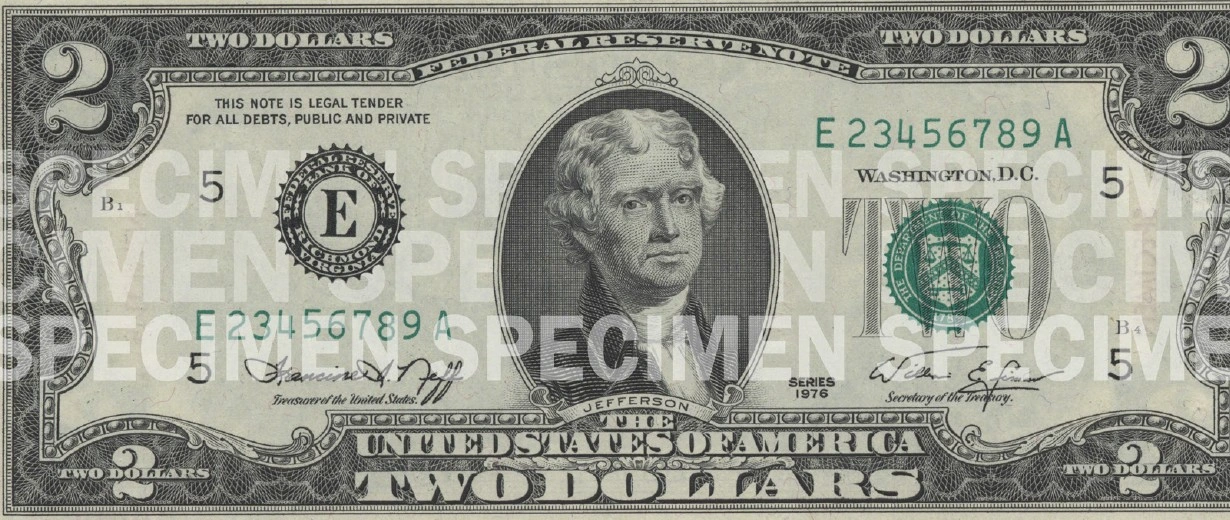
A Series 1976 $2 bill in circulated condition is usually worth $2, because so many were made. CoinWeek reports that the Bureau of Engraving and Printing produced 590,720,000 Series 1976 $2 notes between 1976 and 1978, all carrying the signatures of Treasury Secretary William E. Simon and Treasurer Francine Irving Neff, and that they were released on April 13, 1976, Thomas Jefferson's birthday.
The Federal Reserve Bank of Richmond's Economic Review of March/April 1976 gave as one reason for its return the need for a denomination between the $1 and the $5. It had been officially discontinued by the Treasury in August 1966, when $2 notes made up about one-third of one percent of all currency outstanding.
On value, CoinWeek's February 2026 guide gives the market as it stood then:
- Circulated Series 1976 notes typically trade at or near face value.
- Uncirculated notes often sell for $3 to $4.
- Star notes bring higher premiums, and high-grade examples and collectible serial numbers bring stronger prices.
- One result CoinWeek cites: a Series 1976 $2 catalogued as Fr. 1935-L, with serial number 1, realized $21,150 at a Heritage auction on January 8, 2016. CoinWeek does not give its grade.
A Friedberg number, such as Fr. 1935-L, is the catalog number a note carries in Paper Money of the United States, the catalog Robert Friedberg first published in 1953 and Arthur L. and Ira S. Friedberg have since edited; CoinWeek reported its 23rd edition in July 2024. Dealers use it to describe a note precisely, and our own paper money listings show it.
Why "1976" is not the year your note was printed
The year on a $2 bill is a series year, not a print date. The Education Program's guide to identifying banknotes explains that the series year marks the year a new design was approved, or the year a new Secretary's or Treasurer's signature was added to the design.
That is how, by CoinWeek's figures, Series 1976 $2 notes were still being printed in 1978. On a 1976 $2, the date alone says almost nothing about value.
What collectors look for on a 1976 $2 bill
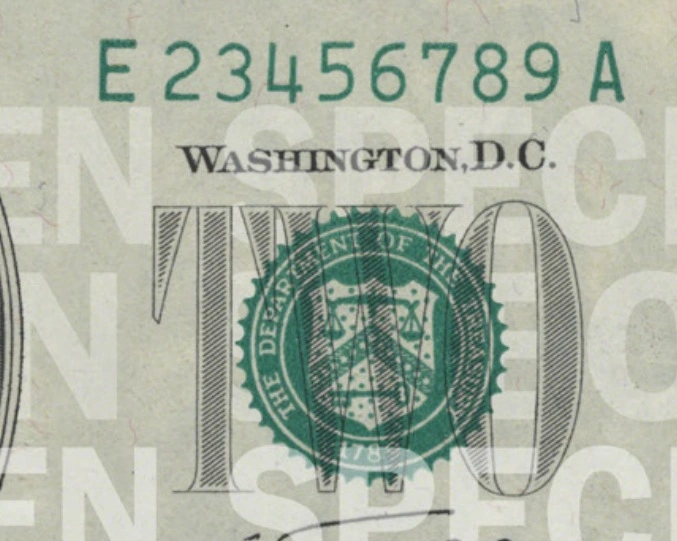
On a Series 1976 note, condition and the serial number matter far more than the date. These are the details a collector checks first.
- Condition. A note that has never been folded or circulated is worth more than a worn one. Grading services such as PMG and PCGS Banknote grade notes from 1 to 70, and PMG adds its Exceptional Paper Quality (EPQ) designation to notes graded Very Fine 20 or higher that its graders consider completely original, with no physical or chemical processing.
- A star in the serial number. A star where the last letter of the serial number would be marks a replacement note: the Education Program explains that a star suffix identifies notes that serve as replacements during the production process. CoinWeek names Fr. 1935-J* as the scarcest star note of the series, and Minneapolis star notes as among the more elusive. J is the letter of the Federal Reserve Bank of Kansas City.
- The district. The black seal to the left of the portrait bears the name and letter of the Federal Reserve Bank that distributed the note, according to the same Education Program features guide. On regular circulated notes the district rarely changes the value; on star notes it can.
- The serial number itself. Very low numbers, and patterns collectors call "fancy", such as a solid number with every digit the same or a radar that reads the same backward and forward, draw specialist interest.
- Printing errors. Misaligned printing, offsets and cutting errors are collected in their own right. Our paper money department lists error notes in other denominations.
For context on how many have been graded, CoinWeek, citing PMG, counted 18,830 grading events for Series 1976 $2 notes across all 12 districts as of July 10, 2024, of which 6,040 were star notes. A grading event is one submission, not one unique note, a point our guide to population reports explains.
Stamped first-day notes
Many 1976 $2 bills carry a postage stamp and a postmark. On release day, April 13, 1976, people took new $2 notes to post offices, stuck Bicentennial stamps on them and had the stamps canceled. CoinWeek reports that most of these trade near face value, though some collectors look for a postmark from their hometown or another meaningful place.
Red seal $2 bills: United States Notes
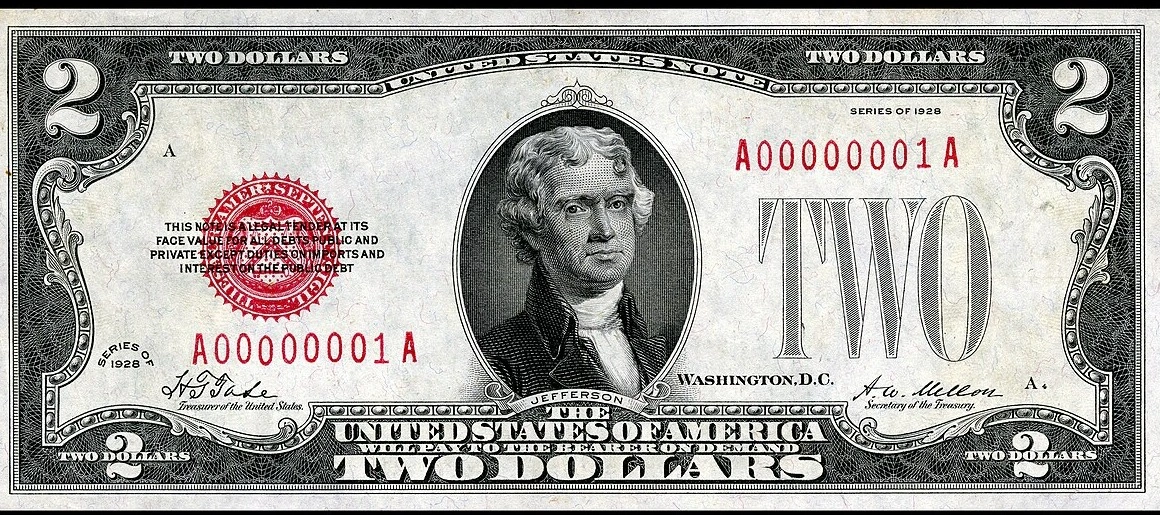
A red seal $2 bill is a United States Note, also called a Legal Tender Note. The Education Program describes United States Notes as a class of currency Congress authorized in 1862, marked by a red seal and red serial number. Small-size red seal $2s were issued from Series 1928 until the Treasury discontinued the denomination in August 1966.
Red seal $2s share the Jefferson portrait with the modern note, but the back shows Monticello rather than the Declaration of Independence. Three looks are easy to tell apart:
- Series 1928 notes, with suffix letters A through G, have the red seal to the left of the portrait.
- Series 1953 notes, with suffix letters A through C, move the red seal to the right.
- Series 1963 notes add the motto IN GOD WE TRUST to the back.
Within those groups, collectors note the series and its suffix letter, the signature combination, the grade and whether the note is a star. For a sense of what a top example looks like, our paper money department lists a Series 1963 $2 United States Note graded PMG 67 EPQ, Friedberg number Fr. 1513, with the Granahan-Dillon signature combination. Its serial number begins and ends with the letter A, which collectors call the AA block.
We do not print value ranges for red seal $2s here, because they depend on all of those factors at once. A specific note is best priced by looking at it.


Large-size $2 notes
A $2 note larger than a modern bill was issued before small-size currency arrived in 1929, and it is a different collecting field. Large-size $2s come in several classes and many signature combinations, and the best known include the Series 1918 Federal Reserve Bank Note often called the Battleship Note. Our guide to large-size U.S. currency covers the classes, the series and what drives their value.
Selling or buying $2 notes at Copper State
Copper State Coin & Bullion buys and sells paper money and offers complimentary appraisal for sellers. Bring in a single red seal, a stack of 1976 notes from a relative's dresser or a star note you found in change, and we will tell you which group each belongs to and what collectors look for in it. Leave the notes as they are: do not flatten, press, wash or tape them, for the reasons given in our large-size currency guide.
If you need a written valuation for insurance, that is a separate, paid service; our guide to insurance appraisals explains what that document contains. Collectors building a set can browse our paper money department, which also includes Confederate issues such as an 1862 $2 note; our guide to Confederate and obsolete currency covers that side of the hobby.
Frequently asked questions
How much is a 1976 $2 bill worth?
Usually $2. CoinWeek reported in February 2026 that circulated Series 1976 notes typically trade at or near face value and uncirculated ones often sell for $3 to $4. Star notes, very low or fancy serial numbers and high grades bring more; CoinWeek cites a Fr. 1935-L with serial number 1 that realized $21,150 at Heritage in January 2016.
Are $2 bills still printed and still legal tender?
They are still legal tender, but they are not printed every year. The U.S. Currency Education Program states that all U.S. currency issued since 1861 remains valid at full face value. The Federal Reserve's 2027 print order includes no $2 notes, yet 1.8 billion $2 notes were in circulation at the end of 2025.
What is a red seal $2 bill?
A red seal $2 bill is a United States Note, also called a Legal Tender Note, recognizable by its red Treasury seal and red serial numbers and by Monticello on the back. Small-size red seals were issued from Series 1928 until the Treasury discontinued the $2 denomination in August 1966. Value depends on the series, signatures, grade and whether it is a star note.
Is a 1976 $2 bill with a stamp on it worth more?
Usually only a little, if at all. On release day, April 13, 1976, many people had Bicentennial stamps canceled on new $2 notes at their post office. CoinWeek reports that most of these stamped notes trade near face value, although some collectors seek a postmark from a particular hometown or another meaningful place.
What makes a $2 star note worth more?
A star note replaced a note spoiled in production, so fewer exist than regular notes of the same series. CoinWeek names Fr. 1935-J* as the scarcest Series 1976 star note; the J marks the Federal Reserve Bank of Kansas City. Condition, the district and the serial number all affect what a particular star note brings.
Bring Your $2 Bills to Copper State
Copper State Coin & Bullion brings over 40 years of numismatic and bullion experience to paper money as well as coins. Whether you have one red seal or an envelope of 1976 notes, bring them to either store for a complimentary appraisal, or browse our paper money department if you are building a collection.
Copper State Coin & Bullion, Peoria
8360 W. Thunderbird Road C#103
Peoria, AZ 85381
(623) 432-3953
Mon-Fri 9:00am-5:00pm | Sat 9:00am-4:00pm | Sun closed
Copper State Coin & Bullion, Phoenix
4550 E Bell Road Suite 188
Phoenix, AZ 85032
(602) 377-1944
Mon-Fri 9:00am-5:00pm | Sat 9:00am-4:00pm | Sun closed