Both are United States currency, both are legal tender today, and both spend at face value. The difference is what the note promised its holder and who issued it. A silver certificate was a claim on silver held by the Treasury; a Federal Reserve note is an obligation of the Federal Reserve System and promises no metal at all. You can read the distinction off the face of the note in about three seconds, once you know which line to look at.
This guide covers how to tell them apart, why the silver certificate disappeared from circulation, and what is and is not still true about the one in your drawer. It is about identification and history rather than pricing — if what you want is what a particular note is worth, start with our guide to silver certificate values, which covers series, condition and the factors that move them.
Read the promise printed on the note
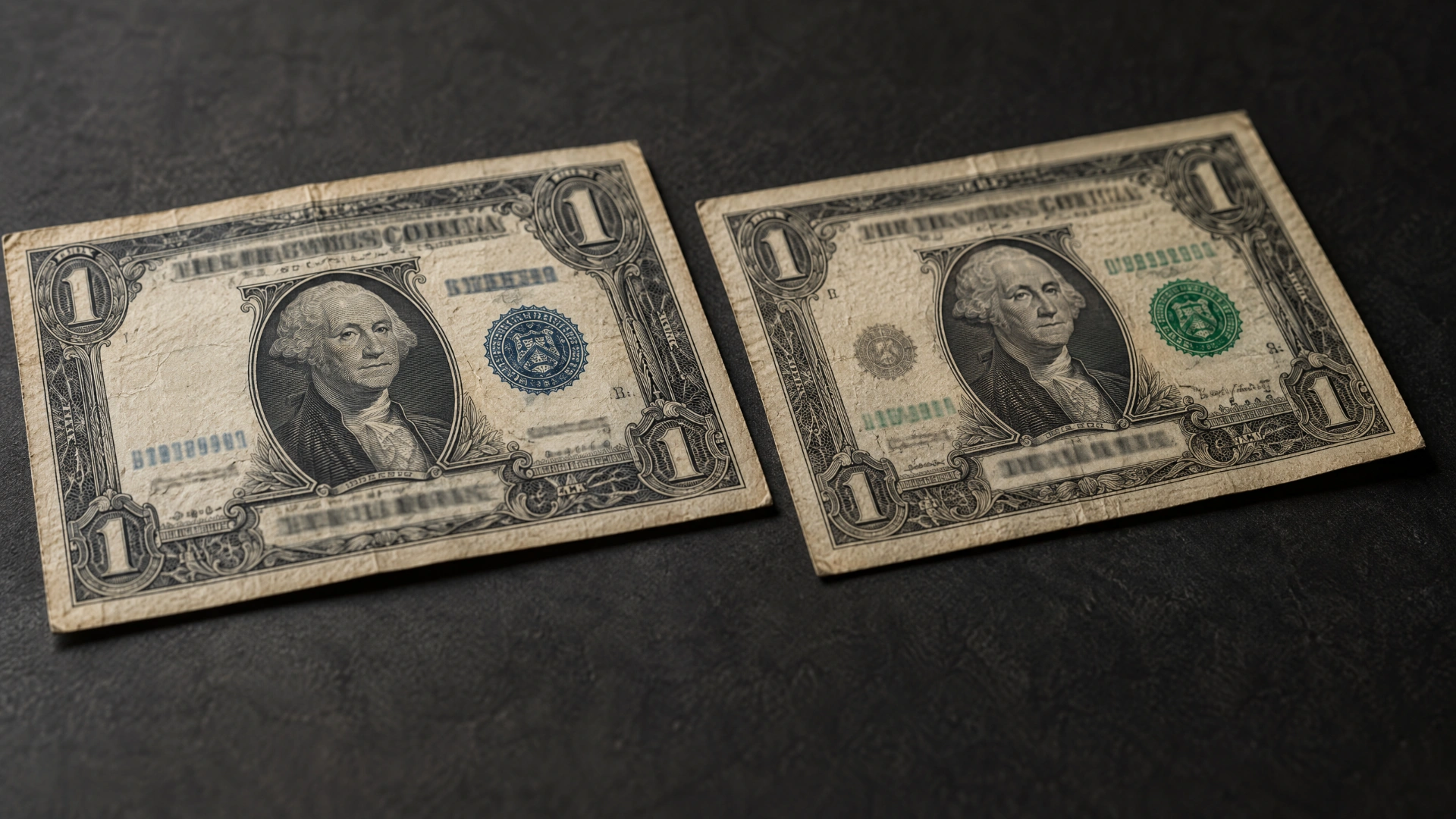
Every class of US paper money carries an obligation line, and the wording is the clearest identifier there is.
A small-size silver certificate of the 1957 series reads: "THIS CERTIFIES THAT THERE IS ON DEPOSIT IN THE TREASURY OF THE UNITED STATES OF AMERICA ONE DOLLAR IN SILVER PAYABLE TO THE BEARER ON DEMAND", followed by "THIS CERTIFICATE IS LEGAL TENDER FOR ALL DEBTS, PUBLIC AND PRIVATE". That first sentence is a receipt. The Treasury was holding silver, and the piece of paper was your claim on it.
A Federal Reserve note carries no such certification. It says "THIS NOTE IS LEGAL TENDER FOR ALL DEBTS, PUBLIC AND PRIVATE" and nothing about a deposit, because there is none to describe. Its value rests on its legal tender status under 31 U.S.C. § 5103, which makes United States coins and currency — expressly including Federal Reserve notes — legal tender for all debts, public charges, taxes and dues.
The heading above the portrait is the other giveaway: SILVER CERTIFICATE on one, FEDERAL RESERVE NOTE on the other.
Colour: the fastest identification there is
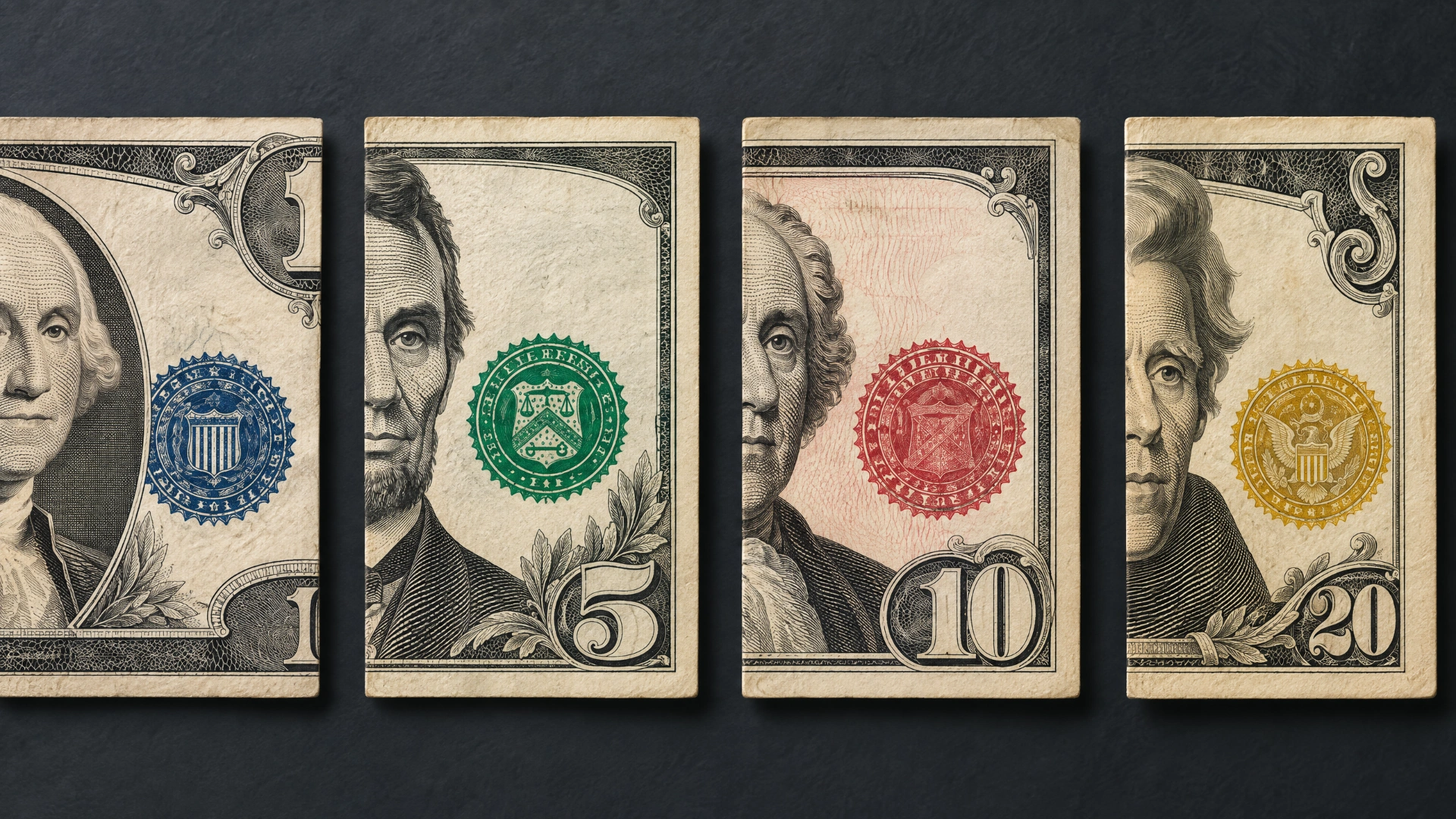
Before 1963 the Treasury seal and the serial numbers on US paper money were colour-coded by class, and that convention still tells you at a glance what you are holding.
| Seal and serial colour | Class of note | What it promised |
|---|---|---|
| Blue | Silver certificate | Silver on deposit in the Treasury, payable to the bearer |
| Green | Federal Reserve note | Nothing in metal; legal tender by statute |
| Red | United States note (legal tender note) | Nothing in metal; issued directly by the Treasury |
| Gold | Gold certificate | Gold coin on deposit; withdrawn in the 1930s |
| Brown or yellow (1942–45) | Wartime emergency issues — the HAWAII overprints and the yellow-seal North Africa notes | Same as the class they were overprinted on; the marking identified them |
United States notes are worth knowing about because people regularly bring in a red-seal note assuming it is a silver certificate. The Bureau of Engraving and Printing records that United States notes, "characterized by a red seal and serial number", were "originally issued in 1862" as the first national currency, and that none have been placed into circulation since 21 January 1971.
Why the silver certificate went away

US currency <a href="https://www.uscurrency.gov/history/archived" rel="noopener noreferrer" target="_blank">shrank by about 30 percent in 1929</a>, to the 6.14 by 2.61 inch format still used.The change happened in a single piece of legislation and took about five years to work through.
Public Law 88-36, enacted 4 June 1963, did two things at once. It repealed the Silver Purchase Act of 1934 and its associated provisions, ending the framework under which the Treasury accumulated silver against certificates. And it amended the ninth paragraph of section 16 of the Federal Reserve Act by inserting "$1, $2," into the list of authorised denominations — which is the technical reason the one-dollar bill in your pocket is a Federal Reserve note. Before 1963 the Federal Reserve Act did not authorise a $1 Federal Reserve note, and the $1 silver certificate held that job. A separate and now-obsolete class, the Federal Reserve Bank Note, had carried a $1 denomination in the Series of 1918.
The first $1 Federal Reserve notes followed as the 1963 series. Silver certificates stopped being printed, and the two circulated side by side for years afterwards.
Redemption ended separately. From March 1964 the Treasury redeemed certificates in silver bullion rather than silver dollars, and then set a closing date. A Treasury release carried by the US Mint's historical documents describes "the remaining period of exchangeability, which ends June 24, 1968", and states that "After that date, silver certificates will continue to be usable as legal currency, but may not be redeemed for silver."
That sentence is the whole of the modern position, written in 1968 and still accurate.
What is still true about a silver certificate today
- A silver certificate is still legal tender. It can be spent at face value like any other US note.
- It cannot be redeemed for silver. That right ended on 24 June 1968 and was not reinstated.
- What it promised changed over time. Small-size certificates read "one dollar in silver" — a monetary value rather than a stated weight. Until March 1964 the Treasury redeemed them in silver dollars; from that month it redeemed in silver bullion instead, and the exchange closed on 24 June 1968.
- Nothing about it is unusual to own. Silver certificates were ordinary money and were printed in enormous quantities, which is why so many turn up in estates and drawers.
The other details that tell you what you have
Once the class is settled, four things on the note narrow it down further.
The series year is not the year of printing. The Bureau of Engraving and Printing changes the series year when the Treasury signatures change; a letter after the year (1935A, 1935B and so on) marks a further change within the same series. A 1935-series note may have been printed well after 1935.
The motto dates the note. Following a 1955 law requiring "In God We Trust" on all currency, the motto first appeared on banknotes on the 1957-series $1 silver certificates, and then on 1963-series Federal Reserve notes. A $1 silver certificate without the motto is therefore a 1935-series note or earlier.
A star replaces a suffix letter. The BEP explains that when an imperfect sheet is found after the serial number has been printed, a "star" sheet is used to replace it, carrying "its own special serial number followed by a star in place of a suffix letter". Star notes were printed in smaller numbers than regular runs.
Size dates it too. US currency shrank by about 30 percent in 1929, to the 6.14 by 2.61 inch format still used. Anything noticeably larger than a modern bill is a pre-1929 large-size note and belongs in a different conversation entirely.
Where value comes from — briefly
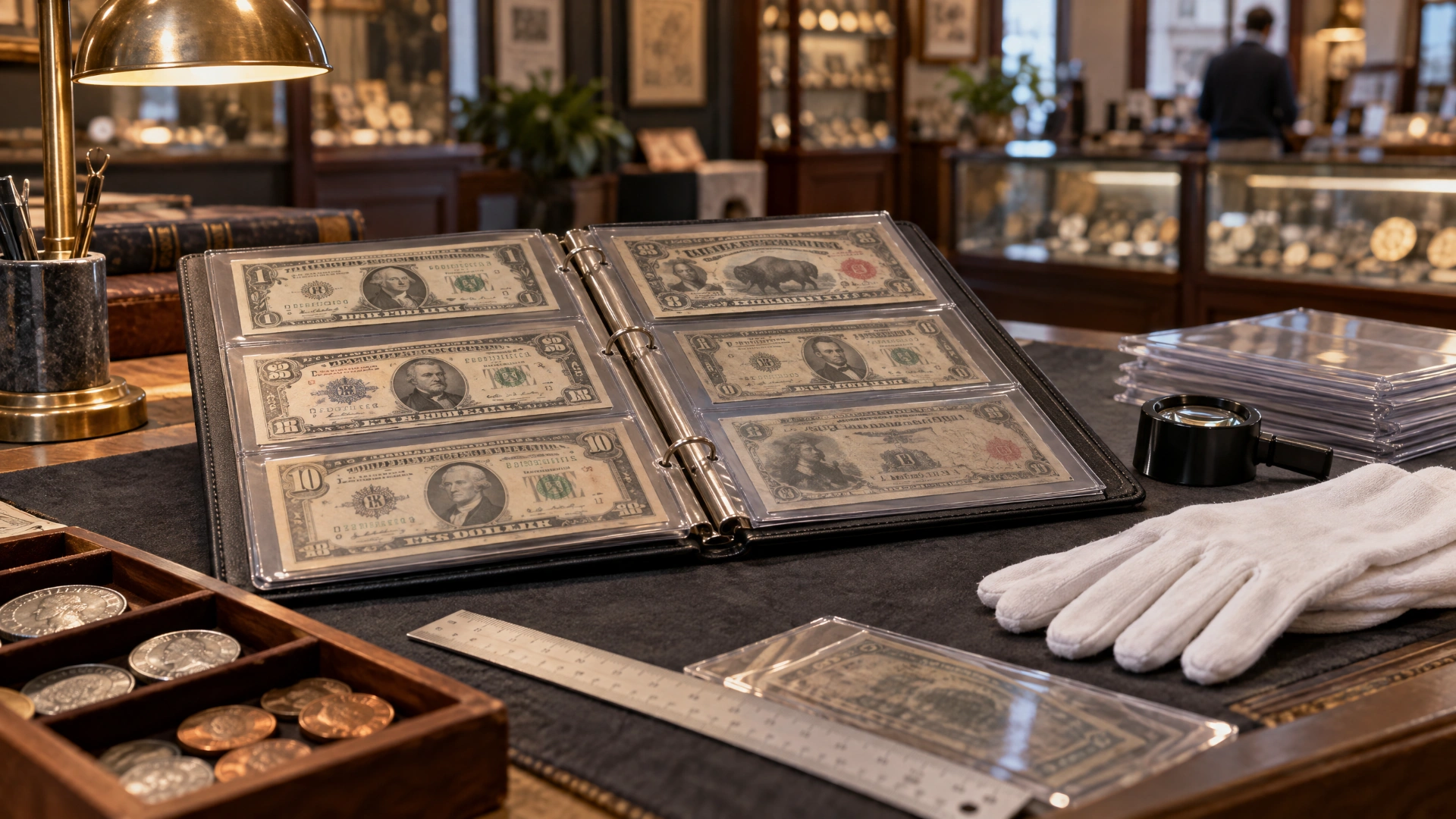
The class of note is only the starting point. What separates a common note from a scarce one is series and signature combination, the presence of a star, block letters, any wartime overprint, and above all condition — a crisp uncirculated note and a soft, folded one of the identical series are not the same item. Grading of paper money is an opinion rendered by a service such as PMG, not an objective measurement, and the same note can be described differently by two people looking at it across a table.
We have set the pricing side out separately rather than repeat it here: see what silver certificates are worth for the series-by-series detail, and our beginner's guide to collecting old paper money for how to start putting a set together. If your notes are state-issued or Confederate rather than federal, that is a separate field again — see Confederate and obsolete banknotes.
This article is educational and reflects general information about precious metals and collectible coins. It is not investment, tax or legal advice, and Copper State Coin & Bullion is not a registered investment adviser, broker-dealer or tax professional. Metal prices fluctuate and past performance does not indicate future results. Consult a qualified professional about your own situation.
What we do with currency
Copper State Coin & Bullion has over 40 years of numismatic and bullion experience, and paper money is a full part of what we handle rather than a sideline: federal issues, obsolete notes and Confederate currency all pass across our counter in Peoria and Phoenix. You can see what we currently hold on our paper money pages.
If you have inherited a folder of notes and do not know what is in it, bring it in. We offer a complimentary appraisal for sellers, and separately, a chargeable insurance appraisal service if you need documentation for a policy rather than an offer. We are members of PMG, PCGS, NGC, the Certified Coin Exchange and ICTA.
Frequently asked questions
Can I still exchange a silver certificate for silver?
No. The exchange period closed on 24 June 1968. The Treasury's own announcement at the time stated that after that date silver certificates would "continue to be usable as legal currency, but may not be redeemed for silver." No later redemption programme has been established; the certificate is now currency and, for many series, a collectible.
How do I tell a silver certificate from a regular dollar bill?
Look at the seal and serial numbers. Blue means silver certificate, green means Federal Reserve note. The heading above the portrait also names the class outright, and a silver certificate carries the line certifying that silver is on deposit in the Treasury. A Federal Reserve note has no such line.
Why do some $1 bills say "Silver Certificate" and others "Federal Reserve Note"?
Until 1963 the Federal Reserve Act did not authorise a $1 Federal Reserve note, so the $1 bill was a silver certificate. Public Law 88-36 added "$1, $2" to the authorised denominations in the Federal Reserve Act, and $1 Federal Reserve notes began with the 1963 series. Both circulated together for years afterwards.
Is a red-seal note a silver certificate?
No. A red seal marks a United States note, sometimes called a legal tender note, issued directly by the Treasury from 1862. The Bureau of Engraving and Printing records that none have been placed into circulation since 21 January 1971. They are a separate class with a separate history, and they never carried a silver promise.
Should I get my notes graded?
Grading is worth the fee only where a note is scarce enough or high grade enough for third-party certification to matter to a buyer. For a common circulated series it usually is not. If you are thinking of selling, bring them in and the complimentary appraisal will tell you which category yours fall into.
Bring your notes in
Currency is the part of this trade where a five-minute look across a counter saves the most guesswork, because so much depends on details that photograph badly. Both stores are open Monday through Saturday and you are welcome to walk in.
Peoria
Copper State Coin & Bullion
8360 W. Thunderbird Road C#103
Peoria, AZ 85381
(623) 432-3953
Phoenix
Copper State Coin & Bullion
4550 E Bell Road Suite 188
Phoenix, AZ 85032
(602) 377-1944
Monday–Friday 9:00 a.m. – 5:00 p.m. · Saturday 9:00 a.m. – 4:00 p.m. · Sunday closed
Sell to us · copperstatecoin.com