A silver certificate is a US banknote that was once redeemable at the Treasury for silver. They are still legal tender at face value, and the great majority of the ones people find in a drawer — blue-seal $1 notes from Series 1935 and Series 1957 — are common notes that carry a collector premium rather than a life-changing one. A small minority sell for substantial premiums over face, and the difference between the two is almost never visible to someone who has not been told what to look at.
This is a guide to what the notes actually are, what makes one worth more than another, and how to find out which kind you have without doing anything that reduces its value.
What a silver certificate is
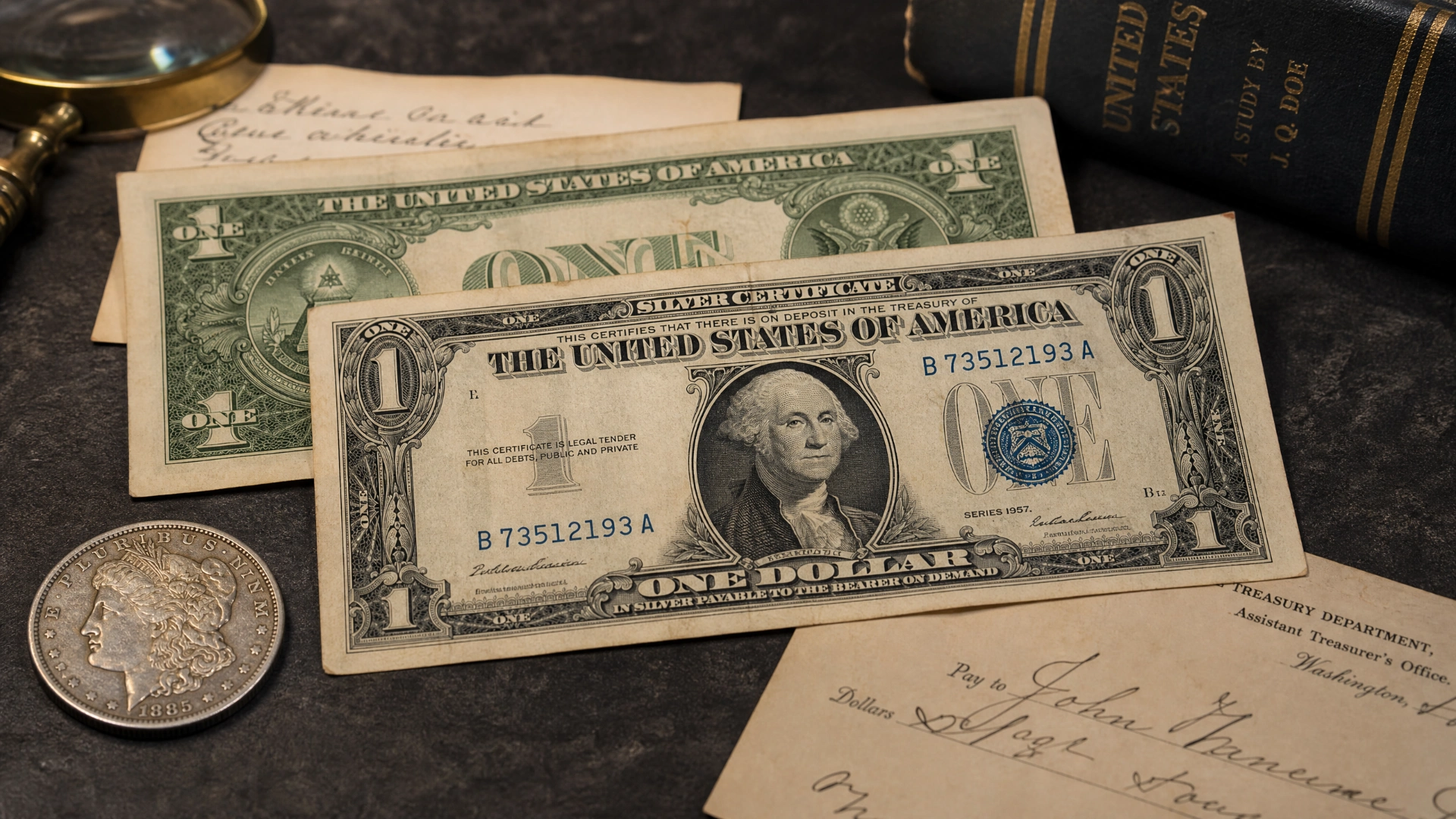
Silver certificates were paper currency issued by the US Treasury against silver held on deposit. Congress created them in the Act of February 28, 1878 — the Bland–Allison Act — whose third section allowed any holder of the newly authorised standard silver dollars to deposit them "with the Treasurer or any depositary of the United States designated for that purpose, in sums not less than $10, and receive therefor certificates." The certificates were "receivable for customs, taxes, and all public dues," as codified at 31 U.S.C. § 405 (1925 edition) from Feb. 28, 1878, c. 20, § 3, 20 Stat. 26.
The same Act, as the US Mint records, "re-authorized the standard silver dollar to the weight and fineness as stated in the Act of January 18, 1837 (26.73 grams; .900 silver, .100 copper)." The certificate and the coin were two sides of one arrangement: the government held the metal, the public carried the paper.
The practical marker on the note itself is the seal and serial number colour. Silver certificates carry a blue Treasury seal, which is the quickest way to separate them from the green-seal Federal Reserve notes in the same wallet. Two wartime exceptions carry other colours, and they matter — more on those below.
Why silver certificates stopped
Two pieces of legislation ended the arrangement, and both explain dates printed on the notes. Public Law 88-36, enacted June 4, 1963, repealed the Silver Purchase Act of 1934 and amended the Federal Reserve Act to insert "$1, $2," into the list of denominations Federal Reserve banks could issue. That is the moment the $1 Federal Reserve note became possible — and the $1 silver certificate unnecessary. Series 1957 is the last date that appears on one.
Redemption in metal ended four years later. Public Law 90-29, enacted June 24, 1967, provided that "silver certificates shall be exchangeable for silver bullion for one year following the enactment of this Act," after which they became redeemable only "from any moneys in the general fund of the Treasury." A Treasury press release preserved by the US Mint set out the procedure and confirmed the exchange period "ends June 24, 1968," with holders presenting notes at the Federal Reserve Banks of New York or San Francisco or at the US Assay Offices in those cities.
After 24 June 1968, a silver certificate has been what it is today: a legal tender note, redeemable for a dollar, and a collectible.
So can you still exchange one for silver?
No. The right to exchange silver certificates for silver bullion expired on 24 June 1968 and has not been restored. A silver certificate presented at a bank today is worth one dollar, or five, or ten, according to its face.
This is the most common misunderstanding about these notes, and it is worth being blunt about. The value above face today is a collector value, set by scarcity and condition, and it has no fixed relationship to the silver price.
What actually determines a silver certificate's value
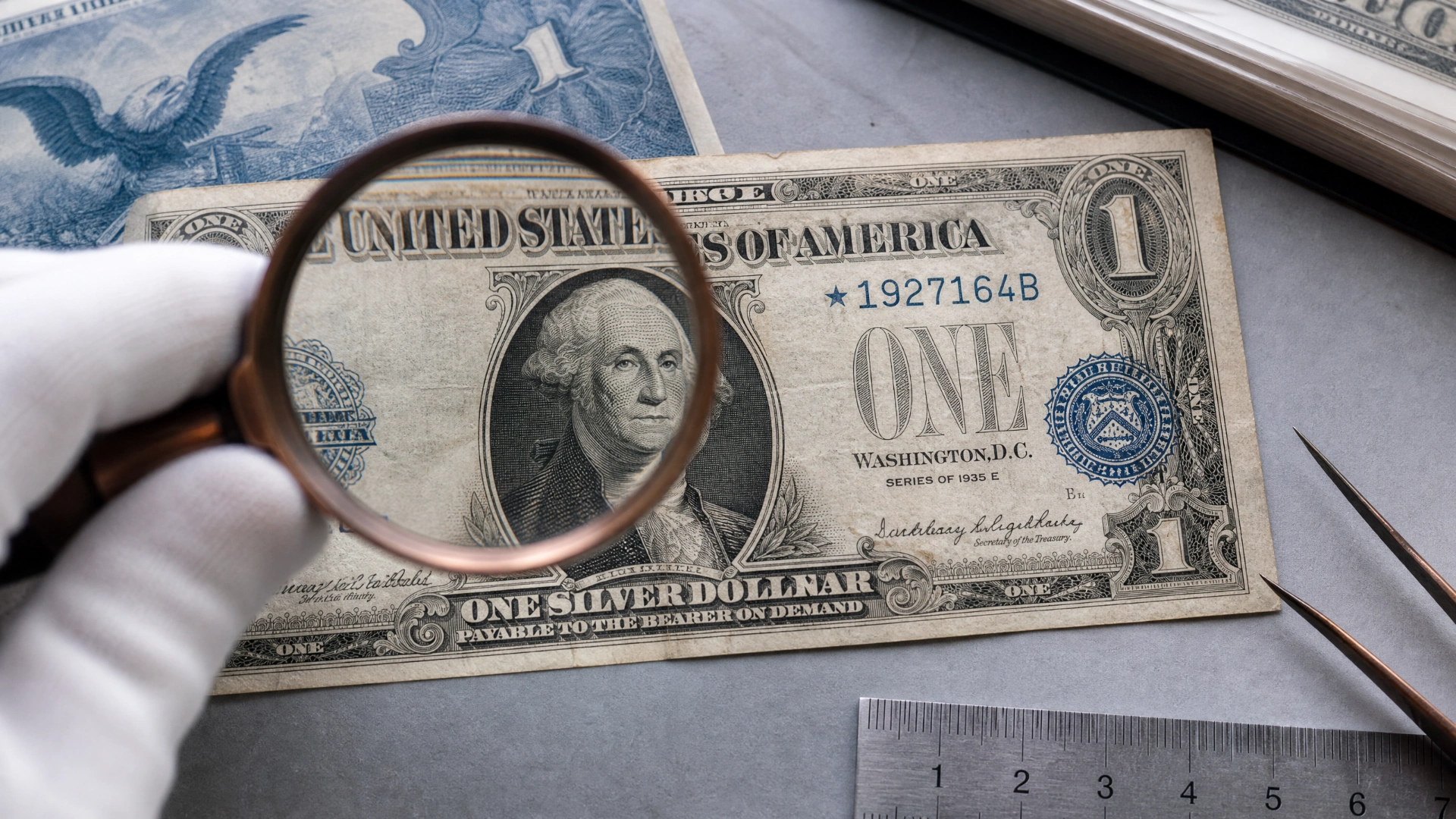
Six variables do most of the work. A note that is ordinary on all six is a common note; a note that is unusual on one or two sits in a different market entirely, and price guides organised by Friedberg number and grade are where that difference is read.
| Variable | What to look for | Why it matters |
|---|---|---|
| Series and series letter | The date on the face, plus any suffix letter (1935, 1935A, 1957B) | Series letters mark signature and design changes; print runs vary enormously between them |
| Friedberg number | The catalogue reference a dealer or grading service assigns (e.g. Fr. 1610) | It identifies the exact variety, which is what price guides are organised by |
| Star note | A star in place of a letter at the end of the serial number | Star notes were replacement printings, produced in much smaller numbers |
| Block and serial | The letters bracketing the serial; very low, very high or repeating numbers | Some blocks are scarce; fancy serials attract a separate collector market |
| Condition | Folds, corner wear, soiling, pinholes, tears, original paper surface | The largest single multiplier on any common note |
| Errors and special issues | Misalignments, ink errors, and the wartime emergency issues below | These move a note out of the common category entirely |
You will notice there is no dollar figure in that table, and that is deliberate. A price quoted without a series, a variety, a grade and the date it was quoted is not information — it is a number that will be wrong for most of the notes it gets applied to, and the notes it is wrong about are usually the interesting ones. Read current values instead from a dated price guide against your note's exact Friedberg number and grade, or from recent auction results for the same combination. PMG's population report, updated weekly, is also worth a look — it shows how many examples of a given variety and grade the service has certified, though PMG is careful to note that a population figure is not by itself an indicator of value or rarity.
Four issues that are not ordinary notes
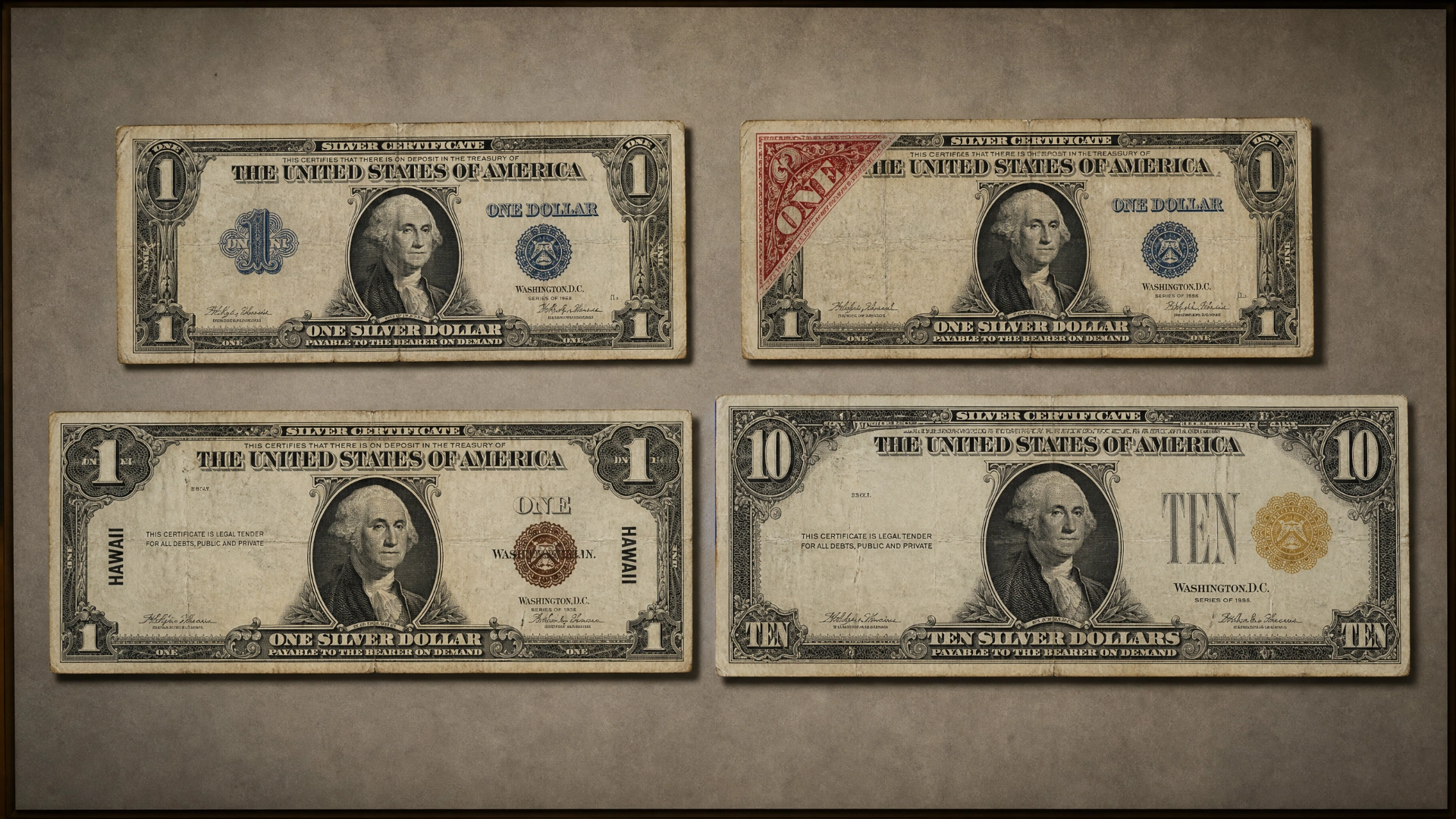
Four categories come up often enough at the counter to be worth naming.
The 1935A "R" and "S" experimentals. In 1944 the Bureau of Engraving and Printing ran a controlled test of a substitute paper, printing two matched groups and marking them with a large red R or S in the lower right corner so their wear could be compared in circulation. PMG records that "2,368,000 from the 1935A series were produced" — 1,184,000 of each — that the two groups were released on 20 June 1944, and that they "make up less than 1% of all 1935A notes and survivors are considered scarce." An R or S in the corner of an otherwise ordinary 1935A note changes the conversation completely.
The Hawaii emergency notes. Overprinted HAWAII front and back and carrying a brown seal, issued during the Second World War so that the currency could be repudiated if the islands were captured.
The North Africa notes. Same wartime logic, different marker: a distinctive yellow Treasury seal, issued for use with Allied forces in North Africa and Europe.
Large-size certificates. Anything physically bigger than a modern note is pre-1929 and belongs to a different world — the 1899 "Black Eagle" $1 and the 1896 Educational Series among them.
None of that makes any individual note valuable on its own, and condition still governs. A heavily circulated example of an unusual issue can be worth less than a pristine example of a common one. What these four categories do is take a note out of the "ordinary drawer find" bucket and into one where it is worth checking the variety properly.
Does a silver certificate need grading?
Grading is worth its cost on notes where the grade meaningfully changes the value, and on notes whose authenticity a buyer would otherwise question. It is usually not worth it on a common circulated $1 certificate, where the fee can exceed the note's premium over face.
Two things about grades are worth keeping in mind on paper specifically. A grade is an opinion on condition: a note is graded 64 by PMG, it is not "a 64" in the abstract, and a resubmission or a different service can reach a different number. And on banknotes the qualifier matters as much as the number — PMG's EPQ designation, for example, speaks to the paper being original and unprocessed, which is precisely what the handling mistakes below destroy. We cover how third-party grading works in more detail in our piece on whether certification is worth it.
What not to do to a silver certificate before you sell
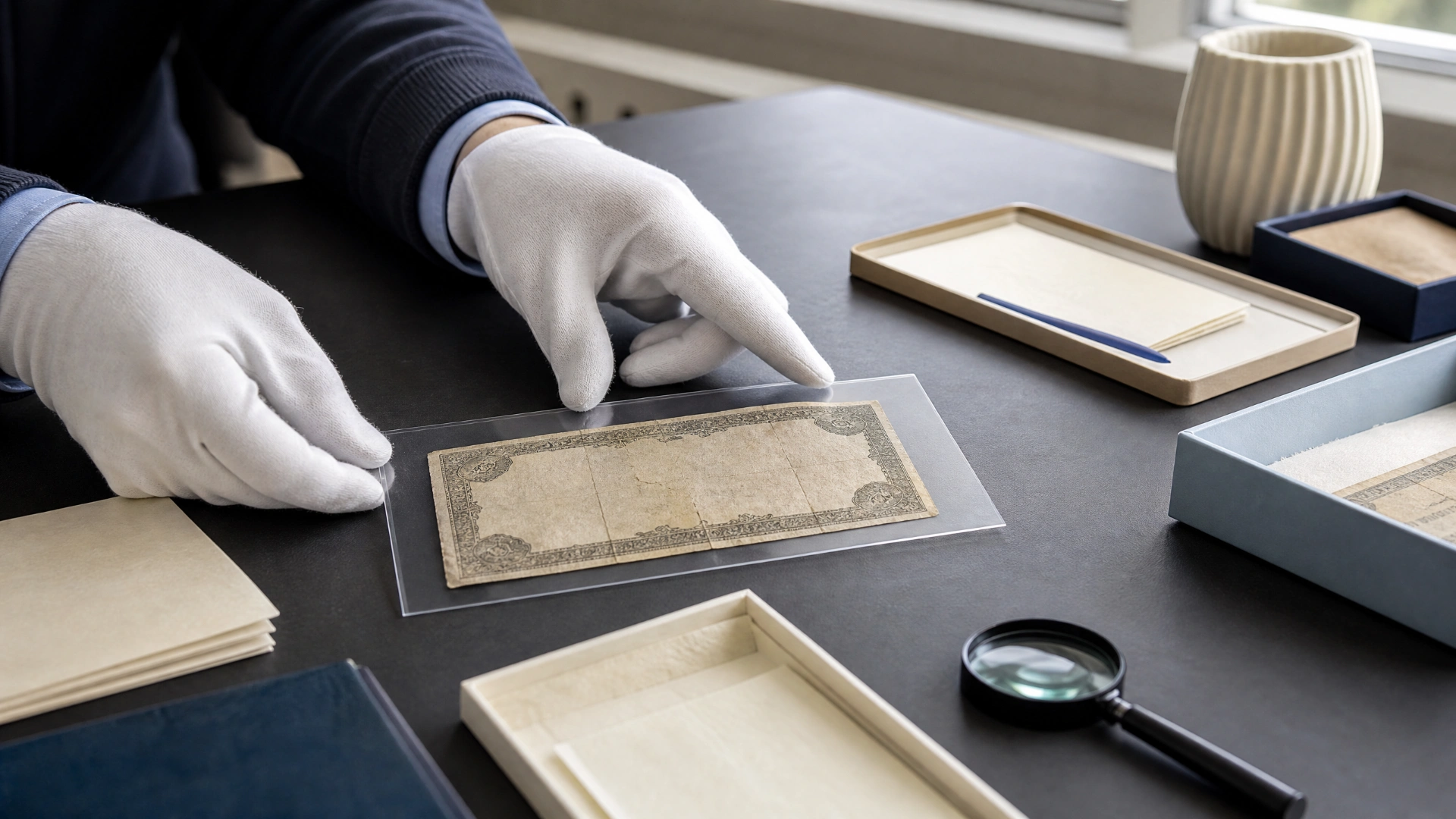
Most of the value destroyed in old currency is destroyed by well-meant tidying, and all of it is permanent.
- Do not clean, wash, bleach or erase anything. Original paper surface is what an EPQ-style qualifier speaks to, and its loss is visible to anyone who handles notes
- Do not press, iron or flatten a note under weight. It disturbs the paper and it does not remove the folds it is meant to hide
- Do not tape, glue or trim a tear or an edge
- Do not store notes in PVC sleeves or against adhesives; use inert currency sleeves, kept flat, dry and out of direct light
If a note is already folded, leave it folded. A grader would far rather see honest wear than an attempted repair. Our beginner's guide to collecting old paper money goes further into storage and handling.
How to find out what you have
Start with what you can read yourself: the seal colour, the series date and letter, whether there is a star at the end of the serial, and whether there is a letter in the lower right corner. Photograph the front and back flat, in daylight, without flash. That is enough for most first conversations.
From there, either work the note up against a dated price guide and recent sales for the same Friedberg number and grade, or bring it in. Copper State Coin & Bullion brings over 40 years of numismatic and bullion experience to US currency and buys and sells paper money alongside coins. Our piece on Confederate and obsolete banknotes deals with the other family of notes that turns up in the same shoeboxes.
This article is educational and reflects general information about precious metals and collectible coins. It is not investment, tax or legal advice, and Copper State Coin & Bullion is not a registered investment adviser, broker-dealer or tax professional. Metal prices fluctuate and past performance does not indicate future results. Consult a qualified professional about your own situation.
Frequently asked questions
Is a silver certificate still legal tender?
Yes. A silver certificate remains legal tender for its face value and can be spent or deposited like any other note. What ended in 1968 was the right to exchange it for silver, not its status as money. Few are spent, because most are worth more to a collector than to a cash register.
How much is a 1957 $1 silver certificate worth?
Most circulated Series 1957 $1 notes carry only a modest premium over face value — they were printed in very large numbers, and series letter, star status and above all condition are what separate one from another. A heavily circulated example and a crisp uncirculated one from the same run are not in the same market. Check a dated price guide for the exact variety and grade, or bring the note in and we will look at it.
What does the blue seal mean?
The blue Treasury seal and blue serial numbers identify the note as a silver certificate rather than a green-seal Federal Reserve note — the full colour code, and what the obligation line on each class says, is in Federal Reserve notes versus silver certificates. Two wartime issues break the pattern: the Hawaii overprints use a brown seal and the North Africa notes a yellow one.
Should I get my silver certificate graded?
Only where the grade will change the value by more than the cost of grading, or where a buyer would otherwise question the note. On a common circulated $1 certificate the fee often exceeds the premium over face. On a star note, an R or S experimental, a Hawaii or North Africa issue, or anything that looks uncirculated, it is worth asking about first.
Where can I sell silver certificate notes in the Phoenix area?
Copper State Coin & Bullion buys US currency at both stores, in Peoria and in north Phoenix. Bring the notes as they are, in whatever they are stored in, and allow a few minutes per note — identifying variety and condition properly is not something to rush.
Bring your notes in
Whether you have one certificate from a relative's papers or a box of them, we will go through them with you, explain what each one is, and make you an offer if you decide to sell. You can also see how we catalogue notes on our paper money pages, or start with the sell to us page if you would rather know how the process works first.
Peoria
Copper State Coin & Bullion
8360 W. Thunderbird Road C#103
Peoria, AZ 85381
(623) 432-3953
Phoenix
Copper State Coin & Bullion
4550 E Bell Road Suite 188
Phoenix, AZ 85032
(602) 377-1944
Both stores: Monday–Friday 9:00–17:00 · Saturday 9:00–16:00 · Sunday closed
copperstatecoin.com