The Columbian half dollars of 1892 and 1893 were the first coins in the classic commemorative series, and the Pilgrim halves of 1920 and 1921 came a generation later. Between them sit the 1915 Panama-Pacific, 1918 Illinois Centennial and 1920 Maine Centennial halves, which this guide does not cover; it adds the 1925 Stone Mountain half as a widely collected later issue. For each coin it covers what it marks, how many reached the public and how to judge the one in front of you.
What is a commemorative half dollar?
A commemorative half dollar is a special-issue 50-cent coin that Congress authorized to honor an anniversary, exposition or monument, sold above face value to raise money for the cause it celebrated. The US Mint's list of commemorative coins from 1892 to 1954 sets out the full classic series.
These issues were struck in 90% silver and 10% copper at 12.5 grams, which works out to about 0.36 troy ounces of pure silver per coin. The Newman Numismatic Portal entry for the 1892 gives that specification. Collectors pay for the design, the date and the condition, so a coin's value is not the same as its silver content.
The silver content sets a melt value, which matters most for worn or damaged pieces. This guide to coin melt value explains the difference between the two.
A melt figure is only as current as the silver price used to calculate it. That price moves through the day and is tracked on the spot silver price page.
What is the 1892 Columbian half dollar?
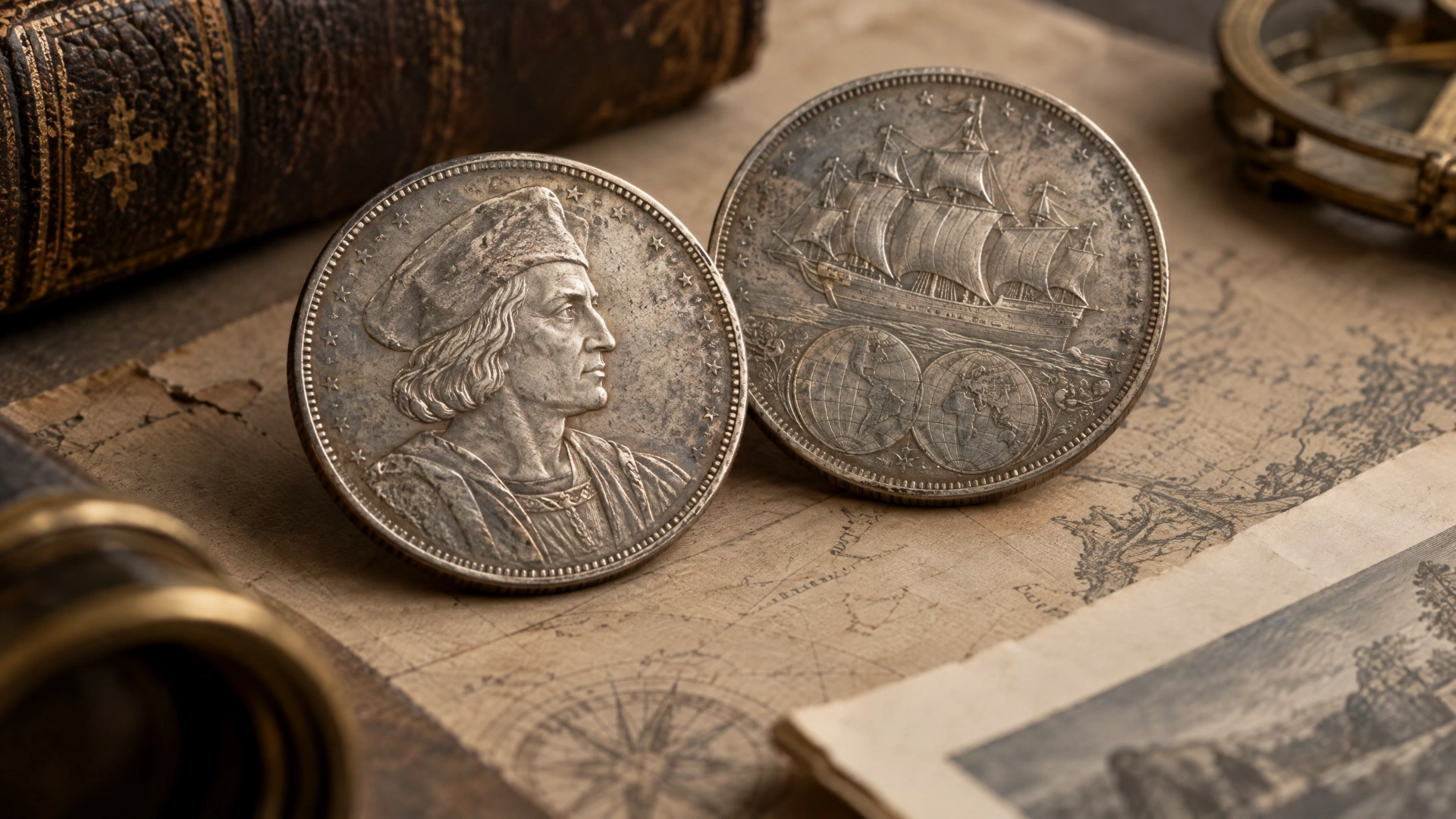
The 1892 Columbian half dollar is the first commemorative coin struck by the United States Mint, issued for the World's Columbian Exposition in Chicago. The Newman Numismatic Portal credits the design to Charles E. Barber and George T. Morgan. The obverse shows a portrait of Columbus, and the reverse shows his ship, the Santa Maria, above two hemispheres.
The 1892 had 950,000 struck, and all were distributed; distribution is the number of coins released to the public after any unsold coins were melted. No melting is recorded for this date.
How does the 1893 Columbian differ from the 1892?
The 1893 Columbian half dollar uses the same designs as the 1892 with the coinage date changed, and it was struck in a much larger quantity: 4,052,105 coins, of which 1,550,405 were distributed. The rest, 2,501,700 coins, were melted, which is more than half of the year's production.
The 1892 and 1893 halves are the two coins most people mean by "the Columbian half dollar." On paper the 1893 is the more common date, because its distribution is larger even after the melt.
Why were so many Columbian half dollars melted or spent?
Sales of the Columbian coins fell short of the quantity struck, and the leftovers were spent or melted. Q. David Bowers, in his commemorative encyclopedia hosted by PCGS, reports that after the Treasury offered the leftover coins at face value in 1894, takers were few, so many went into circulation and others were melted. Bowers notes that most surviving Columbian halves show wear, either from casual handling as souvenirs or from circulation, and that in general 1892-dated coins are better struck than those dated 1893.
What is the Pilgrim half dollar?
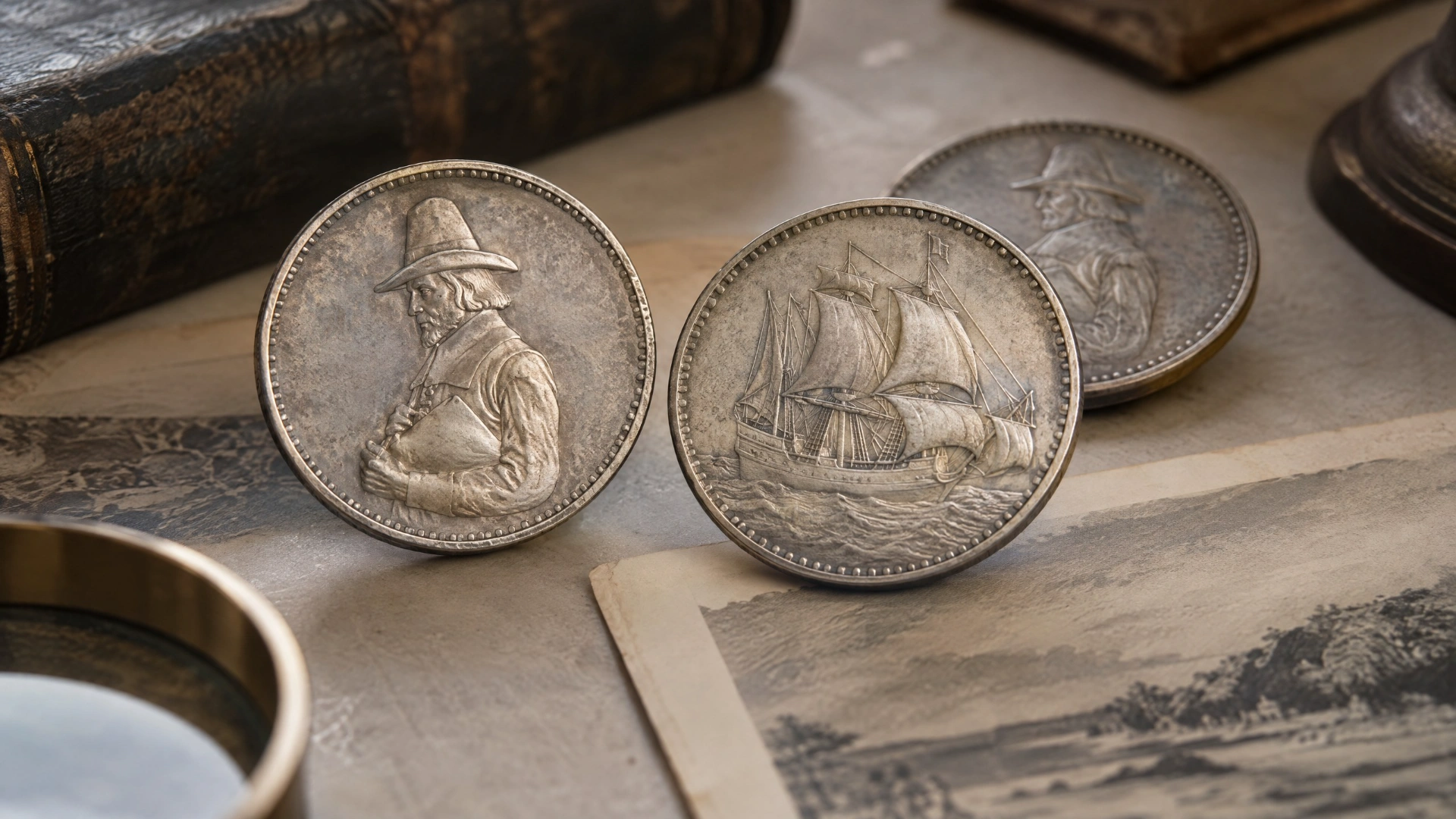
The Pilgrim half dollar is a commemorative issue for the 300th anniversary of the Pilgrims' landing at Plymouth in 1620, designed by Cyrus E. Dallin. It was struck in two years, 1920 and 1921, and the 1921 issue adds that date to the left side of the obverse, which is how the two are told apart.
The second date was added to encourage repeat sales. David Hall, writing on the PCGS CoinFacts page for the 1921 and citing Q. David Bowers, calls it the first commemorative "variety" made to increase sales to collectors, and notes that sales of the 1921 were much smaller than the 1920.
The Pilgrim mintages were far smaller than the Columbian ones. In 1920, 200,112 were struck and 48,000 melted, leaving 152,112. In 1921, 100,053 were struck and 80,000 melted, leaving 20,053, so by distribution the 1921 is the scarcer of the two. These figures come from the Pilgrim chapter of Bowers's encyclopedia. David Hall notes on the same PCGS CoinFacts page cited above that the gap among surviving coins is smaller than the distribution figures suggest, and that in Gem condition the 1921 is only a little rarer than the 1920.
What is the Stone Mountain half dollar?
The Stone Mountain half dollar was struck in 1925 to raise funds for the memorial carving on Stone Mountain in Georgia. It was issued through the Stone Mountain Confederate Monumental Association and designed by the sculptor Gutzon Borglum. The obverse shows two mounted figures, Robert E. Lee and Thomas "Stonewall" Jackson, and the reverse shows an eagle on a cliff.
In all, 2,314,709 were struck, including 4,709 assay coins, which are pieces set aside so the Mint could test their weight and fineness. Of the total, 1,000,000 were melted and 1,314,709 were distributed, according to the Stone Mountain chapter of Bowers's encyclopedia. That is the second-largest distribution of the five issues here, after the 1893 Columbian.
Mintage and distribution at a glance
The table compares struck, melted and distributed figures for the five issues. Each issue links to its PCGS CoinFacts page, which gives the distributed figure; struck and melted figures are from Bowers's encyclopedia, cited in the sections above, and for the 1893 Columbian the melted figure is struck minus distributed.
| Issue | Struck | Melted | Distributed |
|---|---|---|---|
| 1892 Columbian | 950,000 | None recorded | 950,000 |
| 1893 Columbian | 4,052,105 | 2,501,700 | 1,550,405 |
| 1920 Pilgrim | 200,112 | 48,000 | 152,112 |
| 1921 Pilgrim | 100,053 | 80,000 | 20,053 |
| 1925 Stone Mountain | 2,314,709 | 1,000,000 | 1,314,709 |
Low distribution does not by itself make a coin more valuable. Condition, eye appeal and demand decide that, and a worn or cleaned coin of a low-mintage issue can still be an ordinary piece.
How do you judge the condition of a commemorative half dollar?
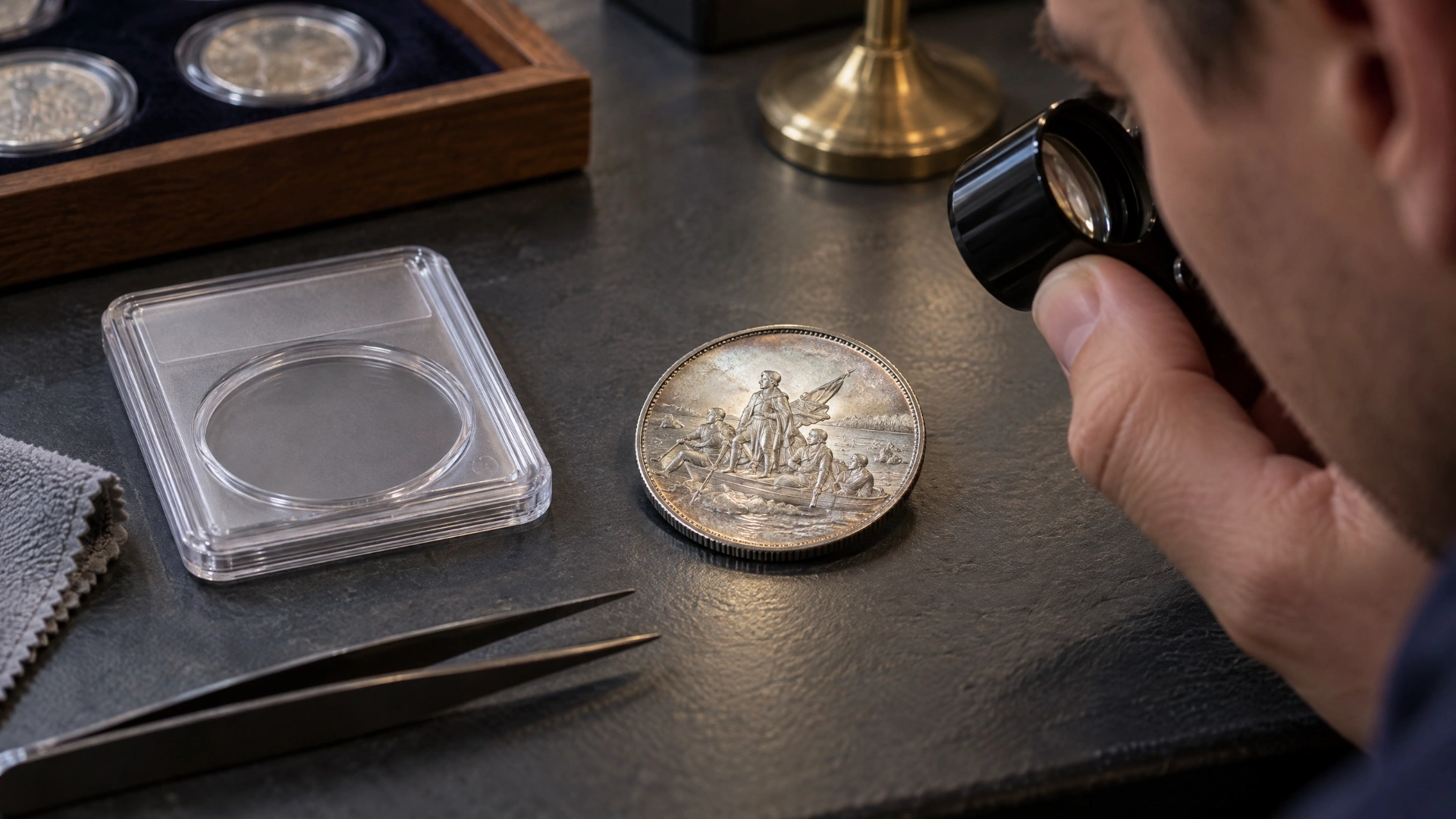
Start with the date, then look at the high points of the design, the luster and any signs of cleaning. Cleaning, harsh toning, scratches and rim bumps are common on these coins, and each lowers the appeal of an otherwise sound piece.
- Date: 1892 and 1893 Columbians look alike except for the year, and 1921 Pilgrims carry a date on the obverse that 1920 coins lack.
- Holder: a coin in a PCGS or NGC holder has had its grade assessed independently, and a PCGS certification number can be checked on the PCGS cert verification page.
- Surfaces: fine parallel lines or an unnatural shine can point to past cleaning.
- Toning: natural toning and artificial color are different things, and a grading service's opinion is the usual way to tell them apart.
These four points separate one example of an issue from another. Grading is easier to follow with a primer, and this coin grading guide for beginners is a good start.
Population data shows how many examples of an issue have been graded at each level. The PCGS and NGC population report guide shows how to read the figures.
How does Copper State handle commemorative coins?
Both Copper State shops quote on classic commemoratives. What the shops have in stock changes with inventory, so a question about a specific issue or date is best asked by phone before a visit.
This article is educational and reflects general information about precious metals and collectible coins. It is not investment, tax or legal advice, and Copper State Coin & Bullion is not a registered investment adviser, broker-dealer or tax professional. Metal prices fluctuate and past performance does not indicate future results. Consult a qualified professional about your own situation.
Frequently asked questions
Are commemorative half dollars still legal tender?
Yes, at face value. Under 31 U.S.C. 5103, United States coins are legal tender for all debts, public charges, taxes and dues, and that includes a classic commemorative half dollar. Its face value is 50 cents, which is far below both its silver content and its collector value.
What did a Columbian half dollar cost when it was new?
Columbian half dollars were sold as souvenirs for $1 each, twice their face value, with the extra going toward the cost of the World's Columbian Exposition in Chicago. Bowers reports that 3,600,000 half dollars remained unsold after the Exposition closed, which is why so many 1893 coins were later spent or melted.
Is the 1921 Pilgrim half dollar rarer than the 1920?
By distribution, yes. The 1921 Pilgrim half dollar had 100,053 struck and 80,000 melted, leaving 20,053. The 1920 issue left 152,112 distributed, so the 1921 is the scarcer date. Condition still matters more to what a particular coin is worth than the date alone.
Where can I sell commemorative half dollars in Arizona?
Copper State Coin & Bullion gives quotes on coins through its Peoria and Phoenix shops. The sell to us page explains how to ask for one, or you can call the Peoria shop at (623) 432-3953 or the Phoenix shop at (602) 377-1944 to ask what to have ready.
Bring your commemoratives to Copper State
If you have a Columbian, Pilgrim or Stone Mountain half dollar and want to know what you own, call or visit either shop. Directions for the Peoria shop are on its location page.
Copper State Coin & Bullion, Peoria
8360 W. Thunderbird Road C#103
Peoria, AZ 85381
(623) 432-3953
Copper State Coin & Bullion, Phoenix
4550 E Bell Road Suite 188
Phoenix, AZ 85032
(602) 377-1944
Both shops: Mon-Fri 9:00 AM-5:00 PM, Sat 9:00 AM-4:00 PM, Sun closed.