A population report is a count of submissions, not a count of coins. It tells you how many times one grading company has assigned a particular grade to a particular date, mint mark and variety since that company opened its doors. It does not tell you how many of those coins exist, how many survive, or what any of them is worth — and both services say so themselves, in writing, on their own pages.
That gap between what the number counts and what people assume it counts is where most of the bad decisions in certified coins get made. Read correctly, population data is one of the most useful tools a collector has. Read as a survival census, it will mislead you in a specific and predictable direction.
What the number actually counts
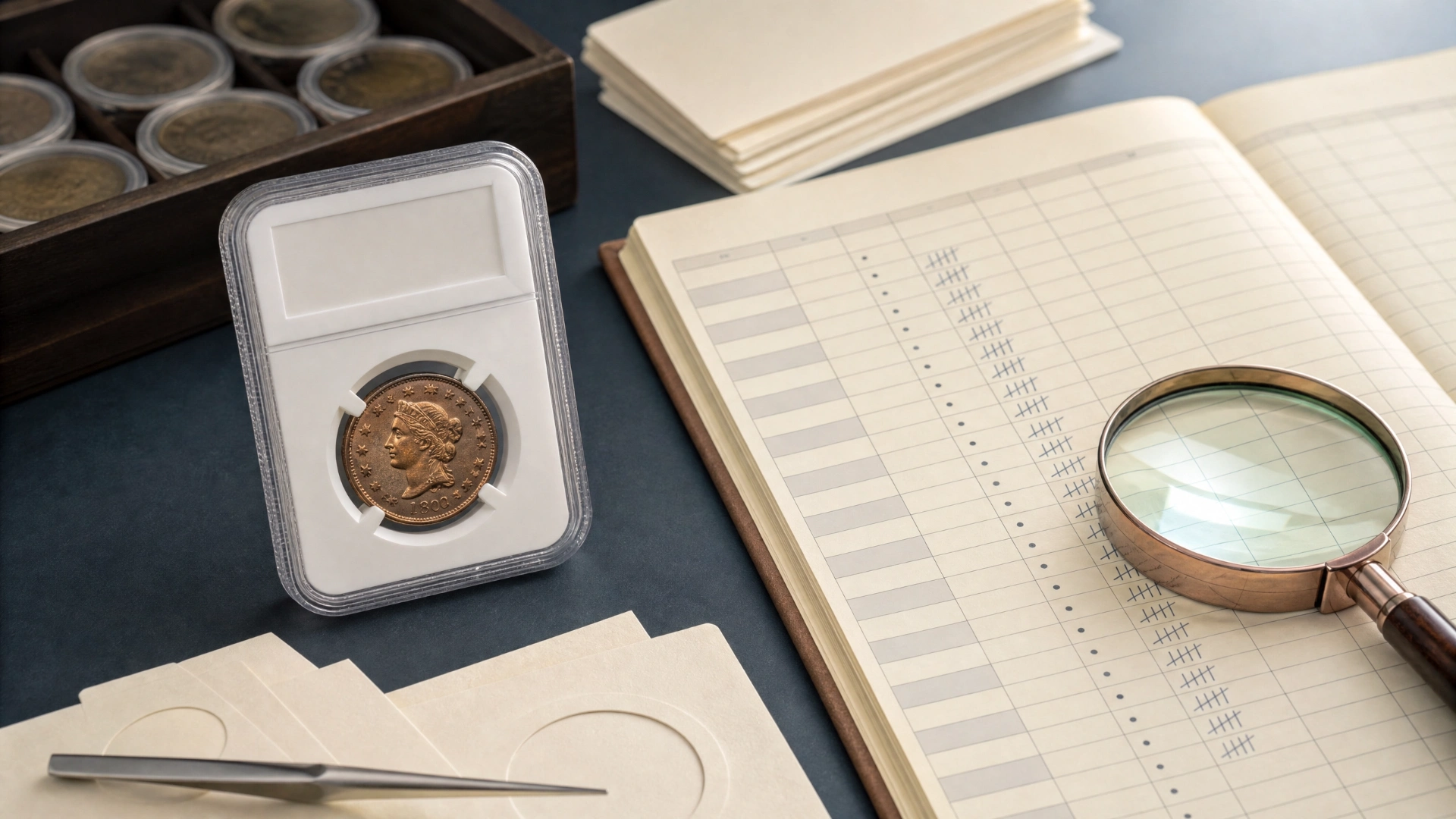
A population report is a tally of gradings, and both companies describe theirs in narrow terms. The PCGS Population Report "profiles the number of coins certified by PCGS at a given grade for each date, denomination, mint mark and variety." The NGC Census is the equivalent record on its side of the market: NGC states that since 1987 it "has graded more than 70 million coins", and the Census is the running record of how those gradings fell.
Two things are load-bearing in those descriptions. The count begins when the company began — NGC states 1987 for its own — so nothing that changed hands earlier is in it unless somebody later paid to have it graded. And the count records events — submissions — rather than objects.
PCGS states the consequence in capital letters on its own page:
"BECAUSE THE Population Report CONTAINS INFORMATION ONLY WITH RESPECT TO THOSE COINS WHICH HAVE BEEN SUBMITTED TO AND CERTIFIED BY PCGS, IT SHOULD NOT BE RELIED UPON TO DETERMINE ACTUAL OR RELATIVE VALUES OF PARTICULAR COINS IN THE MARKETPLACE."
NGC's Census disclaimer is blunter still: using the report "as a tool for assessing the population and value of certified numismatic coins in any character or grade is unreliable."
It is worth sitting with that for a moment. The two companies that produce this data both publish a warning against the most common use of it.
Why the number is cumulative — and what that does to it
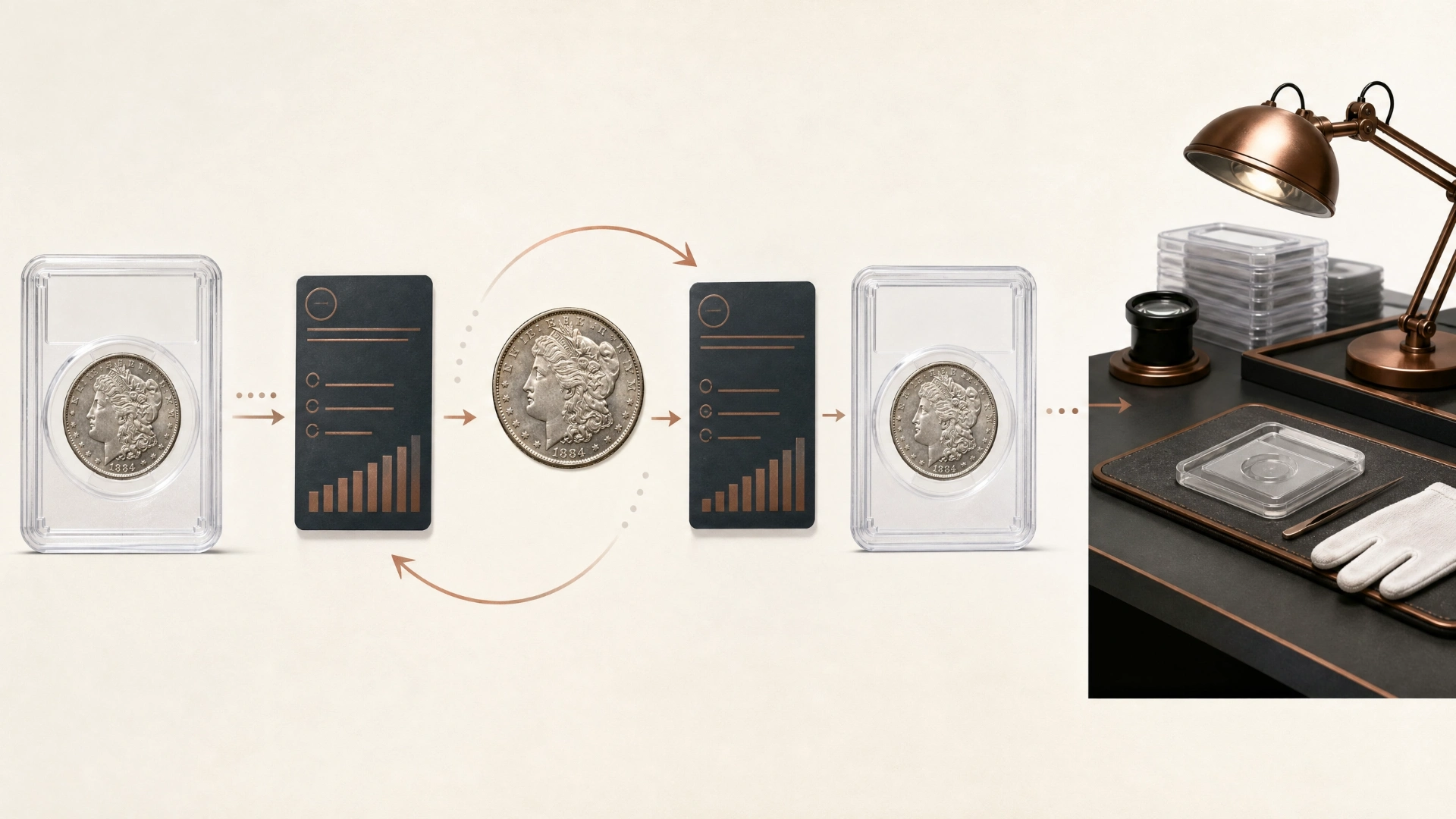
A population figure only goes up on its own. It comes down only when someone takes a deliberate step to bring it down, and that step is optional.
Resubmission. A coin graded MS-64 that its owner believes is an MS-65 can be broken out of its holder and sent back in. If it grades 65 the second time, the report should lose one from the 64 column and gain one in the 65 column — but only if the old label goes back with it.
PCGS says exactly this: "dealers often remove coins from PCGS holders and re-submit them in hopes of receiving a higher grade. Sometimes the dealers return the old inserts to PCGS so that coins can be removed from the Population Report, but sometimes they do not." Writing on NGC's own site, the dealer Jeff Garrett put the reason more bluntly: "Some dealers are just too lazy or disorganized to send back labels once coins have been broken out and resubmitted."
One coin, submitted four times over fifteen years, can therefore appear in the report as up to four coins. On a common date at a common grade this is noise. On a scarce date at the top of the grade scale, where the entire population might be a dozen, it is the difference between a real figure and a fictional one.
Attrition that is never recorded. PCGS notes that its figures "may not reflect any reduction for coins that have been lost, destroyed, or removed from PCGS holders." NGC says the same thing from the other direction: certified coins "are often removed from their holders without notice to the grading service." A coin cracked out to be sold raw, melted, or simply lost stays in the count indefinitely.
Newly recognized varieties. When a variety is first attributed, only the coins submitted since then carry the attribution. PCGS warns that populations for these "may be artificially low, and not representative of the actual number of these coins available in the marketplace." A new variety with a population of three is usually a young number, not a rare coin.
Notice that these errors do not cancel out. Resubmission inflates. Unrecorded attrition inflates. New-variety attribution deflates, but only briefly. Read together, the two services' own statements point to a net upward bias in a mature population figure — an inference from what they say, not something either of them asserts.
Two reports, two companies, and why you cannot add them
PCGS and NGC each publish data about their own work only. Neither publishes combined data, no cross-service register exists that we are aware of, and adding the two numbers together produces something worse than either one.
The reason is crossover. A coin graded by one service can be submitted to the other with a request to cross at the same or a higher grade. If it crosses, it now has an entry in the second company's data — and unless the first holder's label is returned, an entry in the first company's data too. The same coin, counted twice, in two reports that were never designed to be summed.
Grading standards also differ in practice between services and have shifted over decades, so "MS-65 at PCGS" and "MS-65 at NGC" are two opinions rather than one measurement. That is a separate reason not to treat the two columns as a single scale, and it is the reason we describe a coin as graded MS-65 by a named service rather than as being MS-65. Our piece on whether coin grading is worth it covers the decision from the submitter's side.
What "finest known" means, and what it does not
"Finest known" means the highest grade a service has assigned to a coin so far, among the examples sent to it. It is the most-quoted phrase in certified coins and the most frequently over-read.
PCGS illustrates the term with a 1948 Franklin half dollar graded MS68FBL, noting that "to date, this is the only Franklin Half Dollar that PCGS has graded MS68FBL" — MS68FBL being Mint State 68 with Full Bell Lines, a strike designation on that series. Note the first two words. That is a precise statement about one company's records on one day.
What it does not mean is that no better example exists. A finer coin may be sitting ungraded in a collection formed in 1955, in a foreign hoard, in an estate that has never been catalogued, or in a competitor's holder. It may also be sitting in the same company's own future — PCGS notes that population figures are updated daily and "can change substantially over a short period of time." A pop-one coin is a pop-one coin until Tuesday.
The other thing "finest known" does not carry is a price. Both services say rarity is one input among several, and NGC explicitly reminds readers that "rarity is only one factor which must be weighed in determining the market value."
Population and mintage answer different questions
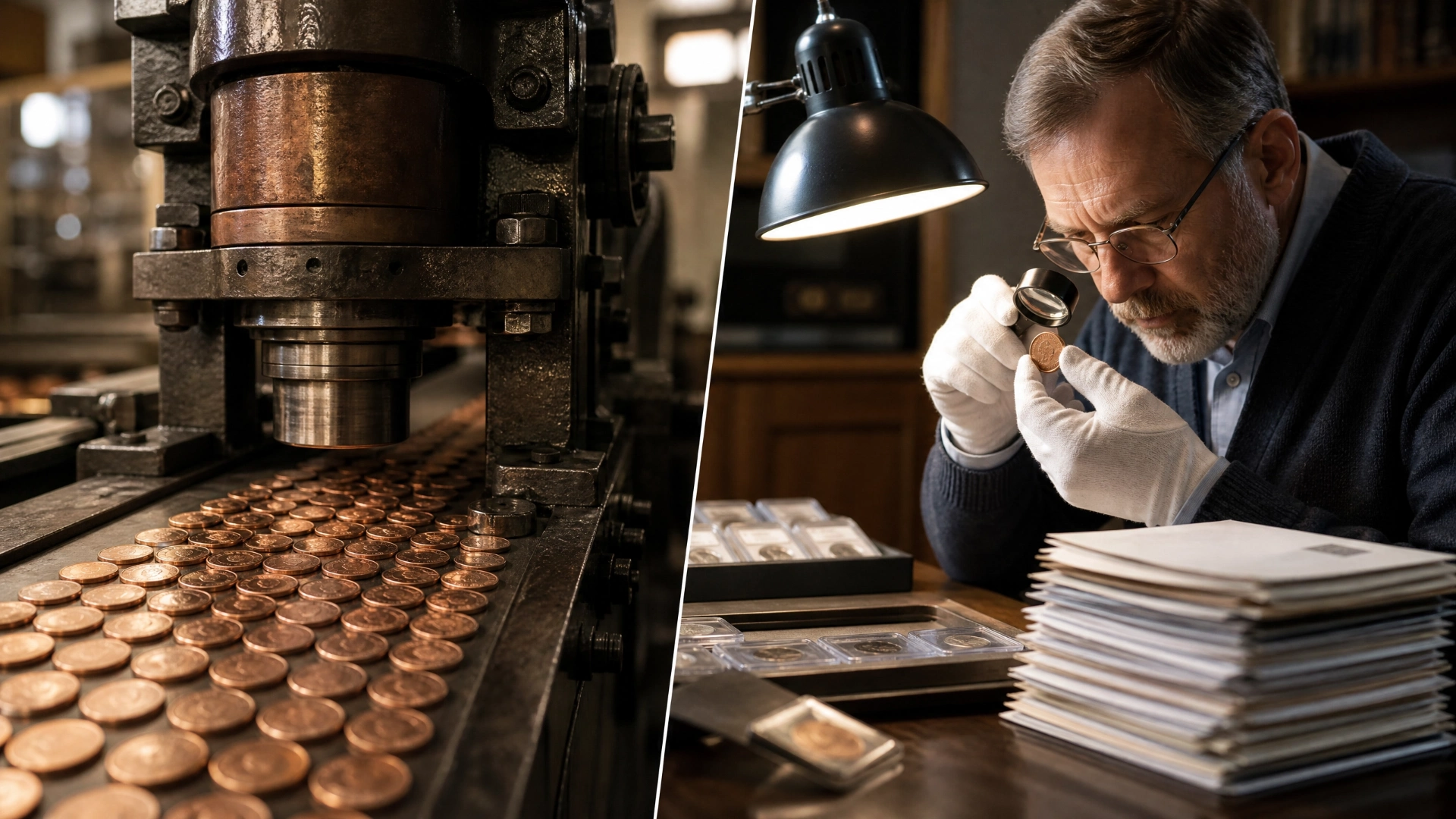
Mintage counts coins struck; a population report counts gradings. Collectors often set the two side by side and treat the pair as a survival estimate, but they are not measuring the same thing, and one of the two is far more reliable than the other.
| Mintage | Population report | |
|---|---|---|
| What it counts | Coins struck, as reported by the issuing mint | Grading events at one company since it opened |
| Source | The mint's own production records | The grading service's submission database |
| Direction of error | Fixed and historical; says nothing about survival | Tends to overstate, through resubmission and unrecorded attrition |
| Changes over time? | No | Yes — daily |
| Good for | How many were made | How the graded supply is distributed across the grade scale |
| Bad for | How many survive | How many exist, and what any of them is worth |
There is one further distortion that catches beginners and is worth naming, because it runs opposite to the resubmission bias. NGC states it directly: "inexpensive coins which are not generally submitted for certification may appear scarce but are not," and certification services "are predominantly utilized for higher grade coins."
Few people pay grading fees on a well-worn common date. So the low-grade rows of a population report are close to empty for coins that are, in fact, everywhere. A population of 11 in Fine does not mean eleven exist in Fine. It means eleven people saw a reason to send one in. Mintage figures, which come from the mint rather than from the market, are the check on that — and they are one of the things we look at in identifying a genuinely rare coin.
Where population data genuinely helps
Within its actual scope, population data is one of the sharpest tools a collector has. Five uses hold up.
- Reading condition rarity within a series. Condition rarity is scarcity at a particular grade rather than scarcity of the coin itself — a date with a million survivors can still be hard to find in Mint State. The shape of the distribution across grades is more informative than any single cell. A date where the graded supply thins sharply above MS-64 is telling you something real about how that date was made and handled, even if the absolute numbers are soft.
- Comparing dates on a like-for-like basis. The biases described above apply roughly evenly across a series, so comparing the 1893 to the 1894 within one service's data is far sounder than reading either figure alone. This is where population data earns its keep on a series such as the Morgan dollar.
- Testing a seller's claim. "Only twelve of these exist" is checkable in about a minute. Usually what the claim means is that one service has graded twelve at that grade or higher, which is a different and much weaker statement.
- Deciding whether to submit. Where a grade tier is already deep, an upgrade may return less than the submission fee; where it is thin, the calculation is different. Fees and outcomes vary by service, tier and coin.
- Tracking movement. Because the data updates daily, watching a figure over time shows you whether a fresh group has entered the market.
The habit that makes all of this work is reading the number as a sentence rather than a quantity: as of today, this company has recorded this many gradings at this grade. Every clause in that sentence is a limit, and all of them are load-bearing.
How we use it at the counter
Copper State Coin & Bullion has over 40 years of numismatic and bullion experience across two Phoenix-area stores, and population data is part of how we look at a coin — one part, alongside the coin itself.
We submit coins to PCGS and NGC, and we are members of PCGS, NGC, PMG and the Certified Coin Exchange, so we work with these reports routinely rather than occasionally. When someone brings in a collection, the report tells us where a date sits in the graded supply; it does not tell us what is in front of us. That still requires the coin, a light and someone who has seen the series before.
Sellers get a complimentary appraisal, and it is worth bringing a collection in as it is rather than pre-sorting or cleaning it — we set out why in our guide to preparing a collection for sale without damaging its value. If you are buying rather than selling, our numismatic coins section is where that inventory sits, and we keep want lists for collectors chasing something specific.
This article is educational and reflects general information about precious metals and collectible coins. It is not investment, tax or legal advice, and Copper State Coin & Bullion is not a registered investment adviser, broker-dealer or tax professional. Metal prices fluctuate and past performance does not indicate future results. Consult a qualified professional about your own situation.
Frequently asked questions
What is the difference between the PCGS Population Report and the NGC Census?
They are the same kind of document produced by two different companies about their own grading. PCGS reports coins it has certified; NGC reports coins it has certified since 1987. Neither includes the other's work, and because coins cross between services without labels always being returned, the two figures cannot be added together to produce a total.
Does a low population number mean a coin is rare?
Not on its own. A low figure can mean a genuinely scarce coin, or it can mean a coin nobody bothers to certify. NGC states that inexpensive coins not generally submitted "may appear scarce but are not," and that certification is used predominantly for higher-grade coins. Read the population alongside the mint's own mintage figure and the coin itself.
Why do population numbers go up when no new coins are being made?
Because the report counts gradings, not coins. Every fresh submission adds to it, including resubmissions of coins already counted. PCGS notes that owners frequently break coins out and resubmit them hoping for a higher grade, and that the old label is not always returned so the previous entry can be removed.
What does "pop 1" or "finest known" actually mean?
It means that as of today, that service has graded one example at that grade and none higher. It is a statement about one company's records, not about the world. A finer coin may exist ungraded, in another company's holder, or simply not yet submitted — and because the data updates daily, the figure can change without notice.
Can I use a population report to price a coin?
Both services advise against it. PCGS states in capitals that the report "should not be relied upon to determine actual or relative values of particular coins in the marketplace," and NGC calls it unreliable for assessing population and value, adding that rarity is only one factor in market value. Realized auction prices for the same date and grade, with dates attached, are the better starting point.
Bring the coins, not just the numbers
A population report will tell you where a date sits in the graded supply. Identifying the coin in your hand is a separate step, whoever does it. We look at collections, single coins and estates at both stores, and sellers get a complimentary appraisal.
Peoria
Copper State Coin & Bullion
8360 W. Thunderbird Road C#103
Peoria, AZ 85381
(623) 432-3953
Phoenix
Copper State Coin & Bullion
4550 E Bell Road Suite 188
Phoenix, AZ 85032
(602) 377-1944
Both stores: Monday–Friday 9:00 a.m. – 5:00 p.m. · Saturday 9:00 a.m. – 4:00 p.m. · Sunday closed
See what we buy and how to start