World banknotes are paper and polymer money issued by countries other than the United States. For a U.S. collector they open up issuers, designs and printing histories from across the world. The value of a foreign note depends mainly on exactly which note it is, its condition, how scarce it is, how many collectors want it, and whether it can still be exchanged for current money.
This guide covers how world notes are identified, how to tell whether an old foreign note still has exchange value, how condition and grading work, what the large numbers on hyperinflation notes really mean, and a few ways to shape a first collection. It does not give prices. A value without the exact note, its grade and a dated source is not information.
Start With the Pick Number
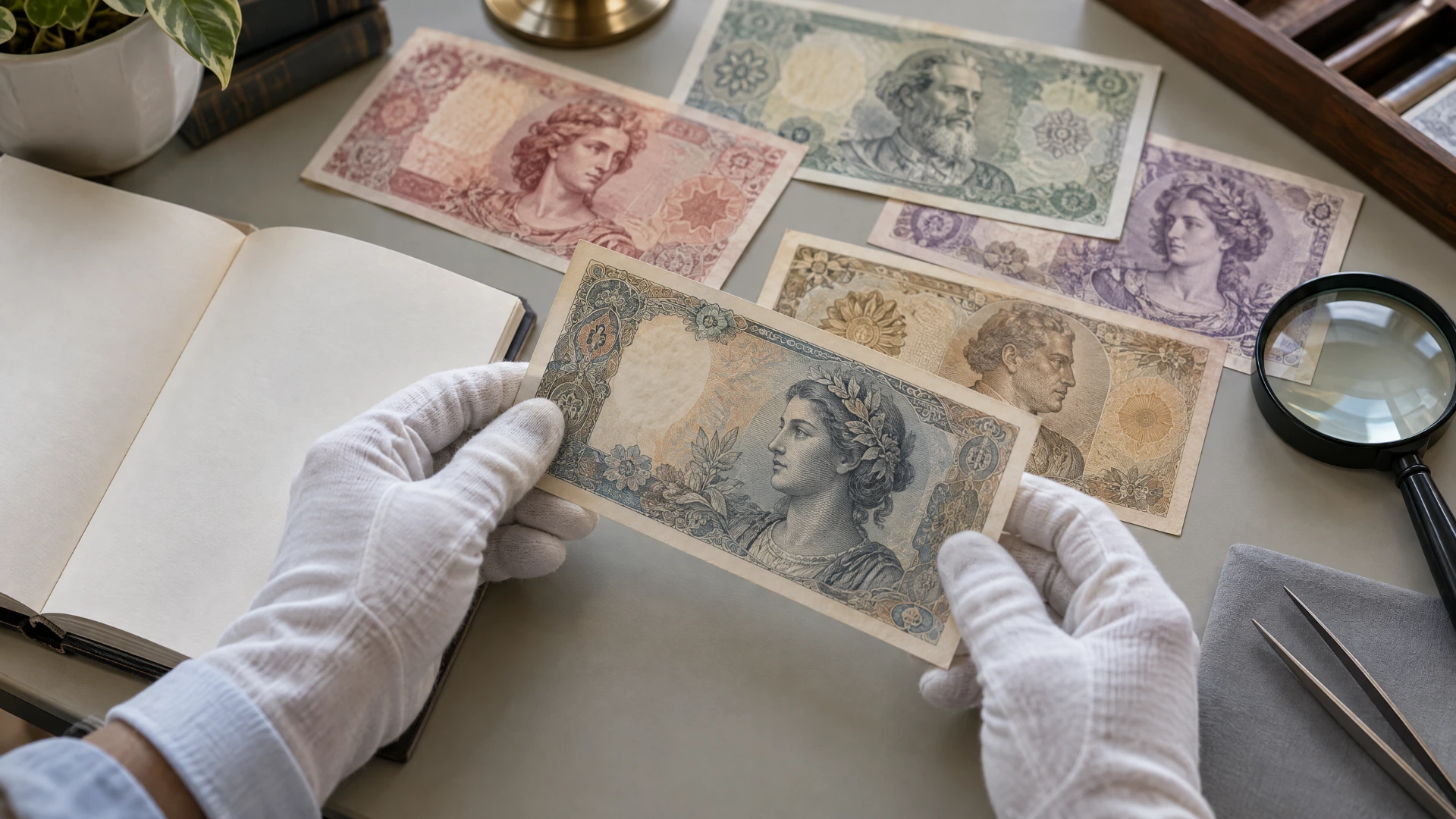
A Pick number is the catalog reference that identifies a specific world banknote within its issuing country. It is written as "P" or "Pick" followed by a number, such as P-567, with a letter added when notes within a series differ by signature combination or another detail, as in P-567a and P-567b, according to Paper Money Guaranty (PMG).
The system is named for the German numismatist Albert Pick, whose research led to the first edition of the Standard Catalog of World Paper Money in 1975. In July 2026, the Certified Collectibles Group, which includes NGC and PMG, announced that it had acquired the Pick catalog along with its world coin counterpart, and that PMG offers the Pick catalog free through its World Paper Money Price Guide on PMGnotes.com.
For a beginner, that is the single most useful step, and most questions about foreign paper money value start there. Two notes from the same country with the same denomination can carry different Pick numbers because of a different date, signature or series, and the catalog listing is where those differences are spelled out. PMG prints the Pick number on its certification labels and organizes its population report by it, so the same reference follows a note from catalog to holder.
Is the Note Still Money? Exchange Value and Collector Value
Many old foreign notes can still be exchanged for current currency at the issuing central bank, and some cannot. That status matters, because a note that can be exchanged has a floor under it, while a note past its deadline has only collector value.
The euro changeover is the clearest example. The European Central Bank states that former national banknotes and coins can in most cases still be exchanged for euro, but only through each country's national central bank, and the deadlines vary widely.
| Former currency | Banknote exchange at the national central bank |
|---|---|
| German mark | No deadline |
| Austrian schilling | No deadline |
| Irish pound | No deadline |
| Dutch guilder | Until 1 January 2032 (see note) |
| French franc | Ended 17 February 2012 |
| Italian lira | Ended 6 December 2011 |
| Spanish peseta | Ended 30 June 2021 |
Source: the ECB's exchange table, checked 24 October 2026. It covers the national banknote series the ECB depicts, and the ECB adds that several national central banks also exchange older series, so check an older note with the issuing central bank. The ECB also notes that De Nederlandsche Bank does not exchange guilders obtained from commercial activities after 27 January 2002. Coin deadlines sit in a separate column of the same table and differ for several countries.
Bank of England notes work differently. The Bank states that there is no deadline to exchange old Bank of England banknotes with it, and it accepts exchanges by post. It warns that postal exchanges are currently taking up to 90 working days, longer when notes need extra checks, and that notes are sent at the sender's own risk. Its page sets out the identification and payment rules for applicants who live outside the UK. Scottish and Northern Ireland notes are covered on a separate page of the Bank's site.
For a leftover note from a trip, check its exchange status before anything else. For an older note, the exchange value and the collector value can be very different, and either one can be the larger.
Condition and Grading for World Banknotes
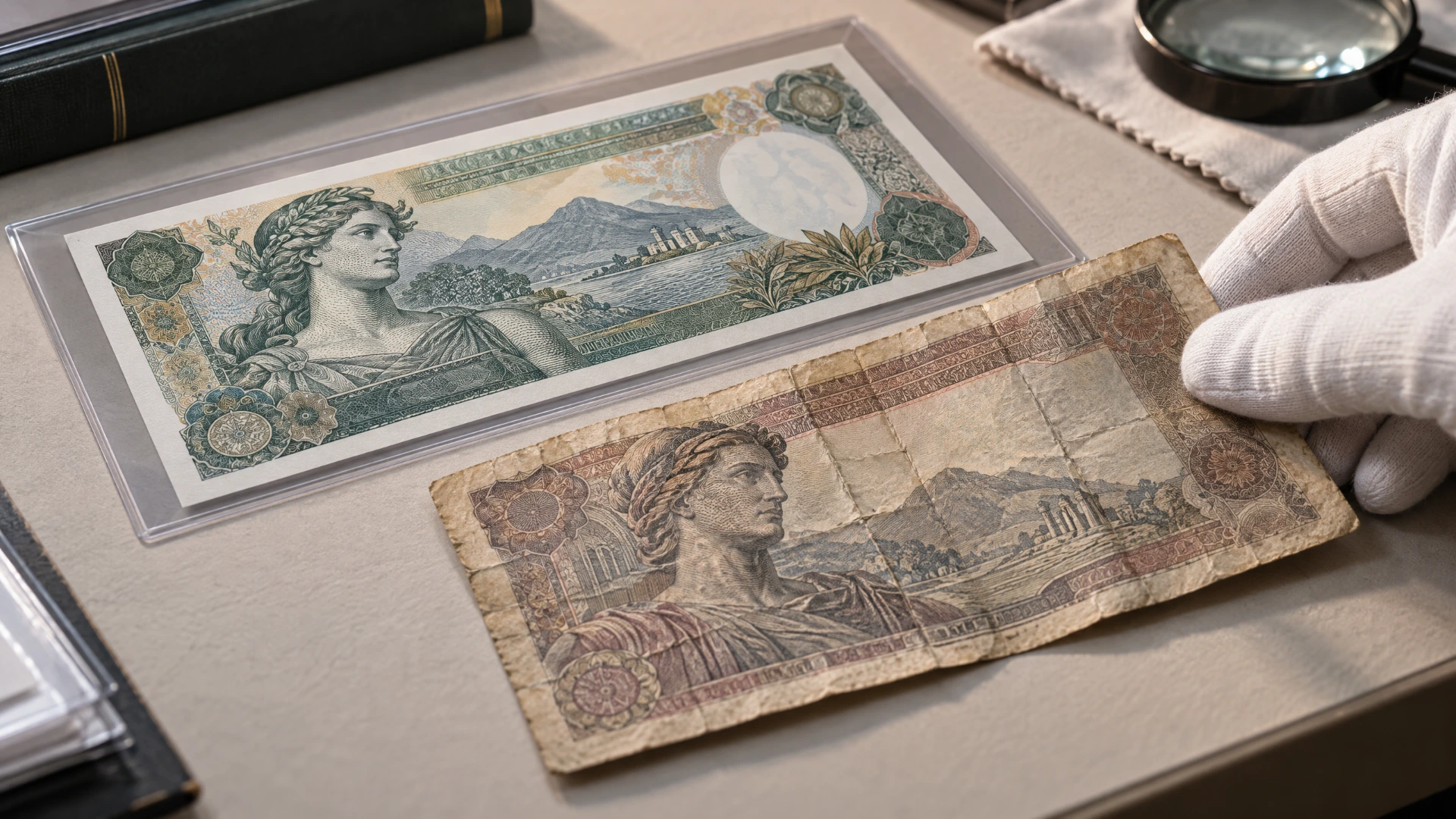
Condition drives value for world notes just as it does for U.S. currency. A note with no folds and original crisp paper sits in a different market from the same note after years in a wallet.
PMG grades notes on a 70-point numerical scale derived from the internationally recognized Sheldon grading scale, and it certifies world notes as well as U.S. ones. On the Singapore label shown in its article on Pick numbers, the Pick number sits beneath the country name. PMG also adds an Exceptional Paper Quality (EPQ) designation for a note that is, in the opinion of PMG graders, completely original: not physically, chemically or materially processed to give the appearance of a higher grade.
That last point is the practical warning. Pressing out folds, washing or any other treatment meant to make a note look better is the kind of processing that designation excludes.
Handle notes by the edges, store them flat in a holder made for paper money, and leave cleaning alone. Our beginner's guide to old U.S. paper money covers examination and storage, and the same habits apply to world notes.
Terms you will see on listings and labels
| Term | Meaning |
|---|---|
| Pick number | The reference number given to each note in the Standard Catalog of World Paper Money |
| Specimen | An example of a fully completed note design, either already in circulation or intended for circulation |
| Remainder | A note fully prepared for issue but never officially issued |
| EPQ | PMG's Exceptional Paper Quality designation for a note its graders judge completely original |
| Contemporary counterfeit | A note that is not genuine and was made at or around the time the genuine note was issued |
Definitions follow PMG's glossary of terms.
Polymer Notes: A Newer Kind of Banknote
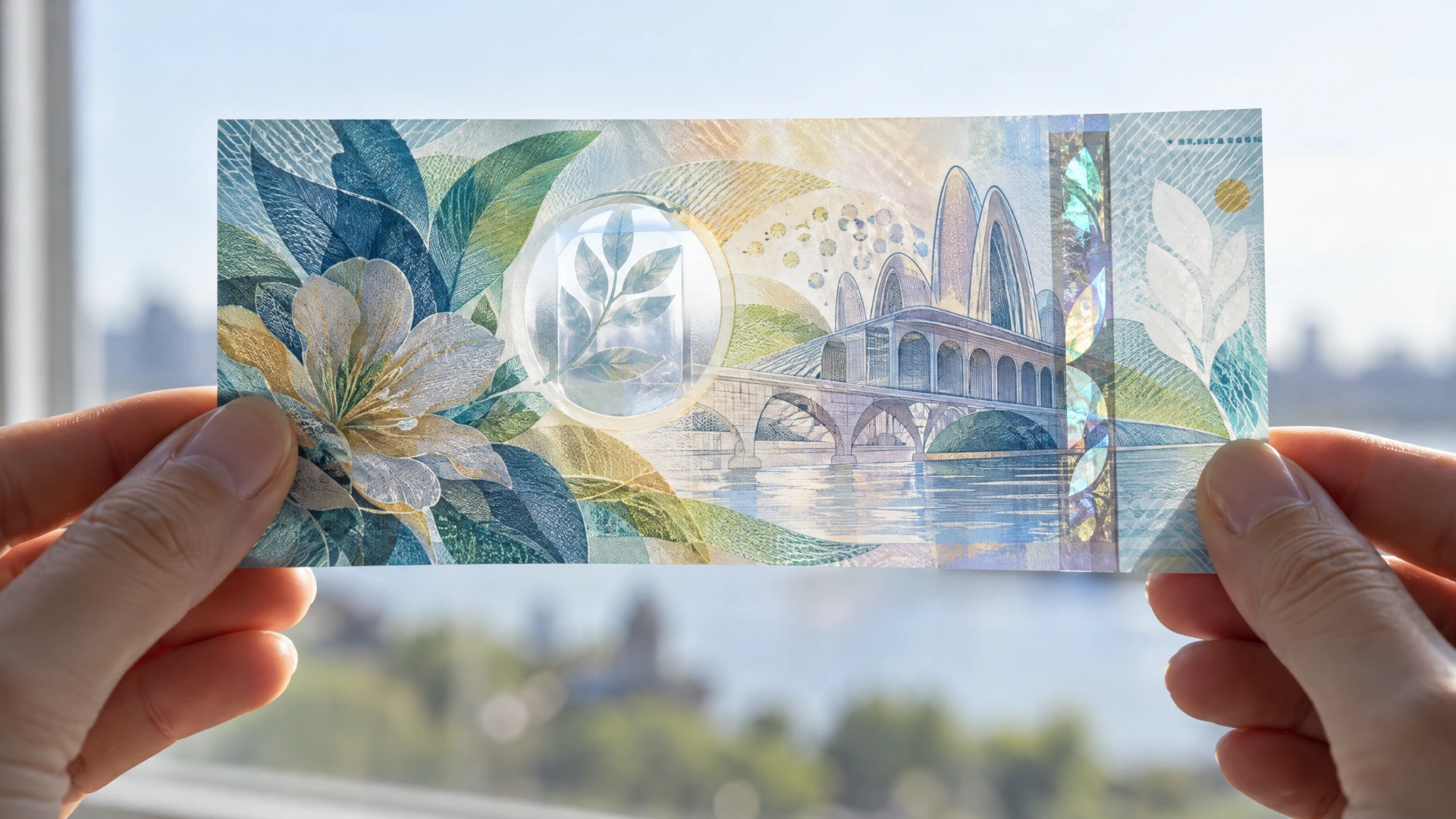
A polymer banknote is printed on a plastic film rather than on cotton or paper. Australia's commemorative $10 note, released on 26 January 1988, is described by the Reserve Bank of Australia's museum as the first banknote printed on polymer substrate with an integrated optically variable device. Australia then issued its New Note Series between 1992 and 1996 and, in the museum's account, became the first nation to convert successfully from paper to polymer banknotes.
Polymer notes are a collecting area of their own, with first issues, commemoratives and the transition between paper and polymer series in each country that adopted them. Australia's 1988 note, the first printed on polymer substrate with an integrated optically variable device, is an obvious starting point for the format.
Hyperinflation Notes: Big Numbers, Separate Questions
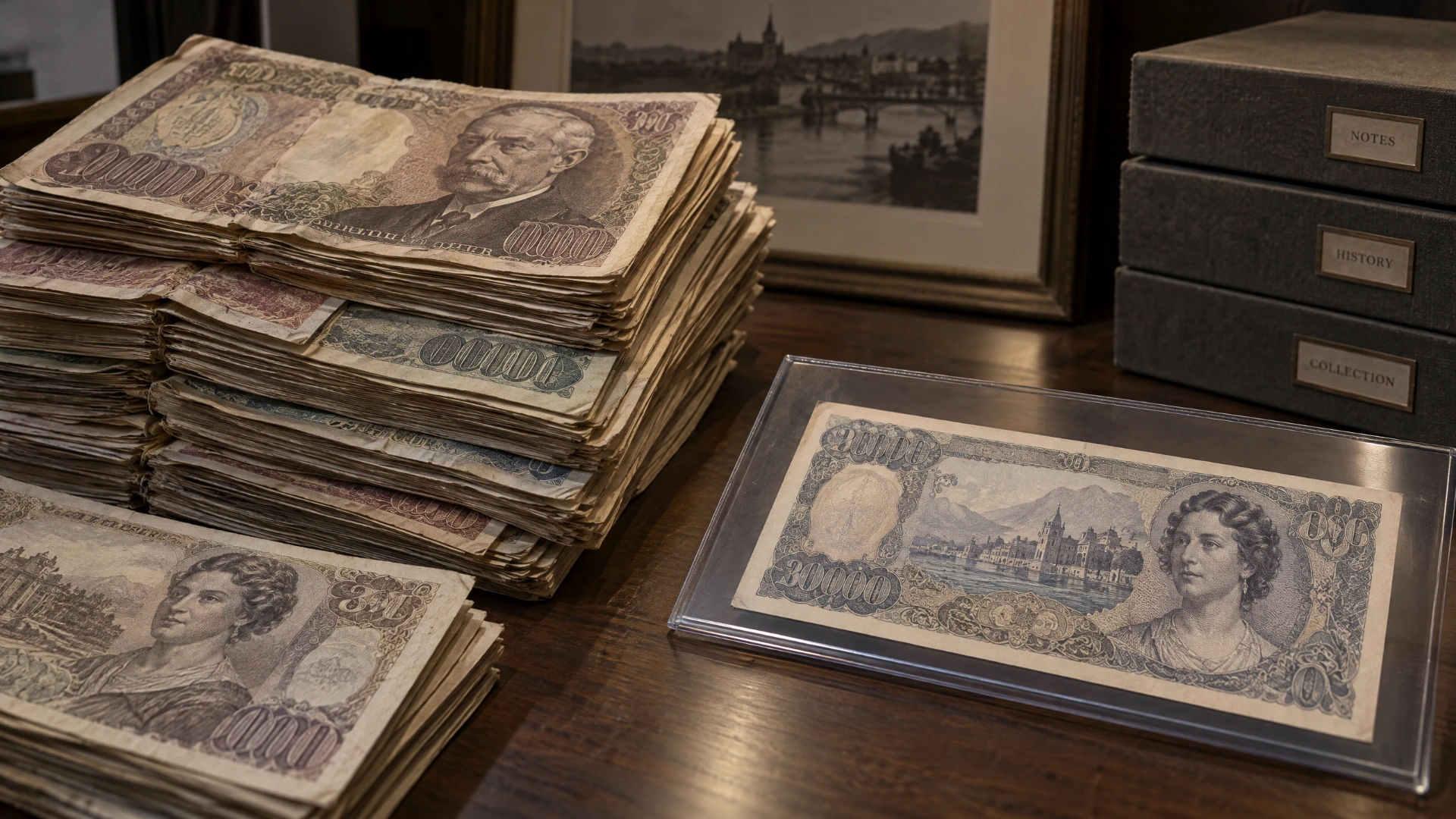
A very large face value tells you about a country's inflation, not about how scarce a note is. The Smithsonian's National Numismatic Collection holds a Zimbabwe 100,000,000,000,000 dollar note dated 2008, which its record describes as issued during a period of hyperinflation, when the government printed larger and larger denominations to keep up with prices.
Notes like this draw attention because of the zeros, and they deserve the same questions as any other note. Which Pick number is it? What condition is it in?
How many has PMG graded at that grade? The PMG population report, organized by Pick number, answers that last question, and it is free to search.
Ways to Build a First World Note Collection
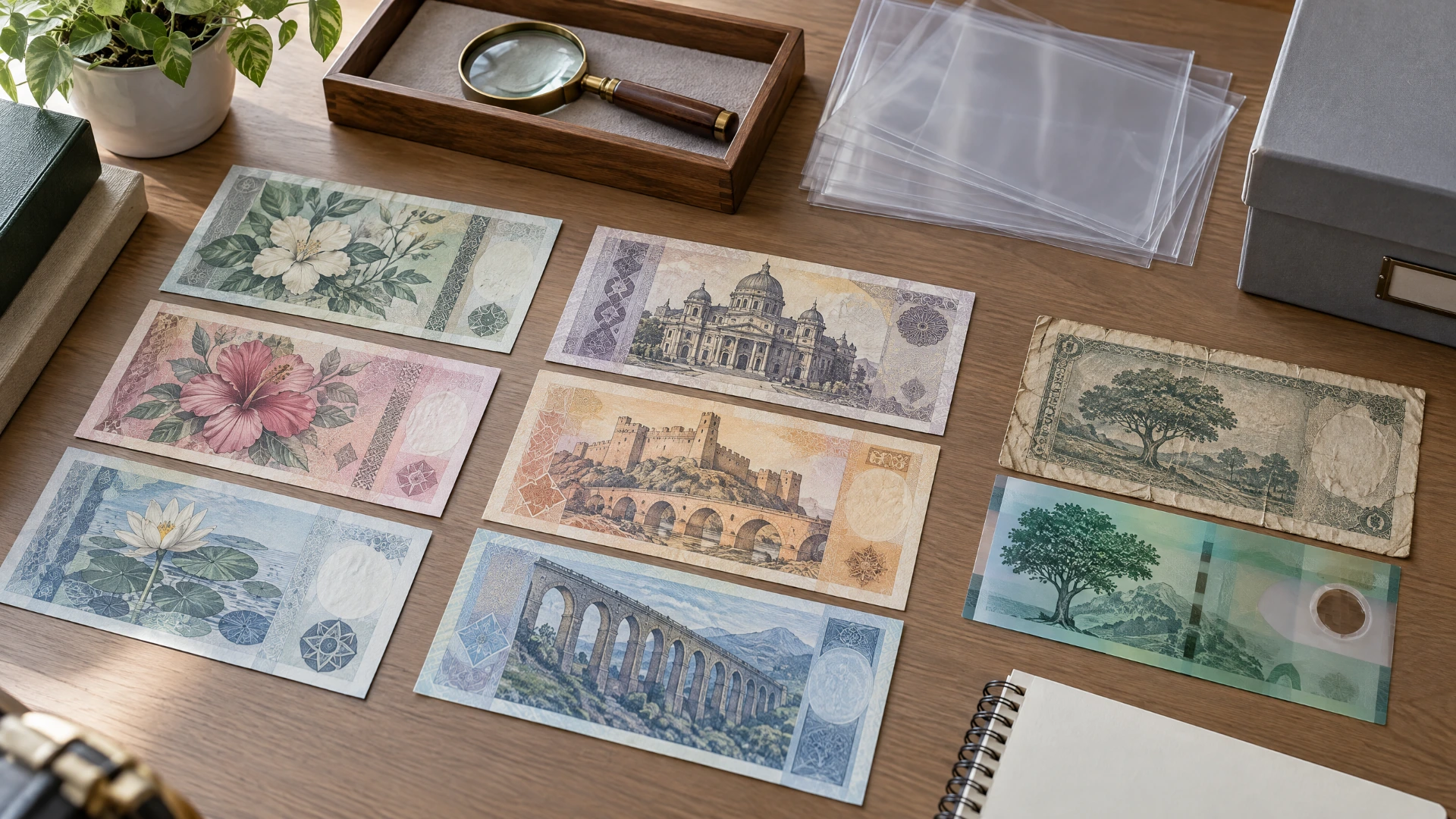
Collecting foreign currency works best with a boundary. Without one, it becomes a pile of unrelated notes. A few common approaches:
- By country. One issuer's notes across several series, which shows how designs, signatures and security features changed over time.
- By theme. Animals, bridges, ships or scientists across many countries. Themes suit collectors who care more about design than about completing a country.
- By transition. The last notes before a currency change and the first after it, such as pre-euro notes, or the paper-to-polymer switch.
- By new issue. Current notes as they are released. The International Bank Note Society, founded in 1961 and counting more than 2,000 members in over 90 countries, names a Bank Note of the Year; its 2025 choice was the 200 gulden of Curaçao and Sint Maarten, from a series inspired by undersea life.
Whichever route you take, record the Pick number and the condition of each note as you acquire it. That record is what lets anyone, including you, value the collection later. Our guide to researching value before a dealer visit is written for coins, and its approach to price guides and dated sources carries over to notes.
World Notes at Copper State Coin & Bullion
Our paper money page shows the notes currently in stock, and foreign coins are listed separately under world coins.
If you have foreign notes you want looked at, call either store before you bring them in and ask whether we are taking world notes at the moment. Our selling page names the U.S. paper money we buy, from silver certificates to obsolete bank notes, and says the appraisal is free with no appointment needed. For foreign notes, ask first rather than assume.
This article is educational and reflects general information about precious metals and collectible coins. It is not investment, tax or legal advice, and Copper State Coin & Bullion is not a registered investment adviser, broker-dealer or tax professional. Metal prices fluctuate and past performance does not indicate future results. Consult a qualified professional about your own situation.
Frequently Asked Questions
Are old foreign banknotes worth anything?
It depends on the note. Some can still be exchanged at the issuing central bank, some are sought by collectors, and the two values can differ widely. Start by identifying the note's Pick number, then check its exchange status. Condition and collector demand decide the rest, and PMG's free World Paper Money Price Guide is a starting point.
Can I still exchange old euro-area currency?
Often, yes, but only at the issuing country's national central bank. For the last pre-euro series, the European Central Bank lists no deadline for German mark, Austrian schilling and Irish pound banknotes; French franc, Italian lira and Spanish peseta notes can no longer be exchanged. Dutch guilders can be exchanged until 1 January 2032, except those obtained commercially after 27 January 2002. Older series vary.
What is a Pick number on a banknote?
A Pick number is the catalog reference for a specific world banknote, named for numismatist Albert Pick and used in the Standard Catalog of World Paper Money. It identifies the issuing country and the exact note, with letter suffixes for varieties such as different signatures. PMG prints it on its certification labels.
Does PMG grade foreign banknotes?
Yes. Paper Money Guaranty certifies world notes, prints the Pick number on the label, grades on a 70-point numerical scale, and can add its EPQ designation for notes its graders judge completely original. Its population report, organized by Pick number, shows how many notes it has graded at each grade.
Does Copper State buy foreign paper money?
Our selling page does not list them, so ask first. It names the U.S. notes we buy, such as silver certificates and obsolete bank notes, but not foreign notes. Phone either store, Peoria at (623) 432-3953 or Phoenix at (602) 377-1944, and ask whether we are taking world notes at the moment.
Bring Your Questions to Peoria or Phoenix
Copper State brings over 40 years of numismatic and bullion experience to both stores. Call ahead about world notes, browse our U.S. paper money online, or stop in Monday through Saturday.
Copper State Coin & Bullion, Peoria
8360 W. Thunderbird Road C#103
Peoria, AZ 85381
(623) 432-3953
Hours: Monday-Friday 9am-5pm, Saturday 9am-4pm, Sunday closed
Copper State Coin & Bullion, Phoenix
4550 E Bell Road Suite 188
Phoenix, AZ 85032
(602) 377-1944
Hours: Monday-Friday 9am-5pm, Saturday 9am-4pm, Sunday closed