A star in a serial number marks a replacement note. When the Bureau of Engraving and Printing finds an imperfect sheet after the serial numbers have been printed, it swaps in a "star" sheet with its own serial numbers, and on a modern Federal Reserve note the star takes the place of the last letter. A star note from a large print run is usually worth face value. The ones collectors pay more for come from small print runs or older series, or carry an error or a notable serial number.
Run size is the figure to look up first: the collector database MyCurrencyCollection says collectors generally consider star notes from runs of 640,000 or fewer rare enough to be worth more than face value.
Why the BEP prints star notes
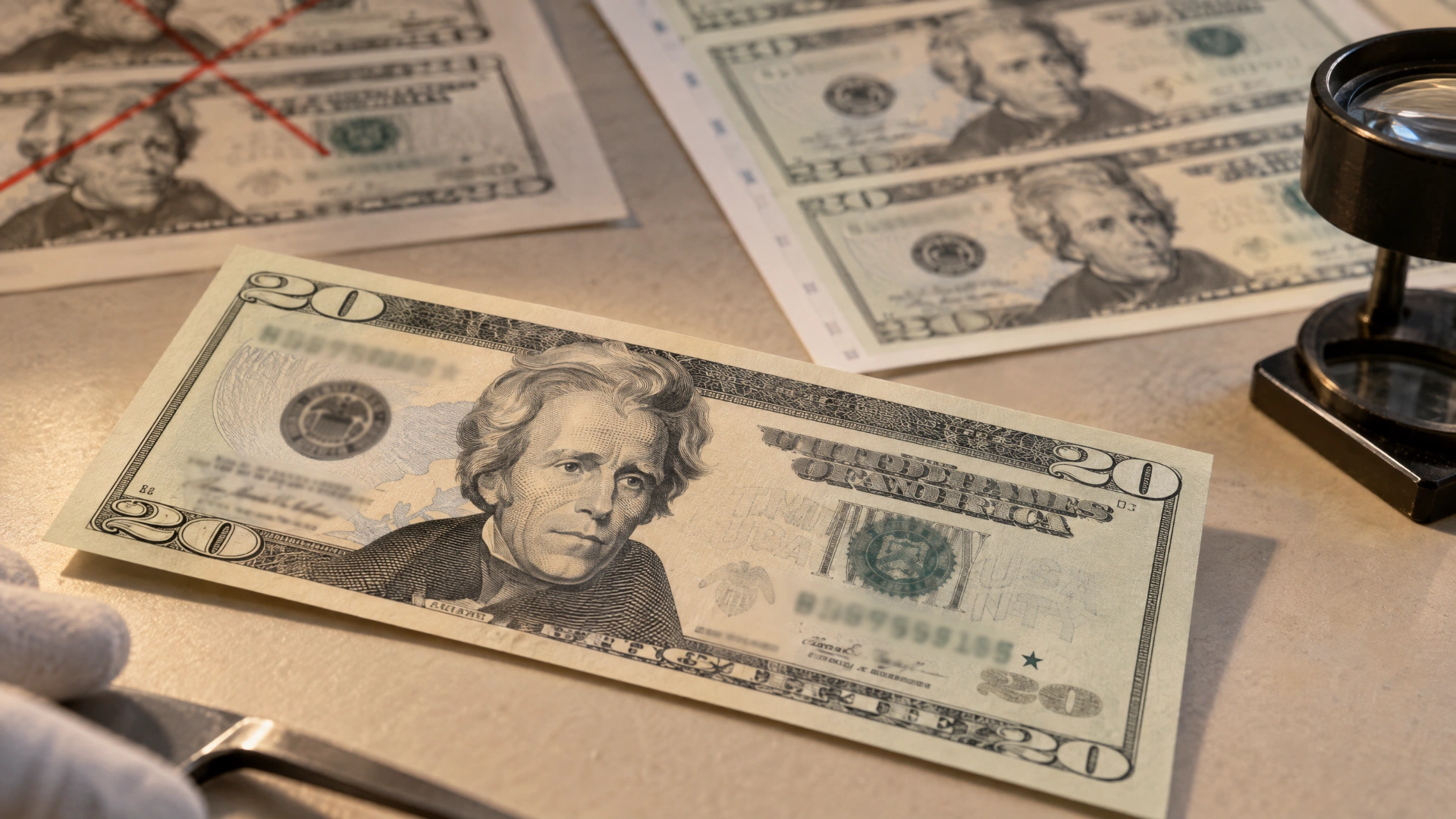
The Bureau of Engraving and Printing (BEP) prints star notes so that it does not have to reprint the exact serial number of a sheet it rejects. Its page on currency serial numbers explains that when an imperfect sheet is detected after the serial number has been overprinted, it must be replaced, and reprinting the exact serial number would be costly and time consuming. The replacement "star" note has its own special serial number followed by a star.
A replacement note is a note printed to take the place of one removed during production. It is not an error itself. The defective note is destroyed, and the star note goes into circulation with everything else. The US Mint's paper currency FAQ adds a point people often ask about: star notes are not sold by the BEP and are only found among circulating currency.
How to read a serial number, and where the star goes
A serial number on a Federal Reserve note is a string of letters and eight digits, and the star takes the place of the final letter. According to the BEP, notes through Series 1995 use one letter, eight digits and one letter, and today only the $1 and $2 still use that form. From Series 1996, notes of $5 and up carry two leading letters: the first indicates the series and the second identifies the issuing Federal Reserve Bank.
| Note | Serial number layout | Where the star sits |
|---|---|---|
| $1 and $2 Federal Reserve notes | Bank letter, eight digits, suffix letter | In place of the suffix letter, at the end |
| $5 and higher, Series 1996 onward | Series letter, bank letter, eight digits, suffix letter | In place of the suffix letter, at the end |
| Older type notes, such as silver certificates | Varies by type and series | At the beginning or the end, depending on the note |
The bank letter runs from A to L, one for each of the twelve Federal Reserve Banks; B is New York, which matters for the 2013 notes below. The BEP notes that the letter O is not used because it looks like the digit 0, and Z is reserved for test printings. For older notes, PMG explains in its announcement on pre-star replacement notes that replacements are identified by a star at the beginning or end of the serial number, and that over a century ago some replacement notes used no star at all.
One label causes confusion. A star printed after a PMG grade, as in 67 EPQ★, is the PMG Star Designation, which PMG assigns to notes with exceptional eye appeal for their grade, and PMG's guide to the PMG Star Designation says it should not be confused with the attribution of star or replacement notes.
Run size and the 640,000 line
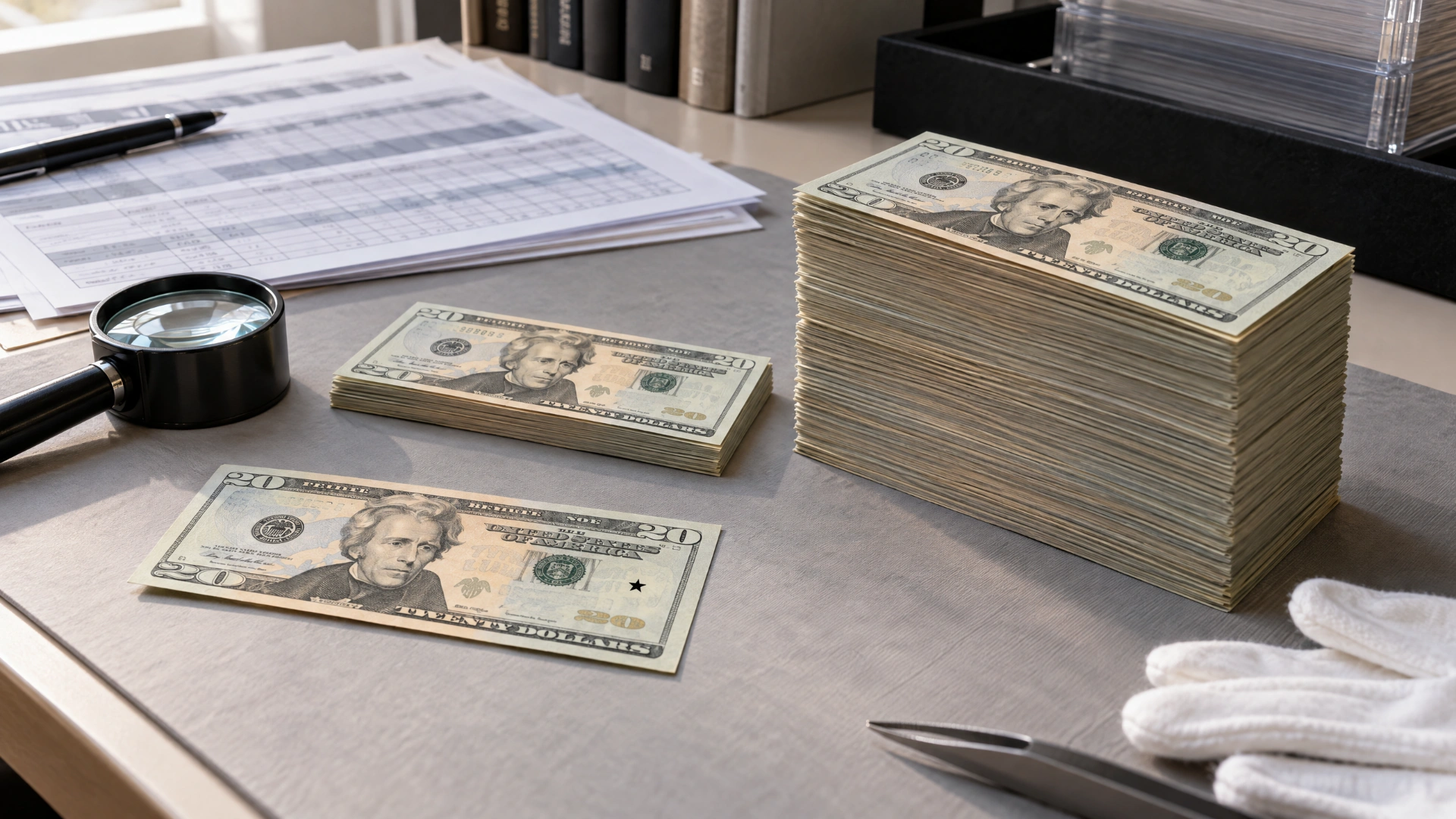
Whether a modern star note is worth more than face value depends mostly on how many notes were printed in its run. A run is a block of consecutive serial numbers printed for one denomination, series and bank. The BEP publishes monthly production reports that list star note runs with their serial ranges and quantities.
The collector database MyCurrencyCollection, whose star note reference covers series 1976 to the present, gives 3,200,000 notes as the maximum star run under the BEP's current printing methods and lists 320,000, 640,000, 1,280,000 and 2,560,000 as common sizes. It says collectors generally consider runs of 640,000 notes or fewer rare enough to be worth more than face value, and that condition is extremely important for modern notes.
To check a note, write down three things: the denomination, the series year printed near the portrait, and the full serial number with its letters and star. Then find the run that contains that serial number in a production report or a star note lookup, and read its size.
The 2013 $1 star notes and the duplicate serial numbers
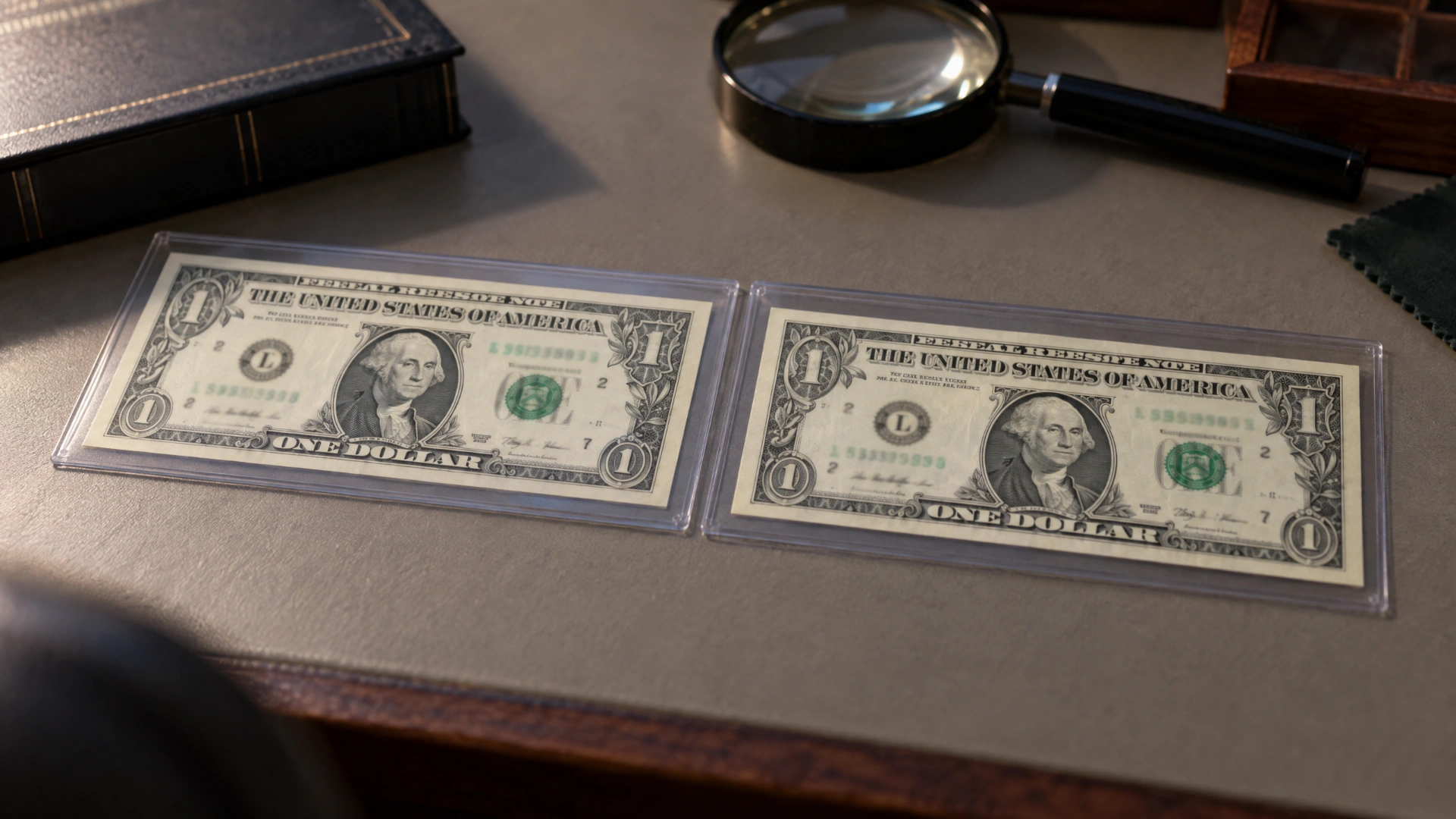
Series 2013 $1 star notes from the New York district are searched for because of a serial number mix-up between the BEP's two printing facilities. PMG reported in a 2021 article on duplicated serial numbers that the BEP accidentally assigned overlapping sets of replacement serial numbers to its two printing facilities, in Washington, DC, and Fort Worth, Texas. The overlap ran from B00000001★ to B00250000★ and from B03200001★ to B09600000★.
The two notes in a pair look almost identical. PMG notes that a Fort Worth note carries the letters "FW" on the lower right of the face, beside the face plate number, and a Washington note does not. Coin World, in its report on a matched pair that sold, dates the Washington printing to October and November 2014 and the Fort Worth run to not quite two years later.
The value sits in the matched pair, not in a single note. A lone Series 2013 B★ note inside those ranges is one half of a possible pair, and PMG says millions of the notes are believed to exist, so the difficulty is finding the twin. Coin World reported that as of September 2021 only 11 confirmed matched pairs had been identified.
Reported figures for pairs are far apart. PMG reported that a pair with serial number B04436550★, graded PMG 66 Gem Uncirculated EPQ and PMG 35 Choice Very Fine, carried an estimate of $10,000 to $15,000 in Stack's Bowers' August 2021 ANA auction. Coin World reported in November 2022 that a pair with those grades sold in that auction for $7,200, and that another pair, graded PMG Very Fine 30 and Gem Uncirculated 67, sold for $25,000 in a verified eBay transaction on October 9. An estimate is not a sale, and none of these figures says what a pair will bring today.
Star notes on older currency
Star notes on older currency follow the same idea with more variety. Silver certificates, United States notes and large-size notes all have star varieties, and on these the series, the signature combination and the condition weigh as heavily as the star itself. Our guide to Federal Reserve notes versus silver certificates explains how to tell the note classes apart by seal color.
The $2 note has its own star varieties, from red seal United States notes to the 1976 Federal Reserve note, and our guide to $2 bills covers what collectors look for on them.
The 2026 change: new equipment prints no star notes
Notes printed on the new equipment carry no star. On September 15, 2026, Federal Reserve Financial Services published a notice on nonsequential currency straps. It says the U.S. Currency Program is now producing $1, $2, $5 and $20 notes on new equipment, and that the new printing equipment will no longer produce star notes. Notes from that equipment arrive in straps whose serial numbers are no longer consecutive.
The traditional equipment will continue to issue star notes to replace imperfect notes in sequential straps, and until the transition is complete both kinds of strap may appear. The same notice confirms that all Federal Reserve notes, including star notes, remain legal tender and worth their face value. What the change will mean for collector demand is not something the announcement addresses, and we would not guess.
Five things that move a note above face
The star makes a note a star note. Whether that note is worth more than face comes down to five things:
- Run size, for modern notes, read from the production records
- Denomination, series and issuing bank
- Condition, ideally confirmed by a grading service such as PMG or PCGS Banknote
- The serial number itself, such as a very low number or a repeating pattern
- Any error on the note, including errors on the star itself
Grading turns condition into a number, and on a modern star note the grade and the run size together do most of the work.


Buying and selling currency at Copper State
We buy and sell currency at both stores, and sellers get a complimentary appraisal. Our online paper money inventory had no star notes listed as of November 2026. If you are hunting a particular star note, send us your want list and our team will tell you promptly once it locates one. Ask the store about any fee, deposit, how long a list stays active and whether you are obligated to buy.
Cleaning, pressing, taping or writing on a note can lower its grade, so bring it as it is.
This article is educational and reflects general information about precious metals and collectible coins. It is not investment, tax or legal advice, and Copper State Coin & Bullion is not a registered investment adviser, broker-dealer or tax professional. Metal prices fluctuate and past performance does not indicate future results. Consult a qualified professional about your own situation.
Frequently asked questions
Is a dollar bill with a star worth anything?
A dollar bill with a star from a large print run is usually worth face value, one dollar. The star marks a replacement note. A modern star note usually brings more than face only when it comes from a small run, 640,000 notes or fewer by the MyCurrencyCollection database's measure, and is in excellent condition, or when it has an error or a notable serial number.
Are 2013 $1 star notes valuable?
A Series 2013 $1 star note is judged like any other star note, by run size and condition. The ones collectors look for are New York notes, starting with B, in two serial ranges that the BEP printed twice, once in Washington and once in Fort Worth. A single note in those ranges is half of a possible matched pair, and it is the pair that collectors pay for.
How do I look up my star note?
Note the denomination, the series year near the portrait and the full serial number, including its letters and the star. Then find the run containing that number in the BEP's monthly production reports or a star note lookup, and read the run size. The MyCurrencyCollection database says collectors generally consider runs of 640,000 or fewer rare enough to be worth more than face value.
Can I still spend a star note?
Yes. A star note is legal tender like any other note of its denomination, and the Federal Reserve confirmed in September 2026 that all Federal Reserve notes, including star notes, remain worth their face value. Before spending one, check its run size and condition, since a small-run note in crisp condition can be worth more to a collector than to a cashier.
Where can I sell star notes in the Phoenix area?
Copper State Coin & Bullion buys currency, including star notes, at 8360 W. Thunderbird Road C#103 in Peoria and 4550 E Bell Road Suite 188 in Phoenix. Sellers get a complimentary appraisal. Both stores are open Monday to Friday 9am to 5pm, and the Peoria store is also open Saturday 9am to 4pm.
Star note appraisals in Peoria and Phoenix
Bring the note, or a folder of old notes, to either store for the complimentary appraisal we give sellers.
Copper State Coin & Bullion, Peoria
8360 W. Thunderbird Road C#103
Peoria, AZ 85381
(623) 432-3953
Monday-Friday 9am-5pm, Saturday 9am-4pm, Sunday closed
Copper State Coin & Bullion, Phoenix
4550 E Bell Road Suite 188
Phoenix, AZ 85032
(602) 377-1944
Monday-Friday 9am-5pm, Saturday and Sunday closed