Indian Head cents were struck from 1859 to 1909, designed by James Barton Longacre, and made in three types: a one-year 1859 copper-nickel coin, copper-nickel cents with a shield on the reverse from 1860, and bronze cents from 1864 to the end of the series. Ron Guth's series commentary on PCGS CoinFacts names three key dates: the 1877, the 1908-S and the 1909-S. Varieties worth checking for include the 1864 with an L on the ribbon, the 1873 Doubled LIBERTY, the 1888/7 overdate and the two 1886 types.
What any one coin is worth turns on its date, variety, grade, color and whether it is genuine. This guide covers how to identify each of those. It deliberately prints no prices, because a figure without a grade and a date attached would mislead more than it helps.
What an Indian Head cent is
The Indian Head cent is the small one-cent coin the U.S. Mint struck between 1859 and 1909, between the Flying Eagle cent and the Lincoln cent. In his PCGS CoinFacts series commentary, Ron Guth notes that the figure on the obverse is not an American Indian at all but "a head of Liberty with an Indian chief's headdress."
The series rewards a close look because it is full of changes within fifty years: two alloys, two reverses, two weights, a designer's initial that appears partway through 1864, and the first circulating cents struck in San Francisco.
The three types
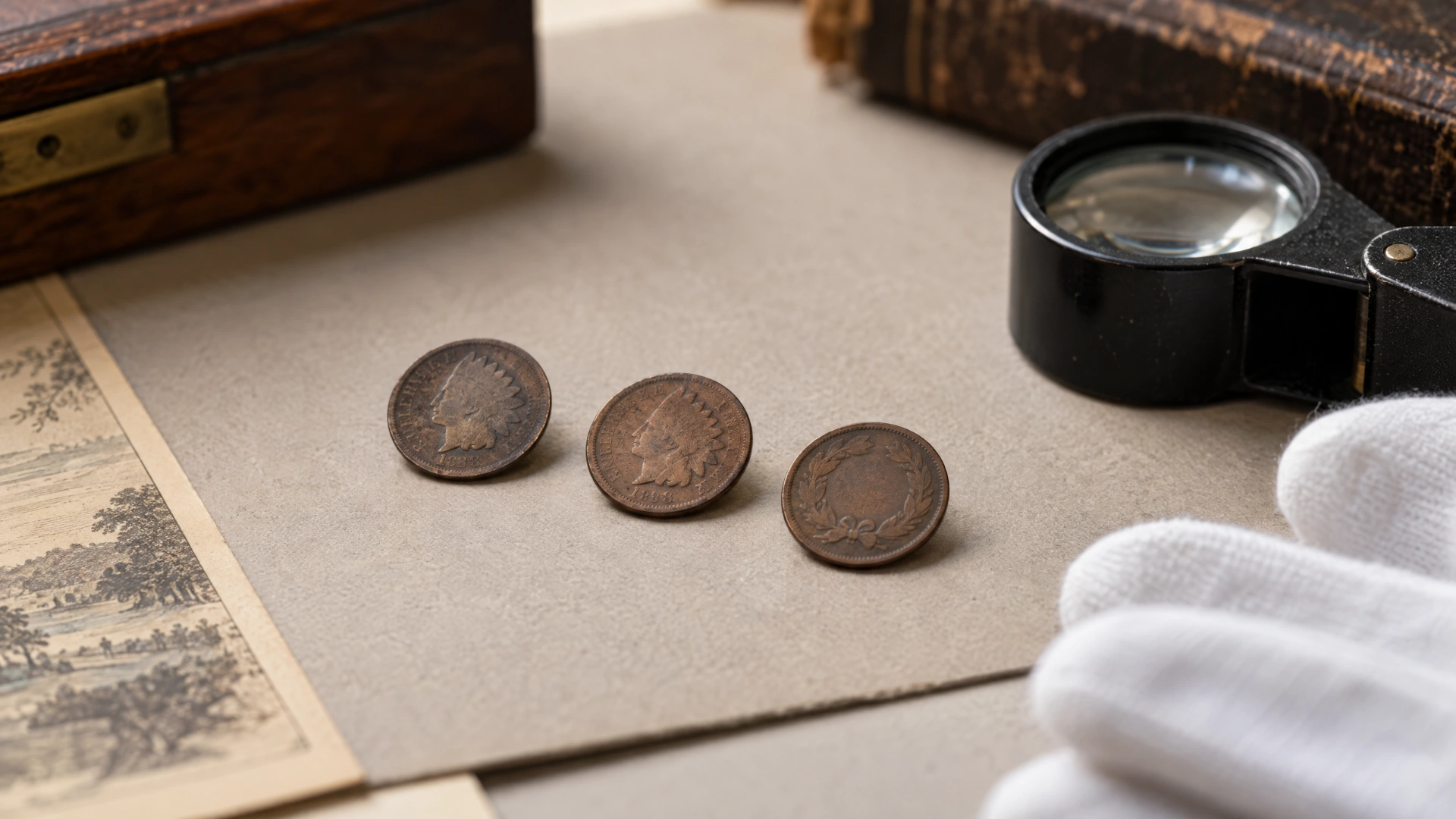
An Indian Head cent belongs to one of three types, and the type tells you its alloy and weight before you look at the date.
| Type | Years struck | Alloy | Weight | Reverse |
|---|---|---|---|---|
| Type 1, no shield | 1859 only | 88% copper, 12% nickel | 4.67 g | Wreath around ONE CENT, no shield |
| Type 2, copper-nickel | 1860-1864 | 88% copper, 12% nickel | 4.67 g | Oak wreath with a small shield at the top |
| Type 3, bronze | 1864-1909 | 95% copper, 5% tin and zinc | 3.11 g | Oak wreath with a small shield at the top |
Type names and year ranges follow the PCGS series listing. The 1859 designer, alloy and diameter are from the PCGS CoinFacts page for the 1859; the 4.67 g copper-nickel and 3.11 g bronze weights and the 1860 reverse description are from Joshua McMorrow-Hernandez's PCGS article on 1856-1864 copper-nickel cents. PCGS lists both the 1859 and the bronze 1877 at 19 mm in diameter.
The 1859 is a one-year type. Jaime Hernandez, on the PCGS page for that date, describes it as "a one year Type and also the first regular issue Indian Head and Wreath design." In 1860 the reverse was redesigned with the shield that stayed for the rest of the series.
The switch to bronze in 1864 came from the Civil War. McMorrow-Hernandez writes that copper-nickel cents were hoarded in great quantity during the war, and that the hard alloy was also difficult to work and wore out dies. Writing for NGC, David W. Lange records that the Act of April 22, 1864 authorized a new cent weighing 48 grains, or 3.11 grams. That is why 1864 cents exist in both alloys.
The key dates
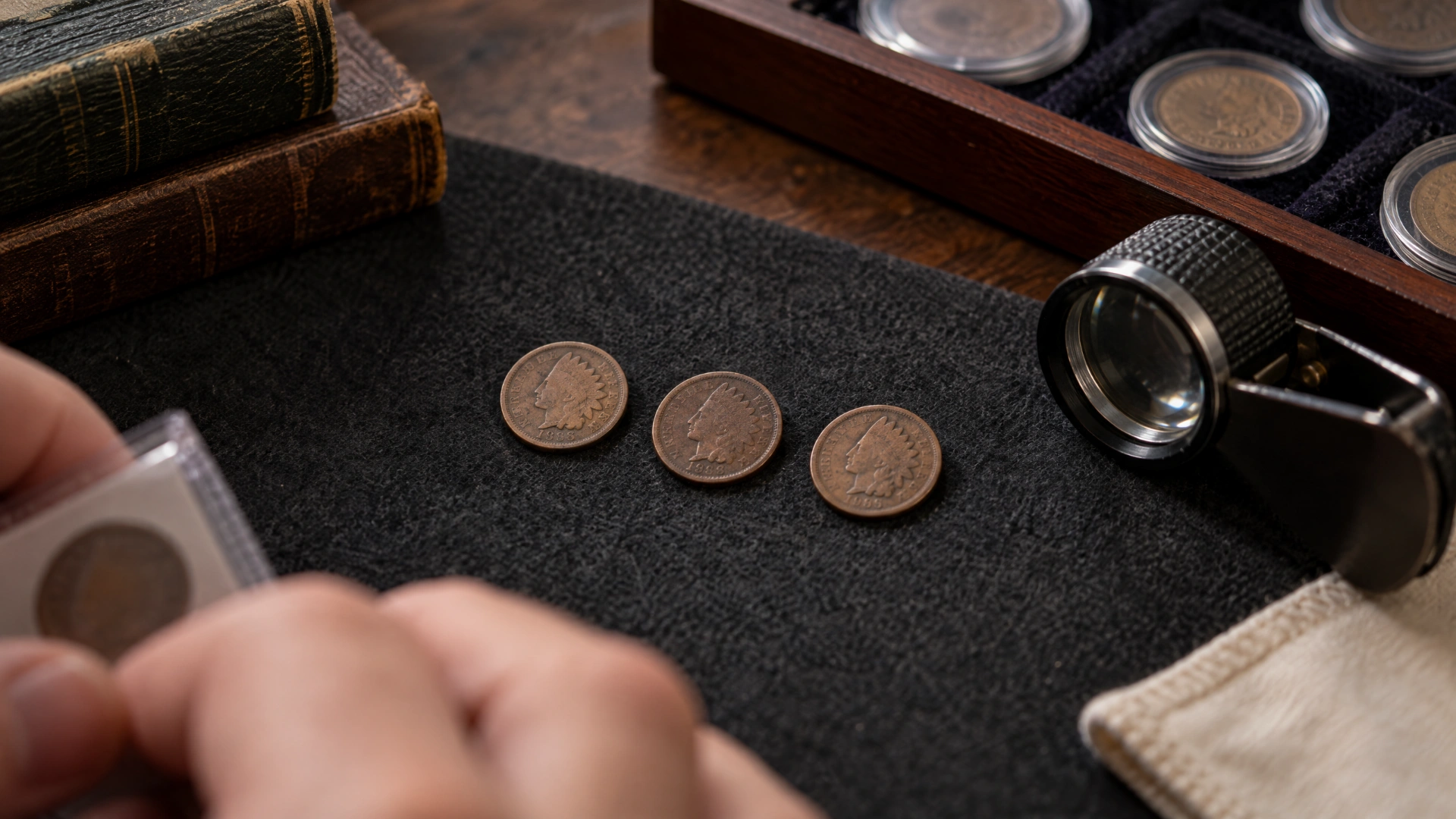
The key dates in a series are the dates hardest to find, which usually means the lowest mintages. Ron Guth names three Indian Head cent key dates. A circulation strike, also called a business strike, is a coin made for everyday use rather than a proof made for collectors, and the mintages below are circulation strikes.
| Date | Mint | Mintage | Why it stands out |
|---|---|---|---|
| 1877 | Philadelphia | 852,500 | Second-lowest circulation-strike mintage in the series |
| 1908-S | San Francisco | 1,115,000 | First circulating one-cent coin struck in San Francisco |
| 1909-S | San Francisco | 309,000 | Lowest circulation-strike mintage in the series |
Mintages from the PCGS CoinFacts pages for the 1877 and 1909-S, and from McMorrow-Hernandez's PCGS article on the 1908-S.
Hernandez notes on the 1909-S page that only the 1877 and the 1909-S have mintages below one million, and that the 1908-S and 1909-S are the only two Indian Head cents carrying an S mint mark. Every other date was struck in Philadelphia without a mint mark.
On its PCGS page Hernandez calls the 1877 "unquestionably the most desirable coin in the entire circulation strike Indian Cent series", and he argues that it survives in smaller numbers than the 1909-S because far fewer people were saving cents in 1877 than in 1909. He also writes that only one reverse die is confirmed for the date, and argues that the reported mintage is overstated; his commentary works from a figure of 877,000, where the PCGS specification lists 852,500. NGC lists the 1877 among commonly encountered counterfeit cents, which is the next section.
The varieties worth checking for
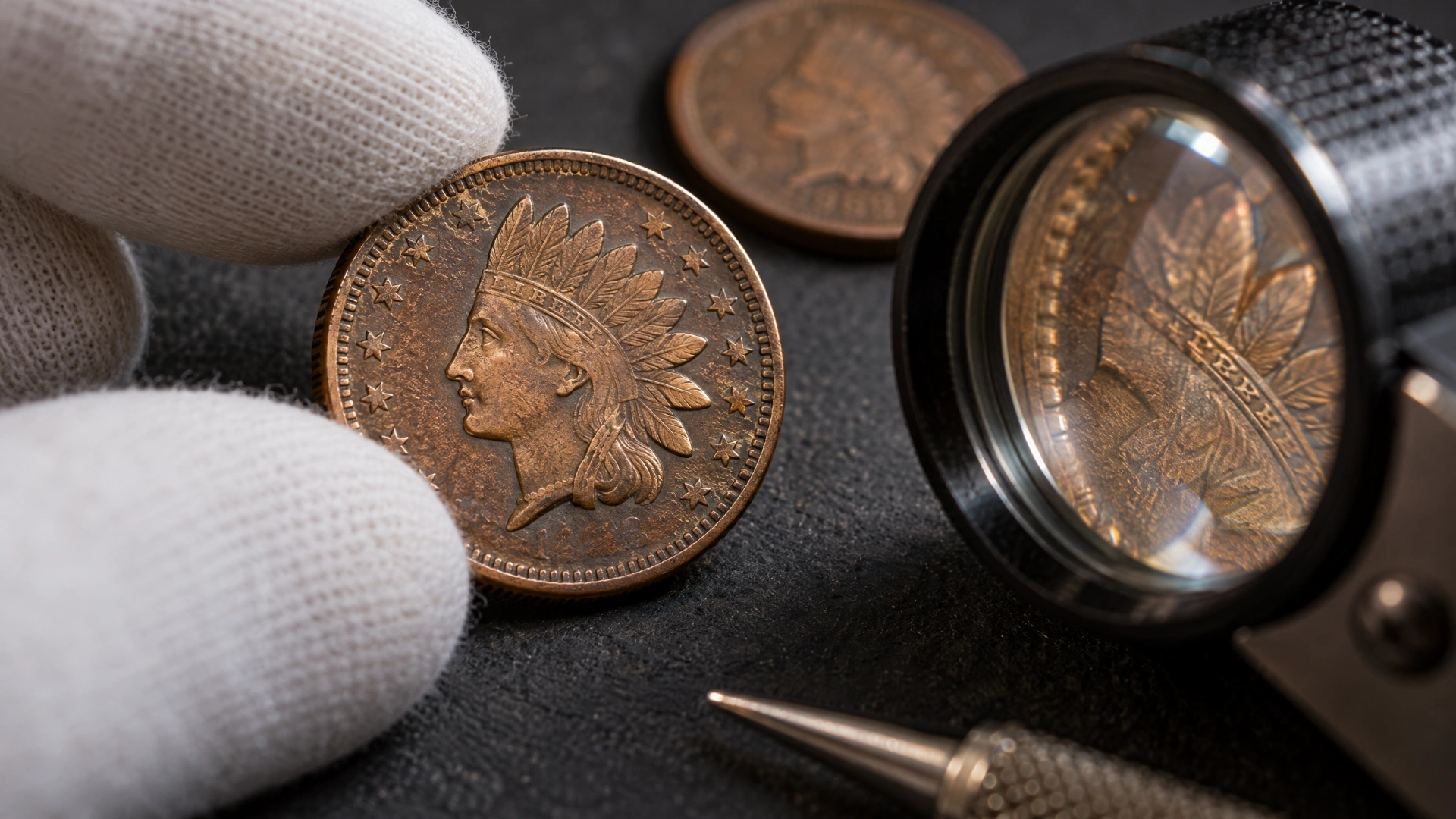
A variety is a coin of a given date that differs from the standard version in a way collectors track, such as a doubled die, an overdate or a design change. Four are worth knowing in this series.
- 1864 with L on the ribbon. David Hall explains on the PCGS page for the 1864-L that the L is the designer's initial, added to the ribbon on the obverse toward the end of the year. He adds that 1864-L cents have a pointed bust, where cents without the L have a rounded one, and calls the variety "scarce in circulated grades and very scarce in mint state."
- 1873 Doubled LIBERTY. A doubled die shows doubling in the word LIBERTY on the headband. Hernandez, on the PCGS page for this variety, calls it scarce and says about 90 to 95% of graded examples are in circulated grades.
- 1888/7 overdate. An overdate is a coin whose final date digit was punched over a different one. On the 1888/7, Hernandez describes traces of the 7 at the top left of the final 8 and a small raised lump near its bottom, and calls the variety scarce in all grades.
- 1886 Type 1 and Type 2. Two obverse versions were used in 1886. Guth writes on the PCGS page for the 1886 Type 2 that on the first, the lowest feather of the headdress points to the IC of AMERICA, and on the second it points to the CA. He says the first is slightly more common than the second, "but not by much."
Each of these needs a loupe and good light rather than a guess. Doubling, overdates and feather positions are small features, and wear removes them first.
The 1877 and the altered date
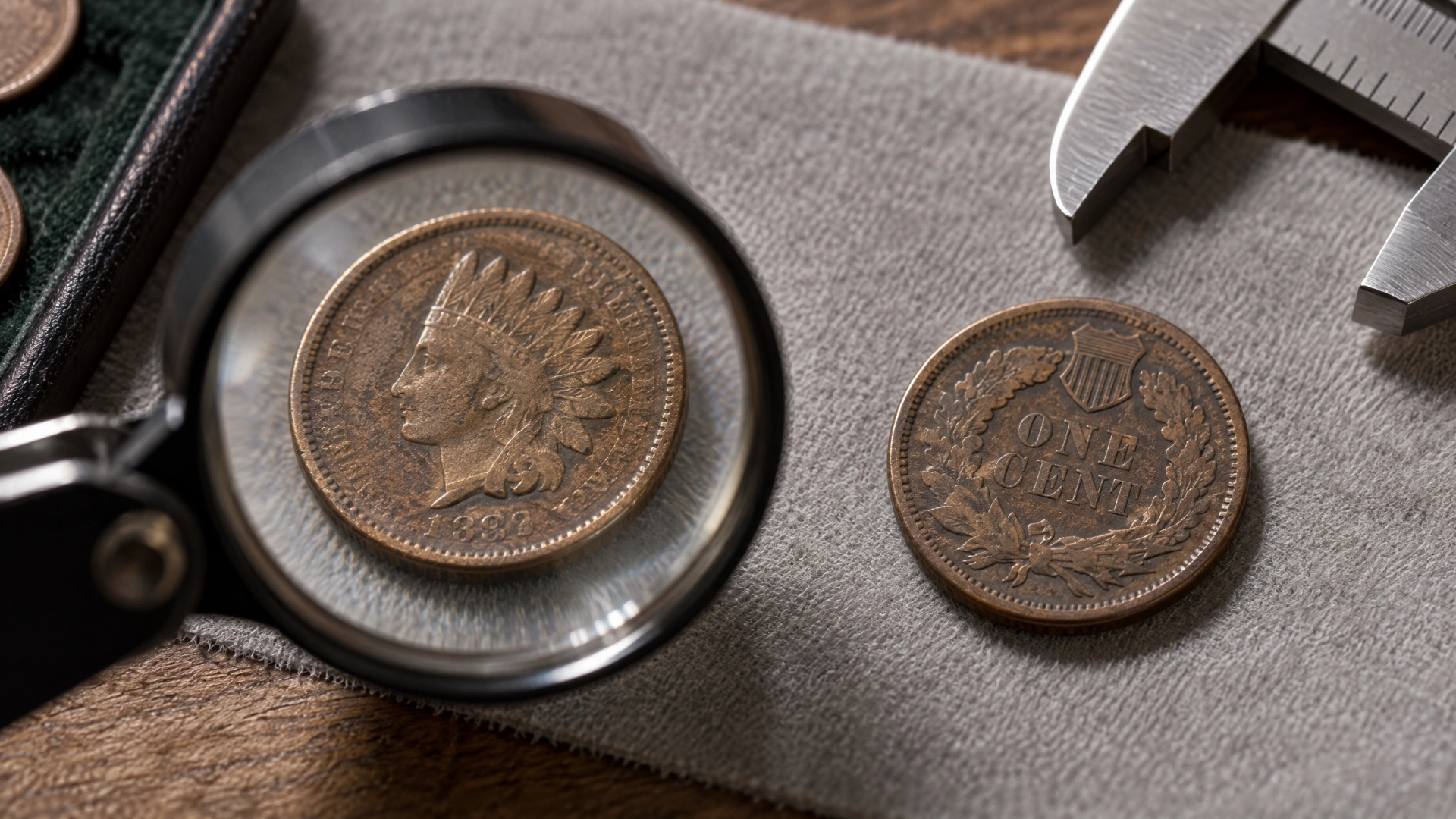
One common way to fake an 1877 is to alter the last digit of a genuine cent of another date. In a 2007 PCGS article on altered 1877 cents, Mike Sargent writes that 1879 seems to be the date altered most frequently, with the final 9 reworked to resemble a 7.
Sargent points to three features of a business-strike 1877:
- The reverse lettering. On genuine business strikes, the bottom right of the N in ONE and the top left of the N in CENT are much weaker than the rest of the denomination. Other 1870s dates have strong letters there, so an altered coin usually fails this test.
- The shape of the 7s. On the genuine coin Sargent shows, both 7s have squared-off serifs; on the altered coin beside it, the bottom of the second 7's serif is not squared off.
- The date area. Altered coins often show tooling marks where metal was moved around the last digit.
Outright counterfeits exist too. NGC lists the 1877 among the cents commonly seen faked or altered and, examining a counterfeit 1875 cent, describes faults struck counterfeits often show: a misshapen date, weak lettering around the rim, a soft strike and odd raised areas in the design. That is why a key date is worth having authenticated by PCGS or NGC before money changes hands.
Color and grade on a copper coin
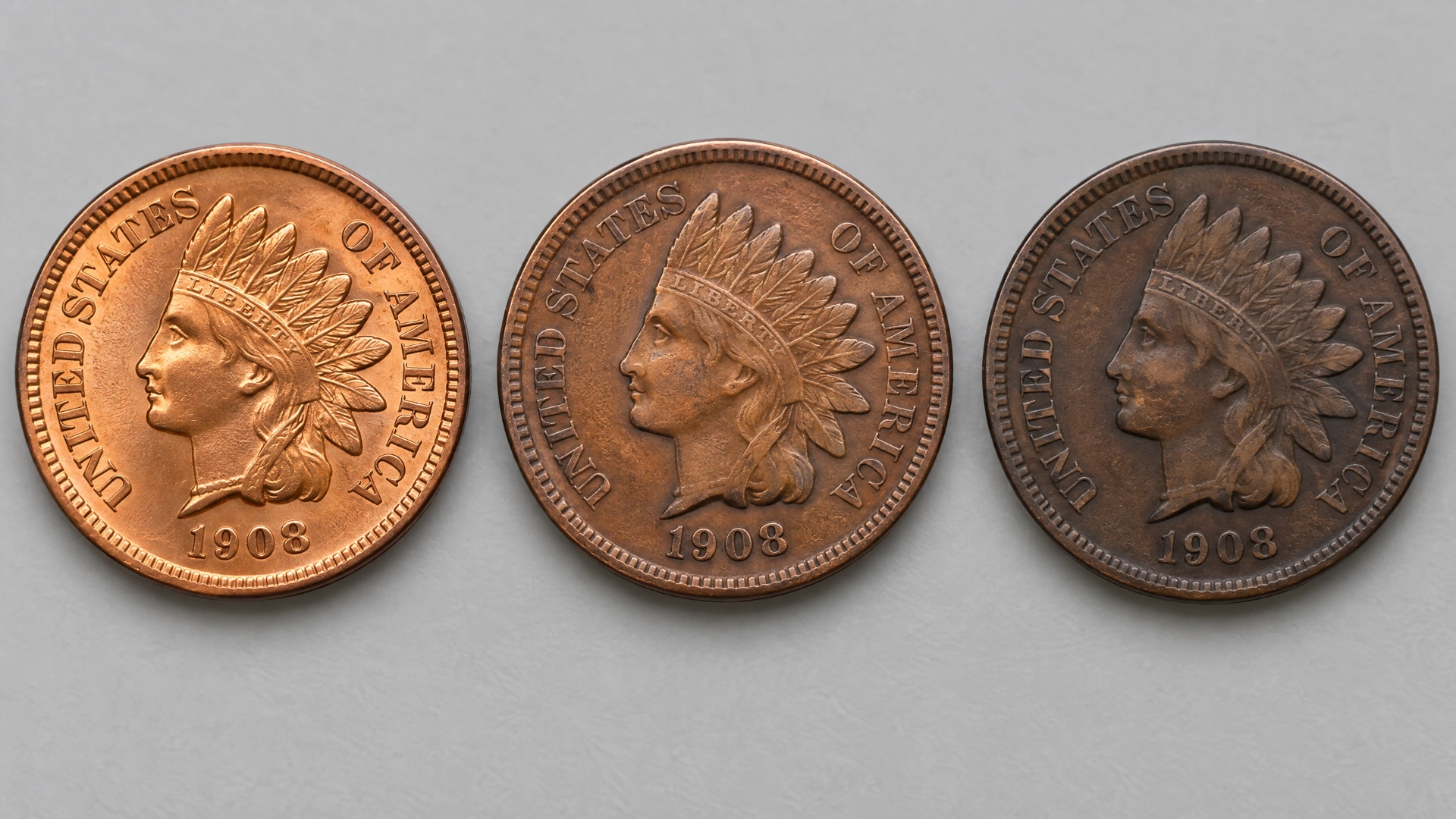
Color is part of a bronze cent's grade, because copper reacts with air and darkens over time. PCGS assigns one of three color designations, which McMorrow-Hernandez sets out in a PCGS article on RD, RB and BN designations:
- RD (Red): 95% or more of the original mint red color, on coins grading MS60 or better.
- RB (Red-Brown): between 5% and 95% of the original red, on coins grading MS60 or better.
- BN (Brown): less than 5% of the original red.
McMorrow-Hernandez notes that red examples are much scarcer among vintage copper and that color affects pricing. That is also why cleaning an Indian Head cent is the costly mistake. A cleaned coin loses its original surface, and no polish puts back mint red. Storage matters for the same reason; Storing Antique Coins covers keeping older coins away from moisture.
A grade itself is a professional opinion, not a measurement. A coin "graded MS-64 RB by PCGS" carries that service's opinion on that day, and the same coin can be graded differently elsewhere.
How Indian Head penny value is actually set
An Indian Head cent's value is set by recent sales of coins of the same date, variety, grade and color, not by its age. That is why this guide does not print a figure: a number without all of those attached describes no real coin.
The usual references are a grading service's price guide, recent auction records and a dealer's current offers, each read with the date it was recorded. Our guide on how to research a coin's value walks through each one and what it measures. For the key dates, it is also worth knowing how many examples the services have graded at each level; what a population report tells you explains how to read those counts without over-reading them.
Bringing Indian Head cents to Copper State
A mixed lot of Indian Head cents sorts quickly with the type table above: copper-nickel dates from 1859 to 1864, then bronze, and only two dates with an S. Any 1877, 1908-S or 1909-S in the pile, and any 1864 with an L, deserves a separate look under magnification. Copper State Coin & Bullion offers sellers a complimentary appraisal, so a lot like that can be looked over before you decide anything, and our Sell to Us page lists what the shop buys.
A collector still chasing an 1873 Doubled LIBERTY or an 1888/7 can send the shop a want list, and the team will let you know once an item on it is located. Our want list guide covers what to ask about fees, deposits and how long a list stays active. The shop's online rare US coins listings are another place to look.


This article is educational and reflects general information about precious metals and collectible coins. It is not investment, tax or legal advice, and Copper State Coin & Bullion is not a registered investment adviser, broker-dealer or tax professional. Metal prices fluctuate and past performance does not indicate future results. Consult a qualified professional about your own situation.
Frequently asked questions
What makes the 1877 Indian Head penny a key date?
Its mintage and its survival. PCGS lists a mintage of 852,500, and Jaime Hernandez notes on the same page that only the 1909-S is lower; he argues the 1877 survives in smaller numbers than the 1909-S because few people collected cents that year. What any one 1877 is worth still depends on its grade, color and authenticity.
How can I tell if my 1877 Indian Head cent is real?
Start with the reverse. Mike Sargent, writing for PCGS, notes that genuine business strikes show weak spots on the N in ONE and the N in CENT, where other 1870s dates are strong. He also points to the shape of the 7s and to tooling around the date on altered coins, most often 1879s in his account. A key date is still worth authenticating with PCGS or NGC.
Which Indian Head cents have a mint mark?
Only two: the 1908-S and the 1909-S, both struck in San Francisco. Joshua McMorrow-Hernandez, writing for PCGS, calls the 1908-S the first circulating one-cent coin struck at that mint, and Jaime Hernandez notes the 1909-S has the lowest circulation-strike mintage in the series, at 309,000. Every other Indian Head cent was struck in Philadelphia and carries no mint mark.
What does the L on an 1864 Indian Head cent mean?
It is the initial of the designer, James Barton Longacre, added to the ribbon on the obverse late in 1864, according to David Hall on PCGS CoinFacts. Hall notes that 1864 cents with the L have a pointed bust, while those without it have a rounded bust, and calls the 1864-L scarce in circulated grades and very scarce in mint state.
Are Indian Head pennies made of copper?
Mostly copper, in two different alloys. Cents dated 1859 to 1864 were first struck in 88% copper and 12% nickel, and from 1864 the coin changed to bronze, 95% copper with 5% tin and zinc, at a lighter 3.11 grams. Coins dated 1864 exist in both alloys, so the 1864 date alone does not tell you which one you have.
Should I clean an old Indian Head cent before selling it?
No. Cleaning removes a copper coin's original surface and its color, and neither can be put back. Original color is part of how a bronze cent is graded, with PCGS using red, red-brown and brown designations. Handle coins by the edges and bring them in as they are.
Indian Head cents at our Peoria and Phoenix counters
Both stores are open six days a week, including Saturdays. Bring your Indian Head cents in as they are, sorted or not.
Peoria
Copper State Coin & Bullion
8360 W. Thunderbird Road C#103
Peoria, AZ 85381
(623) 432-3953
Mon-Fri 9:00-17:00, Sat 9:00-16:00, Sun closed
Phoenix
Copper State Coin & Bullion
4550 E Bell Road Suite 188
Phoenix, AZ 85032
(602) 377-1944
Mon-Fri 9:00-17:00, Sat 9:00-16:00, Sun closed