A Kennedy half dollar dated 1964 is 90% silver and was struck with 0.3617 troy ounces of silver. Halves dated 1965 through 1970 are 40% silver, with 0.1479 ounces, and circulating halves dated 1971 or later contain no silver at all. A few later collector issues were struck in silver, and a handful of 1964 coins and varieties have sold for far more than their metal, which is where the date, the finish and the grade start to matter.
Kennedy half dollar silver content by date
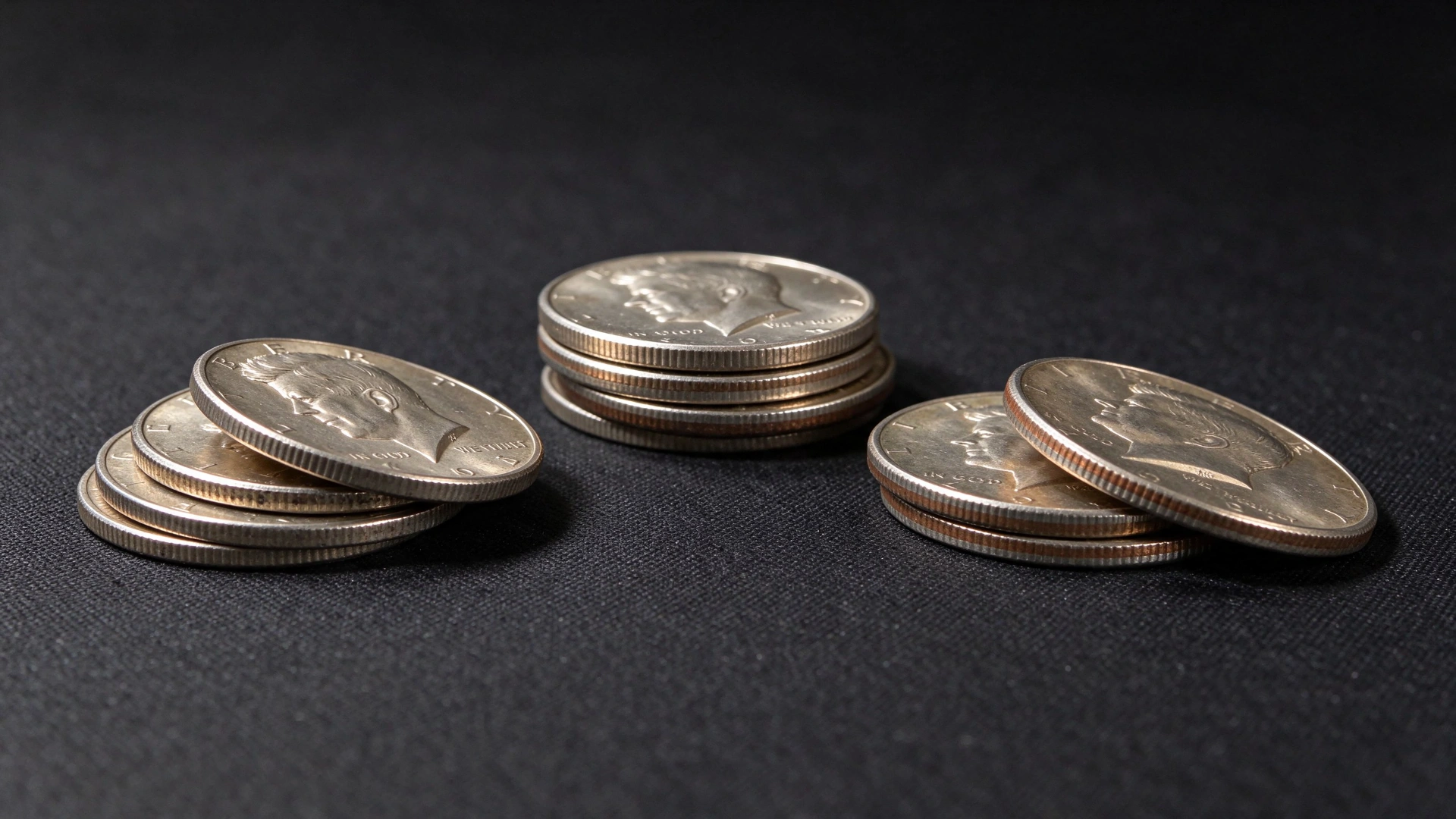
The date on a Kennedy half tells you its alloy, because the composition changed twice in seven years. These are the three compositions used for circulating halves.
| Dates | Composition | Weight | Silver per coin |
|---|---|---|---|
| 1964 | 90% silver, 10% copper | 12.50 g | 0.3617 troy oz |
| 1965-1970 | 40% silver clad: outer layers of 80% silver over a core of about 21% silver | 11.50 g | 0.1479 troy oz |
| 1971 to date (circulating) | Copper-nickel clad on a copper core, 8.33% nickel overall | 11.34 g | None |
The 40% composition is set out in the Coinage Act of 1965 and described in the U.S. Mint's December 1965 press release announcing the first strikes. The current copper-nickel specification is on the Mint's half dollar page. The Act itself sets the 40% half at 11.5 grams containing 4.6 grams of silver, which is 0.1479 troy ounces. The 1964 figure is 12.5 grams at 90% silver, as Greysheet's catalog lists it, which is 11.25 grams of silver or 0.3617 troy ounces.
1964: the one 90% silver year
The 1964 Kennedy half is the only one made in 90% silver for circulation. President Kennedy was assassinated on 22 November 1963, and on 30 December 1963 President Johnson signed the law directing the Mint to produce a new half dollar bearing Kennedy's likeness.
To save time, Chief Engraver Gilroy Roberts and assistant engraver Frank Gasparro adapted designs they had already made for a Kennedy medal, and the Treasury first offered the coins to the public on 24 March 1964, according to the National Park Service. The reverse, by Gasparro, is based on the Presidential Coat of Arms.
The 1964 date also outlived 1964. The Mint's December 1965 release says some 390 million 90% silver Kennedy halves made during 1964 and 1965 all bear the date 1964, so a 1964 date does not mean a coin was struck that year.
The 1964 proofs are a separate group of 3,950,762 coins, the mintage Greysheet lists, and among them is the Accented Hair variety, which shows extra lines in the hair just below the part and a weak or broken lower-left serif on the I in LIBERTY.
The 40% silver halves of 1965-1970
From 1965 the half dropped to 40% silver. The Coinage Act of 1965, signed on 23 July 1965, took silver out of the dime and quarter and kept a reduced amount in the half: outer layers of 80% silver bonded to a core of about 21% silver, for 40% overall. The Mint said the new coin would look nearly identical to the 90% half.
The 1965 law also suspended mint marks, so halves dated 1965, 1966 and 1967 carry none. Mint marks were back for 1968, and the non-proof halves of 1968, 1969 and 1970 were struck only at Denver, according to PCGS.
The 1970-D is the odd one out. No half dollars were minted for circulation between December 1969 and February 1971, per the Mint's 1971 press release, so the 2,150,000 Denver halves of 1970 went only into that year's uncirculated mint sets, as Numismatic News records. It is the only 1970 half made outside the proof sets, so any 1970 half with a D mint mark came from a mint set.
For readers who buy 40% halves by the roll, the face-value arithmetic is in our guide to bulk coin lots and rolls.
Copper-nickel halves since 1971, and the collector-only years
Every circulating Kennedy half from 1971 on is copper-nickel clad with no silver. Public Law 91-607 removed the 40% silver content, and the Denver Mint began striking the new copper-nickel halves on 3 February 1971.
Several later dates matter to collectors:
- Halves struck in 1975 and 1976 carry the Bicentennial double date 1776-1976 and Seth Huntington's Independence Hall reverse. The Mint also produced 40% silver versions for collectors, so a 1976-S half from a silver set is 40% silver like the 1965-1970 coins.
- In 1987 no halves were struck for circulation, one of two temporary hiatuses, with 1970, that PCGS notes before collector-only production began in 2002.
- From 2002 through 2020 halves were struck only for collectors. In 2021 the Mint struck them for circulation again, the first time since 2001, per PCGS.
- The Mint began issuing silver halves again for collectors in 1992, in the old 90% alloy. In 2019 it switched them to .999 fine silver, the first change to that composition since 1837, as NGC reported.
- The 2026 half carries a one-year Semiquincentennial design without Kennedy, covered in our article on the 2026 coins. The Circulating Collectible Coin Redesign Act requires the 2027-2030 halves to keep a likeness of Kennedy on an obverse designed to be distinguishable from the current one, with a Paralympic sport on each reverse.
So the Roberts portrait that began in 1964 ran through 2025, and from 2027 Kennedy returns on a redesigned obverse.
Telling a 90%, 40% and clad half apart
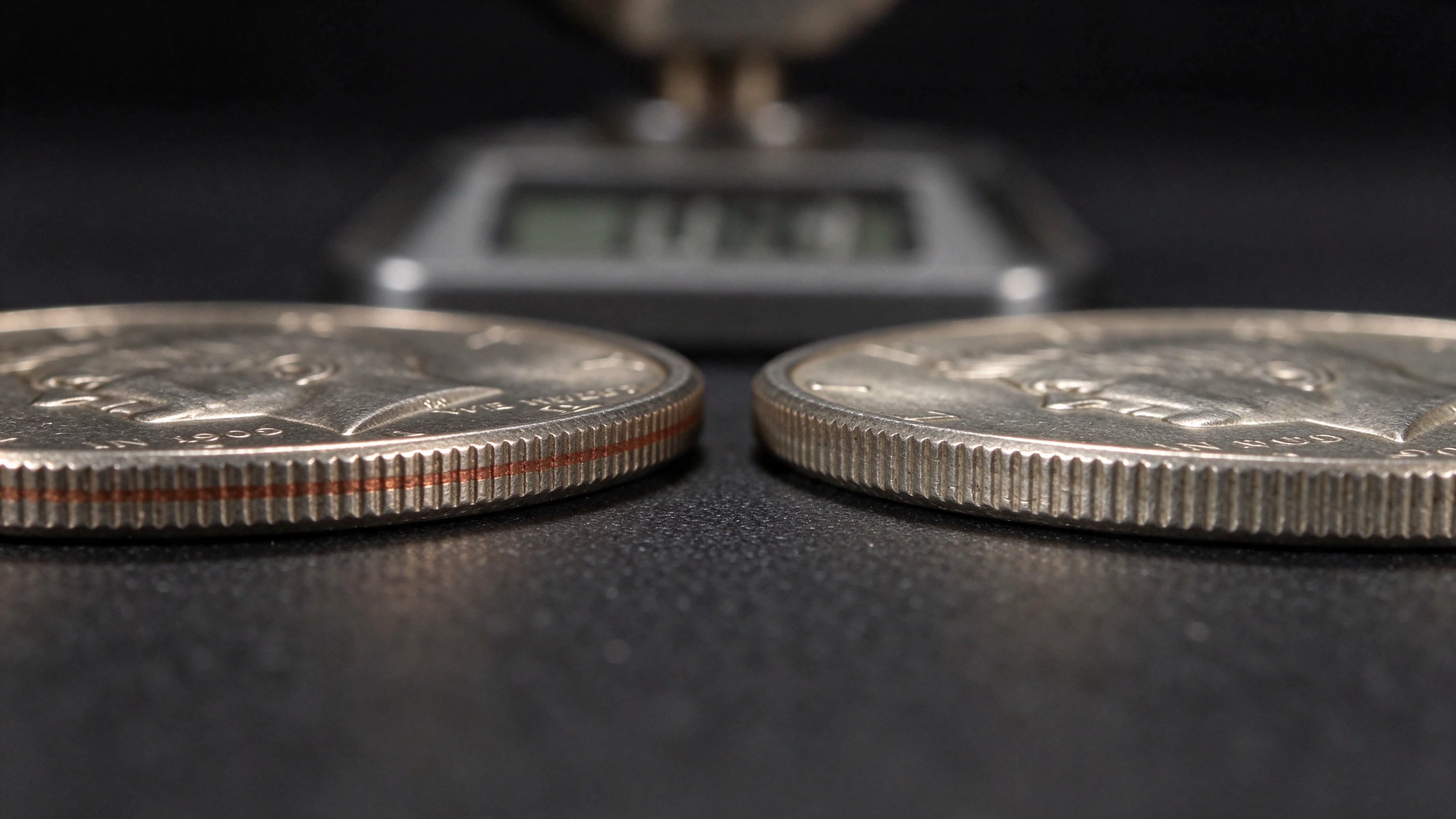
The date settles most cases: 1964 is 90%, 1965-1970 is 40%, and 1971 or later is clad unless it is a collector issue struck in precious metal, such as a coin from a silver proof set or a silver Bicentennial set, or the 1998-S Matte Finish. When a date is worn or a coin looks wrong, weight and the edge help.
A 1964 half weighs 12.50 grams, a full gram more than a 40% half at 11.50 grams, so any scale that reads to a tenth of a gram separates them. The 40% and clad halves are only 0.16 gram apart, at 11.50 and 11.34 grams, close enough that wear on a circulated 40% half can bring it down toward the clad weight, so the edge is the better check for that pair.
The edge sorts the clad coins out. A clad half from 1971 or later shows its copper core as a reddish band around the edge. A 40% half has a core that is itself about one-fifth silver, so it does not show that plain copper band, and a 1964 half is one silver alloy all the way through. Between a 40% half and a 1964 half, the scale is the surer test. The mint mark location and how it moved over the years are covered in our guide to mint marks.
What Kennedy halves sell for
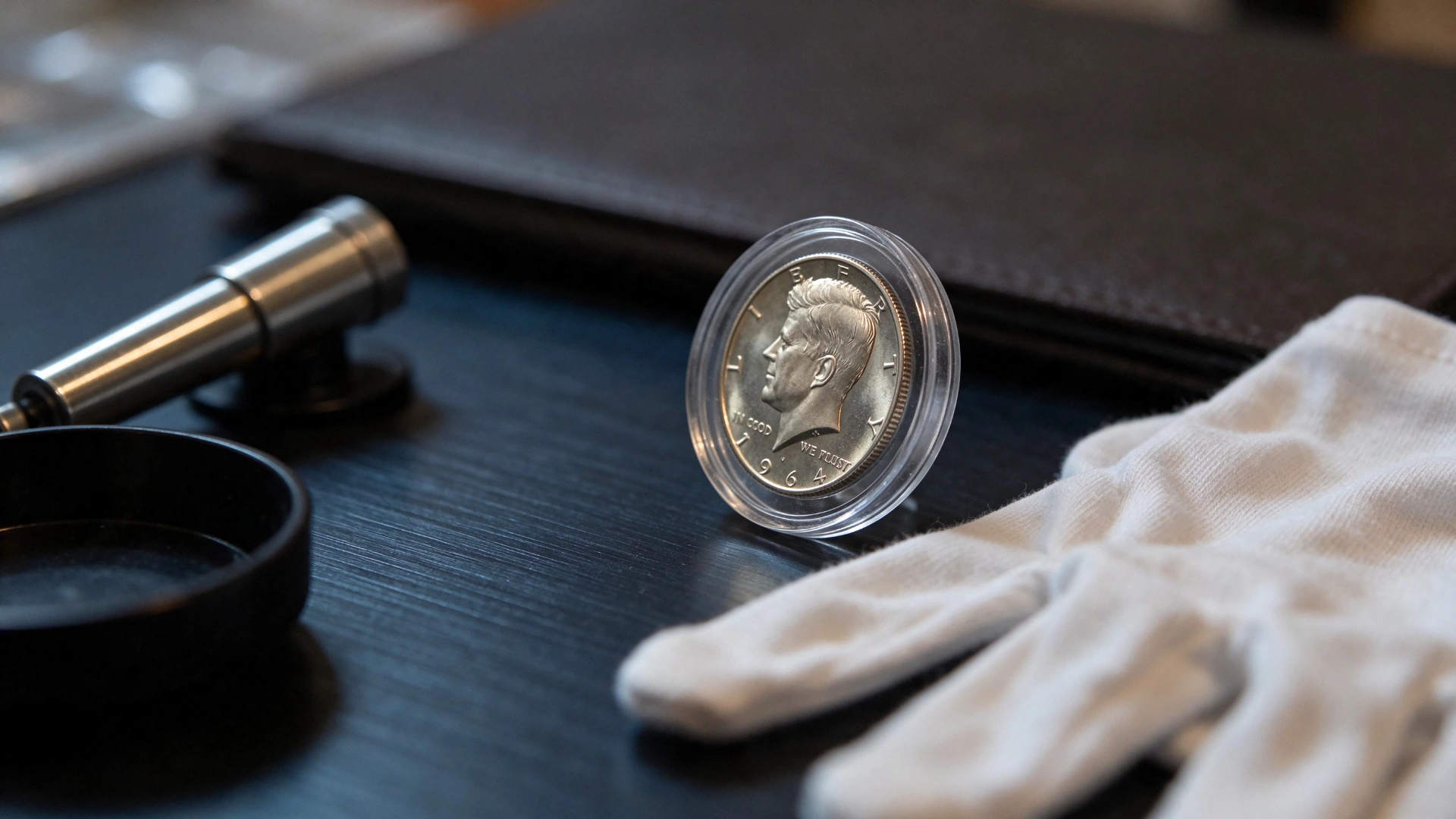
For circulated common-date 1964 and 40% halves, the silver content is the starting point for any price. Melt value is the coin's silver content times the day's spot price: 0.3617 times spot for a 1964 half, 0.1479 times spot for a 1965-1970 half. Our live spot silver page has the current figure, and coin melt value explained walks through the calculation.
Clad halves from 1971 on have no precious-metal value. Anything they bring above 50 cents comes from the coin rather than the metal, such as condition, a proof finish, a date struck only for collectors, certification or an error, and is judged coin by coin.
A few Kennedy halves have sold for far more than their silver. These are past auction results, not price quotes, and every grade below is the opinion of the grading service named.
- The 1964 SMS-finish half has the finish seen on the 1965-1967 Special Mint Set coins, although, as Coin World notes, no U.S. Mint records document any official SMS sets struck in 1964. Coin World describes it as one of around a dozen known. One graded SP67 SMS by PCGS sold for $108,000 at Heritage on 25 April 2019. Another, graded SP68 by PCGS, sold for $156,000 at Stack's Bowers in August 2019.
- On the 1964 Accented Hair proof, grade drives the price. Greysheet's auction records show one graded PR65 by PCGS selling for $64 at Heritage on 30 June 2026, while one graded PR69 by NGC brought $840 at Stack's Bowers on 25 March 2026. Those are the lowest PR65 and the highest PR69 prices among the 2026 sales Greysheet lists for those two grades and services.
- The 1998-S Matte Finish half, in 90% silver, was sold only in the 1998 Kennedy Collector's Set with an uncirculated Robert F. Kennedy silver dollar. PCGS lists a mintage of 62,000, though Ron Guth notes that sources give figures from 62,000 to 64,000. Greysheet's records show examples graded SP70 by PCGS at $293 (Heritage, 28 July 2026) and $171 (Heritage, 18 August 2026).
Two SP70 coins selling three weeks apart for $293 and $171 is a fair picture of how wide the range can be even within one grade. A grade, a date and a sale date belong together; a price quoted without them says very little.
Finding and selling Kennedy halves through Copper State
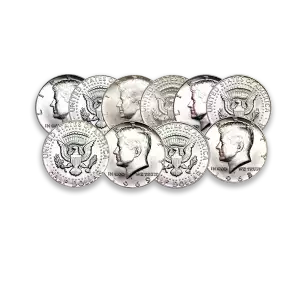
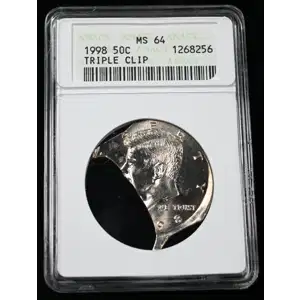
The Kennedy halves in our online catalog on 21 November 2026 were a bullion listing of 40% silver halves dated 1965-1969 and one error coin, a 1998 half graded MS64 by ANACS with a triple clipped planchet.
If you are hunting a specific coin, such as a 1970-D, a silver proof or a 1998-S Matte Finish, our want list service lets you name it and hear from us when we locate one. If you are selling, appraisals for sellers are complimentary, and our sell to us page explains how to start.
This article is educational and reflects general information about precious metals and collectible coins. It is not investment, tax or legal advice, and Copper State Coin & Bullion is not a registered investment adviser, broker-dealer or tax professional. Metal prices fluctuate and past performance does not indicate future results. Consult a qualified professional about your own situation.
Frequently asked questions
Is a 1964 Kennedy half dollar silver?
Yes. Every 1964 Kennedy half was struck in 90% silver and 10% copper and weighs 12.50 grams, which works out to 0.3617 troy ounces of silver. That includes the 1964 and 1964-D business strikes and the 1964 proofs. It is the only year the Kennedy half was made in 90% silver for circulation.
How much is a 1964 Kennedy half dollar worth?
A circulated 1964 half was struck with 0.3617 troy ounces of silver, so its melt value is 0.3617 times the day's spot silver price. Proofs, SMS-finish coins and high-grade examples are priced by grade instead. The 1964 SMS-finish halves, which Coin World describes as around a dozen known, have sold for six figures, including $156,000 for one graded SP68 by PCGS at Stack's Bowers in August 2019.
Are 1965 to 1969 Kennedy halves silver?
Yes, they are 40% silver. Kennedy halves dated 1965 through 1970 have outer layers of 80% silver over a core of about 21% silver, for 40% overall. Each weighs 11.50 grams and was struck with 0.1479 troy ounces of silver, about 41% of the silver in a 1964 half.
How much is a 1971 half dollar worth?
A 1971 Kennedy half is copper-nickel clad and contains no silver; 1971 was the first year of that composition. A circulated example is generally a 50-cent coin. Any value above face comes from exceptional condition, the proof finish of a coin from a 1971 proof set, certification by a grading service or a mint error, and is judged one coin at a time.
Which Kennedy half dollars are worth the most?
Of the sales cited here, the 1964 SMS-finish halves brought the most. Coin World describes around a dozen known. One graded SP67 by PCGS sold for $108,000 at Heritage in April 2019, and one graded SP68 by PCGS brought $156,000 at Stack's Bowers that August. Collectors also seek top-grade 1964 Accented Hair proofs, the 1998-S Matte Finish, the mint-set-only 1970-D and high-grade or error coins, each priced by grade.
Which Kennedy halves were not made for circulation?
Several dates were struck only for collectors. No halves were minted for circulation between December 1969 and February 1971, so the 2,150,000 Denver halves of 1970 went into that year's mint sets. None were made for circulation in 1987 or from 2002 through 2020, and the 1998-S Matte Finish was sold only in a set with a Robert F. Kennedy silver dollar.
Bringing Kennedy halves to Peoria or Phoenix
Bring a roll or a single Kennedy half to either store for a look at dates, finishes and grades.
Copper State Coin & Bullion - Peoria
8360 W. Thunderbird Road C#103
Peoria, AZ 85381
(623) 432-3953
Monday-Friday 9am-5pm, Saturday 9am-4pm, Sunday closed
Copper State Coin & Bullion - Phoenix
4550 E Bell Road Suite 188
Phoenix, AZ 85032
(602) 377-1944
Monday-Friday 9am-5pm, Saturday and Sunday closed