A bulk lot is priced on what can be verified about it, not on what might be inside it. That single sentence explains almost every price you will see on rolls, bags and mixed lots: silver coins are priced off their metal content, scrap and foreign coins off their weight, and collectible material coin by coin. Anything sold on the strength of what could be in there is being priced on hope, and hope is the part the buyer pays for.
This guide covers what a roll actually contains, how the three pricing bases work, what the word "unsearched" can and cannot mean, and where buying in bulk makes sense for a collection.
What a roll actually is
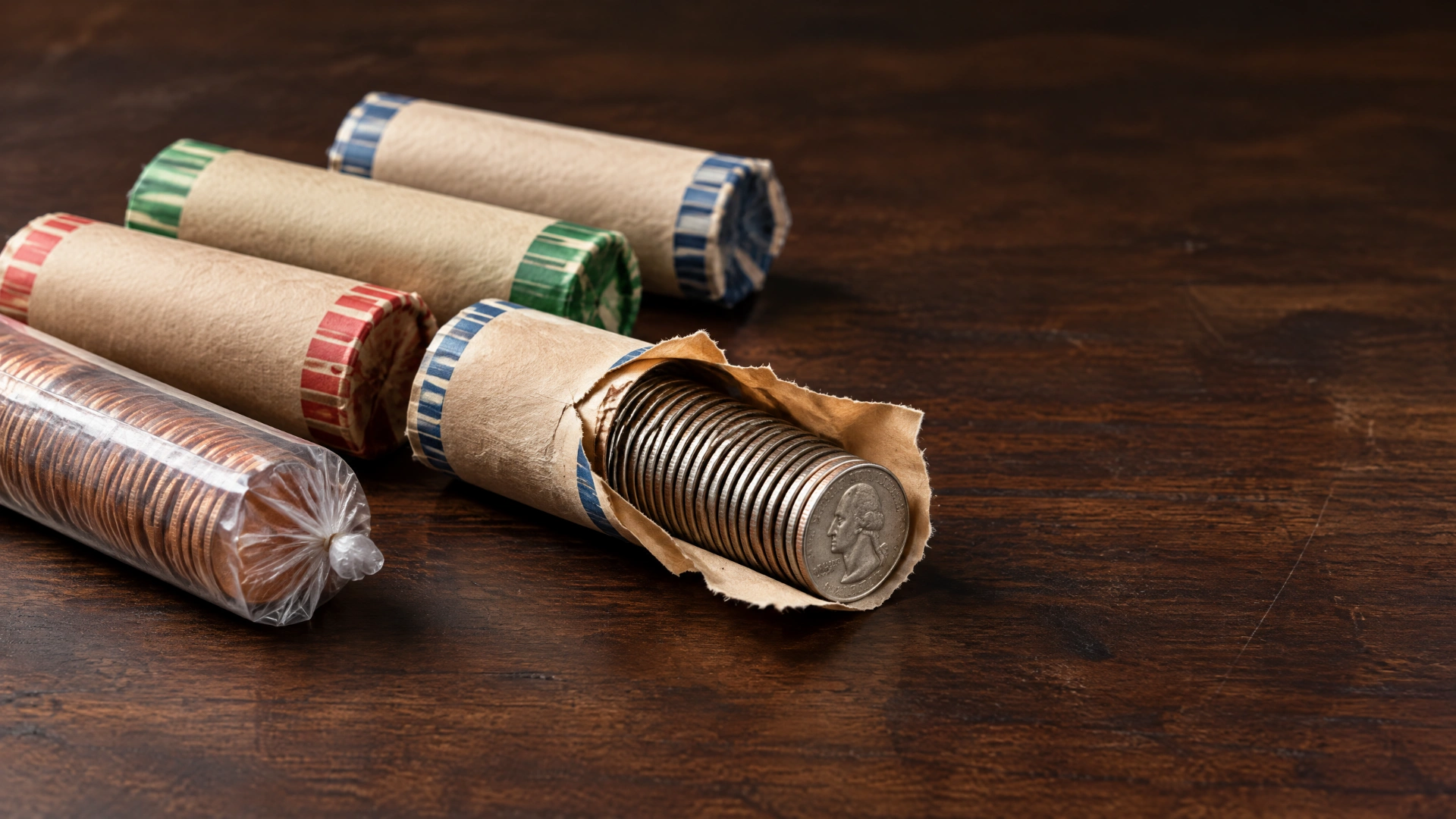
A roll is a fixed count of one denomination in a paper or plastic wrapper. The counts are standard across banks and dealers, and they are worth committing to memory because every bulk price you see is quoted against them.
| Denomination | Coins per roll | Face value |
|---|---|---|
| Cent | 50 | $0.50 |
| Nickel | 40 | $2.00 |
| Dime | 50 | $5.00 |
| Quarter | 40 | $10.00 |
| Half dollar | 20 | $10.00 |
| Small dollar | 25 | $25.00 |
The quarter count is confirmed by the United States Mint, which sells circulating-quality quarters in two-roll sets at 40 coins per roll alongside 100-coin and 1,000-coin bags. Bulk coin also moves in larger units: the Federal Reserve publishes standard bag amounts by dollar value — $50 in cents, $200 in nickels, $1,000 in dimes, quarters or halves, and $2,000 in small dollars.
Who did the wrapping matters more than the wrapper looks like it should:
- Original mint-wrapped. Machine-wrapped at the Mint or by a Federal Reserve contractor, never opened. The crimp is uniform and the paper is unbranded or carries the wrapping house's mark.
- Bank-wrapped. Wrapped by a bank's counting machine from coin that has already circulated. Standard count, no claim about contents.
- Hand-wrapped. Rolled by a person, at some point, for some reason. Hand-crimped ends are easy to spot and easy to fake, and a hand-wrapped roll tells you nothing about its history.
Silver rolls, and the arithmetic behind them
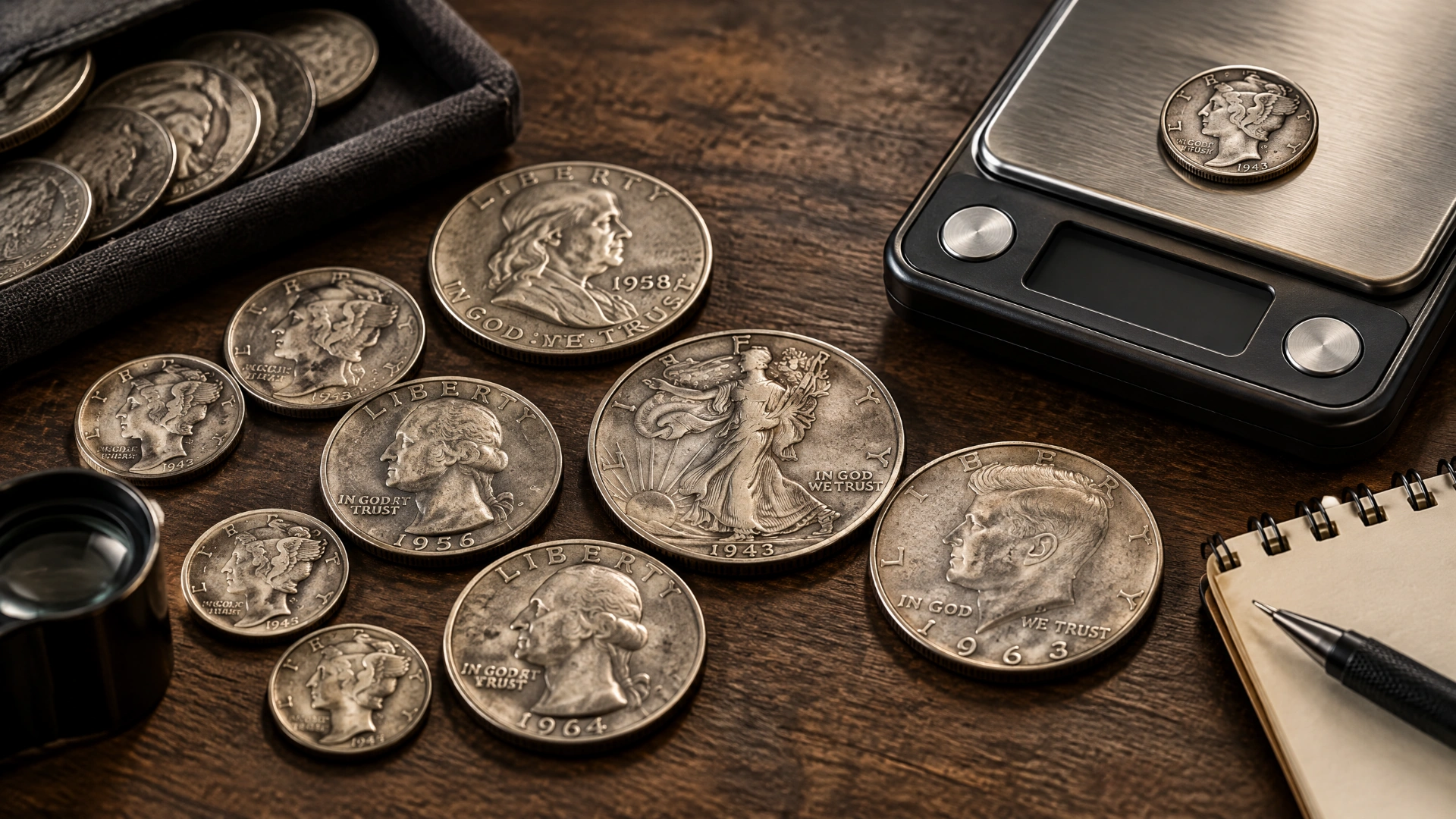
The most traded bulk lots in the United States are pre-1965 dimes, quarters and half dollars, because they contain real silver.
The standard comes from the Coinage Act of 1873. Section 13 set the fineness of United States silver coin at nine hundred parts pure metal to one hundred parts alloy, and Section 15 fixed the half dollar at twelve and a half grams, with the quarter dollar and dime at proportionate weights. That gives 25 grams of coin for every dollar of face value, of which 22.5 grams is silver — about 0.7234 troy ounces as struck. The trade generally works from a slightly lower figure for circulated coin, because decades of handling wear metal away.
Two later changes matter just as much when you are sorting a lot:
- 1964 is the cut-off for 90% silver. The Coinage Act of 1965 replaced the silver dime and quarter with copper-nickel clad coins weighing 2.268 and 5.67 grams respectively.
- 1965–1970 half dollars are still partly silver. The same 1965 Act specified a half dollar with a cladding of 800 parts silver to 200 parts copper over a silver-and-copper core, "such that the whole coin weighs 11.5 grams and contains 4.6 grams of silver and 6.9 grams of copper" — 40 percent silver overall, which is where the trade's shorthand comes from. Circulating half dollars from 1971 onward are copper-nickel clad.
Two exceptions are worth knowing before you sort on dates alone, because both are silver and neither was struck for circulation. The Mint records that Congress mandated at least 45 million numismatic Bicentennial coins struck in 40 percent silver, in quarter, half dollar and dollar denominations. And the Mint's annual silver proof sets have long contained silver dimes, quarters and half dollars — the 2019 set was the first at .999 fine, the earlier ones being 90 percent. Neither turns up in a bank-wrapped roll, but both turn up in estate material and mixed collector lots.
With those exceptions noted, the dates and weights above do most of the sorting work on a mixed bag of junk silver. For how content is turned into a melt figure and how melt relates to what a dealer pays, see our article on coin melt value.
The three ways a bulk lot gets priced
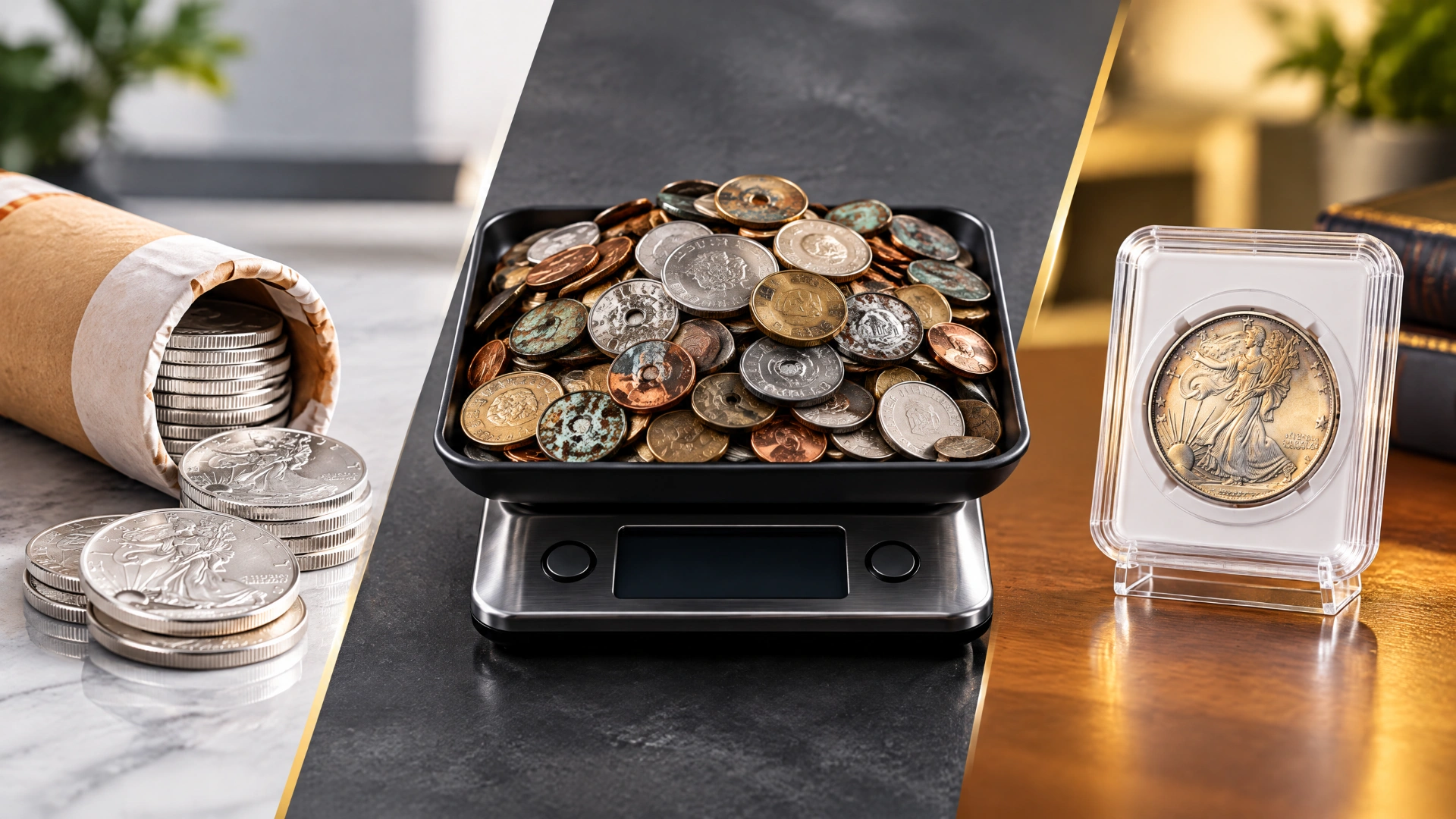
A bulk lot is priced on one of three bases, and which one applies depends on what can be verified about the contents without opening and sorting everything first.
| Basis | Used for | What the buyer is paying for |
|---|---|---|
| Face value multiplier | Pre-1965 US silver, 40% halves | Silver content, which is known exactly from the date and denomination |
| Weight | Scrap, world coins, unsorted accumulations | Metal recovered, less the cost of sorting and refining |
| Per coin | Collectible material, graded coins, key dates | The individual coin, on its own date, mintmark and condition |
A lot that mixes all three gets priced on the lowest basis that covers it, and that is not a dealer being difficult — it is the only defensible way to price an unknown. Sorting a bag takes hours of someone's time, the contents cannot be confirmed until that work is done, and anything genuinely collectible in there is a bonus that nobody could have guaranteed in advance. That is precisely why bulk sells below the sum of its best-case parts. Our overview of bullion versus numismatic value goes into how the two bases differ.
"Unsearched" — what the word can and cannot mean
"Unsearched" is a claim about history, not about contents. At best it means the seller has not gone through the lot. It cannot mean that nobody ever has, because no one can verify a negative about coins that have passed through banks, wholesalers, estate buyers and previous owners over several decades.
So treat it as a provenance statement and ask provenance questions:
- Who wrapped it, and when? An original mint-wrapped roll with an intact machine crimp is a documented thing. A hand-crimped roll is not.
- Where did it come from — a bank order, an estate, a wholesale purchase, a previous collector?
- Is the lot priced as if it were plain metal or plain face value? If so, the "unsearched" description is not doing any work in the price, which is the honest arrangement.
- Is the price above the metal or face value it can be verified to contain? If it is, you are paying for the possibility, and possibility is exactly what cannot be returned.
The straightforward test: work out what the lot is worth on its verifiable basis — face value for silver, weight for scrap — and compare that with the asking price. Everything above that number is the seller's confidence, priced and sold to you.
What a bulk lot typically looks like when you open it
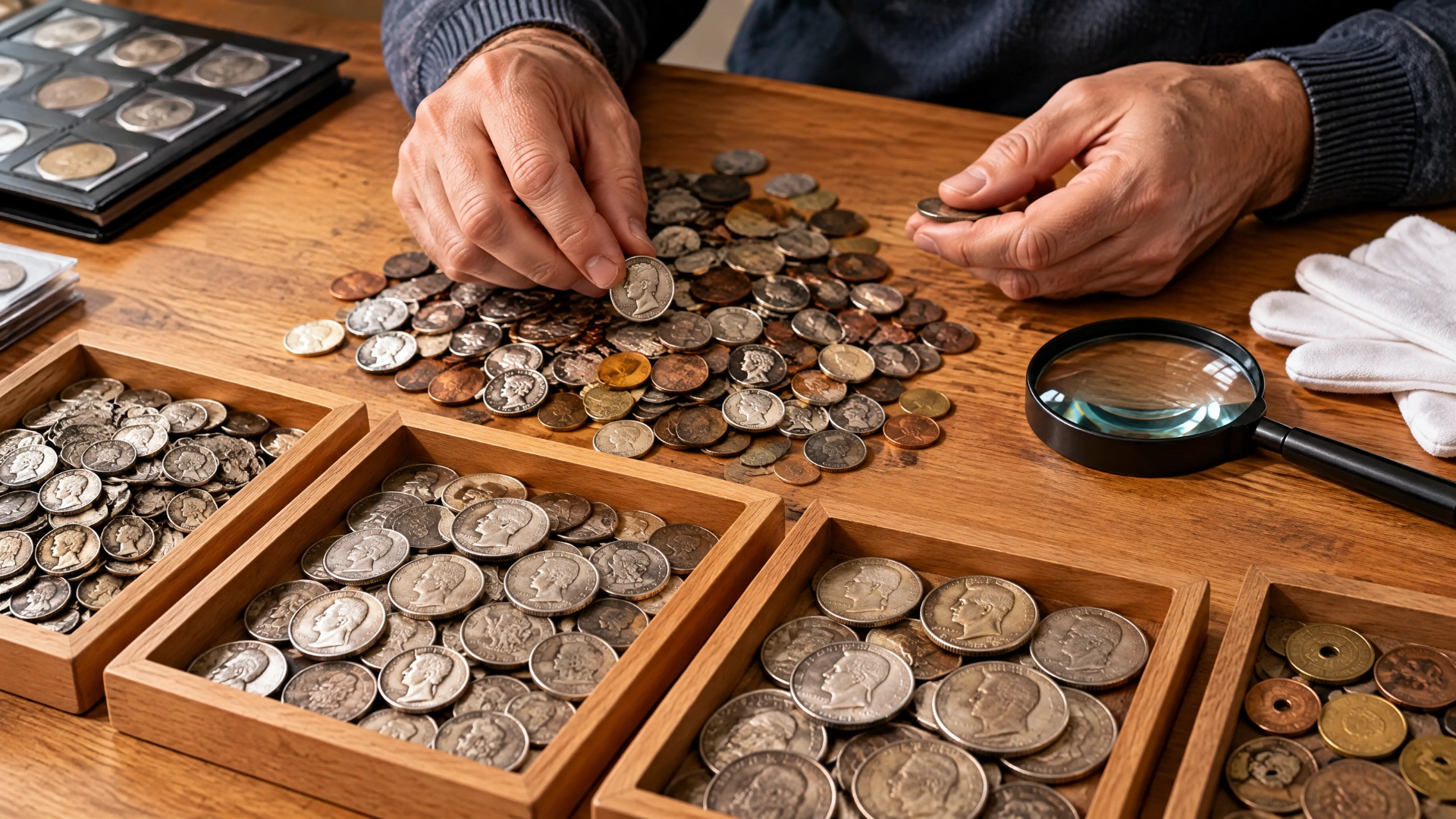
Circulated bulk is, by definition, what stayed in circulation. Expect heavy wear, common dates, a spread of mintmarks weighted toward whichever mint served the region, cleaned and damaged pieces mixed in, and the occasional foreign coin that slipped into a till decades ago. That distribution is not a disappointment; it is the reason the lot is affordable.
Condition language is worth keeping straight while you sort. Grading is an opinion rendered by a grading service on an individual coin, which is why a lot is never sold as a grade. A roll described by a range of grades is describing the seller's impression, not a certification.
Where bulk makes sense, and where it does not
Bulk lots do three things well. They are an efficient way to acquire silver by content rather than by premium. They fill the common slots in a type or date set at a fraction of the cost of buying those coins individually. And for collectors who enjoy the sorting itself, the process is a large part of the point.
They do other things poorly. If you need a specific date and mintmark, buying bags in the hope of finding it is far more expensive than buying the coin. If you want certified material, bulk is the wrong department entirely. And if you are buying for silver content alone, a bag of worn 90% silver and a modern bullion coin are both priced off the same metal — the difference is the premium and the divisibility, not the silver.
For a specific coin, a want list is the cheaper route: you tell us what you are looking for and we source against it as material comes in.
One Arizona note
Arizona's dealer rules sit in A.R.S. Title 44, Chapter 11, and they apply to "precious items" — secondhand jewellery, flatware, holloware and certain stones and pearls. Section 44-1601 states that the term does not include coins, which on the face of the statute puts a bulk coin transaction and a scrap jewellery transaction under different rules at the same counter. That reading is not settled by any Arizona court decision or Attorney General opinion we could find, and § 44-1604 allows a city or county to impose stricter requirements on top. We set the chapter out in full, with those caveats, in our article on Arizona precious metals dealer law.
Bulk at Copper State
We keep a standing Bulk Items section, including common-date material, alongside the rare US coin, currency and bullion departments. Lots are priced on the basis that fits them, and we will tell you which basis we are using and why.
If you are selling a bulk lot, appraisal for sellers is complimentary; formal insurance appraisal documentation is a separate, chargeable service. If you are buying toward a set, ask about the want list. We have over 40 years of numismatic and bullion experience, submit coins to PCGS and NGC and notes to PMG, and are members of the Certified Coin Exchange and ICTA.
This article is educational and reflects general information about precious metals and collectible coins. It is not investment, tax or legal advice, and Copper State Coin & Bullion is not a registered investment adviser, broker-dealer or tax professional. Metal prices fluctuate and past performance does not indicate future results. Consult a qualified professional about your own situation.
Frequently asked questions
How many silver coins are in a roll?
The count is the same whether the coins are silver or clad: 50 dimes, 40 quarters or 20 half dollars to a roll. A roll of pre-1965 dimes and a roll of pre-1965 quarters therefore hold $5 and $10 of face value respectively, and the silver content follows directly from the face value rather than from the number of coins.
Are unsearched coin lots worth buying?
It depends entirely on the price. If the lot costs no more than its verifiable content — face value for silver, weight for scrap — you have bought metal and the sorting is a free pastime. If it costs more, you have paid for a possibility that cannot be confirmed before purchase or returned afterwards.
What is the difference between bulk coin lots and wholesale coin lots?
In practice the terms overlap. "Bulk" usually describes unsorted or lightly sorted material priced by weight or face value. "Wholesale" usually implies quantity pricing on material that has already been sorted into categories. Both are priced on the same three bases; the difference is how much sorting work has already been done.
Can I sell a bulk lot without sorting it first?
Yes, and many people do. A dealer will sort it, which takes time and is reflected in the price. Sorting it yourself first can mean a stronger number on the silver, but only if the sorting is accurate — mixed dates and 40% halves counted as 90% will be caught at the counter and will need re-quoting.
Do bulk lots contain rare coins?
Some do and most do not, and nobody can tell you in advance which is which without opening the lot. That uncertainty is what the discount to retail is compensating you for. Treat any find as an outcome rather than an expectation, and never pay a price that only makes sense if the find happens.
Come and look through a lot
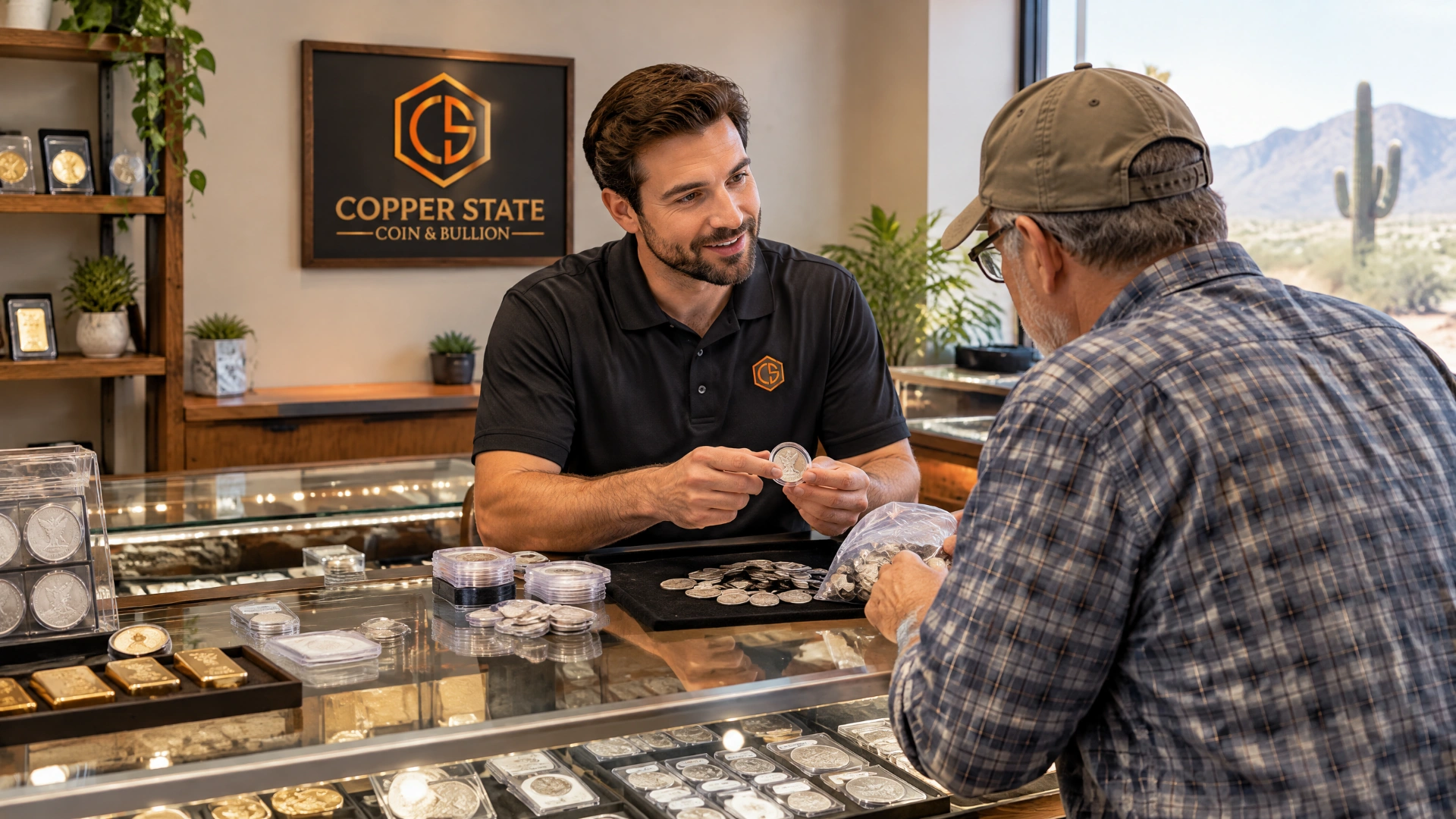
Bulk material is easier to judge in person than in a photograph. Call the store you plan to visit to check what bulk is on hand, and you are welcome to go through it at the counter.
Peoria
Copper State Coin & Bullion
8360 W. Thunderbird Road C#103
Peoria, AZ 85381
(623) 432-3953
Phoenix
Copper State Coin & Bullion
4550 E Bell Road Suite 188
Phoenix, AZ 85032
(602) 377-1944
Both locations: Monday–Friday 9:00–17:00 · Saturday 9:00–16:00 · Sunday closed
Browse bulk coins, rare US coins and paper money, or see what we are buying.