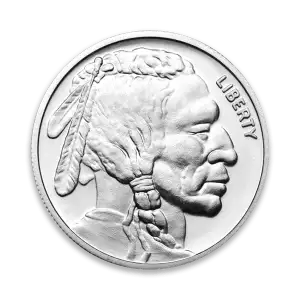
Buffalo nickel value comes down to four things: the date, the mint mark, whether the coin is a recognized die variety, and its condition. The complication is that this series wears in a way that removes the first of those four. The date sits on a raised surface and is usually the first device to disappear, which is why so many surviving Buffalo nickels cannot be identified by date at all. This guide covers the dates worth knowing, where the mint mark sits, and how to work with a coin whose date has gone.
Why the date wears off a Buffalo nickel
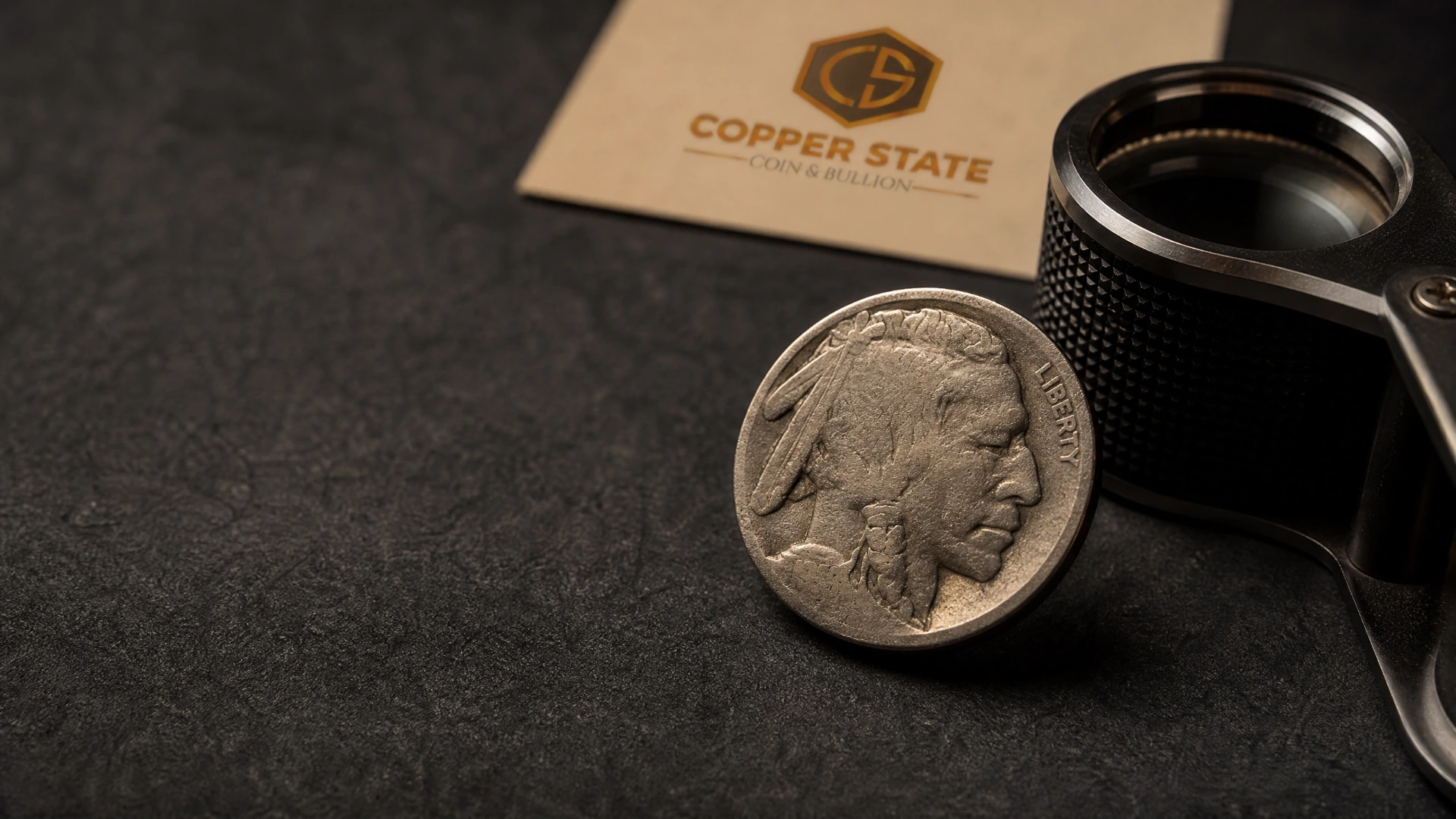
The date takes the friction of circulation before almost anything else because of where it sits. The obverse is the front of a coin and the reverse is the back; on this design the date is at the lower right of the obverse, standing proud of the field rather than protected in a recess. The practical result is a large surviving population of coins that are complete in every respect except the one thing that identifies them.
James Earle Fraser designed the coin, and the U.S. Mint struck it from 1913 to 1938 at 5.00 grams, 21.21 mm, plain edge, in an alloy of 25% nickel with the balance copper. That alloy is hard. According to PCGS, many branch-mint strikings from the 1910s and 1920s came out soft, with mushy detail even on coins that never circulated — which means a weak-looking Buffalo nickel is not automatically a worn one.
Type 1 and Type 2: the 1913 reverse change
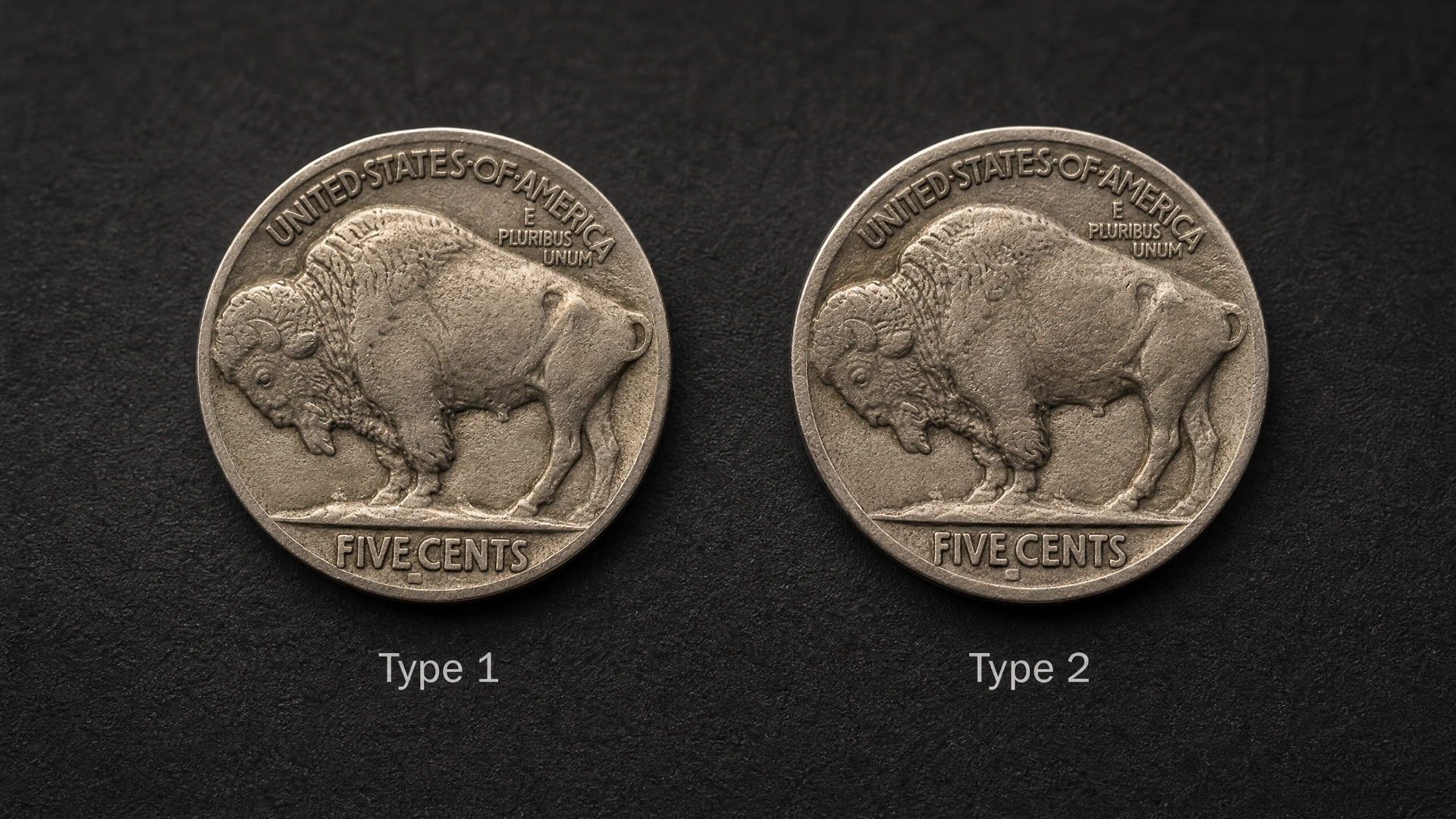
Buffalo nickels exist in two reverse types, and only the 1913 issues exist in both. PCGS describes the original Type 1 reverse as showing the bison standing on a raised mound with FIVE CENTS in raised lettering. The denomination sat on the highest point of the design and began wearing away almost immediately, so the Mint revised the reverse in the spring of 1913: the bison stands on a flat plain and FIVE CENTS sits in a recess below it, protected from wear.
Every issue from 1914 through 1938 uses the Type 2 reverse. The obverse date, however, was never redesigned, and stayed raised for the whole run — the Mint fixed the denomination and left the date exposed.
| Type 1 (1913 only) | Type 2 (1913–1938) | |
|---|---|---|
| Bison stands on | A raised mound | A flat plain |
| FIVE CENTS | Raised lettering | Recessed below the line |
| Mint mark position | Below FIVE CENTS | Below FIVE CENTS, lower on the coin |
| Issued | Early 1913 | Spring 1913 onward |
Design details as described by PCGS, "Buffalo Nickel Facts Every Collector Should Know."
Where the mint mark sits, and what it tells you
The Buffalo nickel mint mark is on the reverse, below FIVE CENTS. A mint mark is the small letter identifying which facility struck the coin — D for Denver, S for San Francisco, and no letter at all for Philadelphia. We covered what mint marks mean across US coinage in more detail separately.
For this series the position matters for a specific reason. The mint mark is on the reverse and the date is on the obverse, so the two devices wear independently, and a coin can lose its date entirely and still show a legible S.
That narrows a dateless coin to one mint and, on a Type 1 reverse, to one year — but a Type 2 reverse leaves the rest of the 1913–1938 run open. It is a useful piece of information, not a solution.
What drives Buffalo nickel value: the four key dates
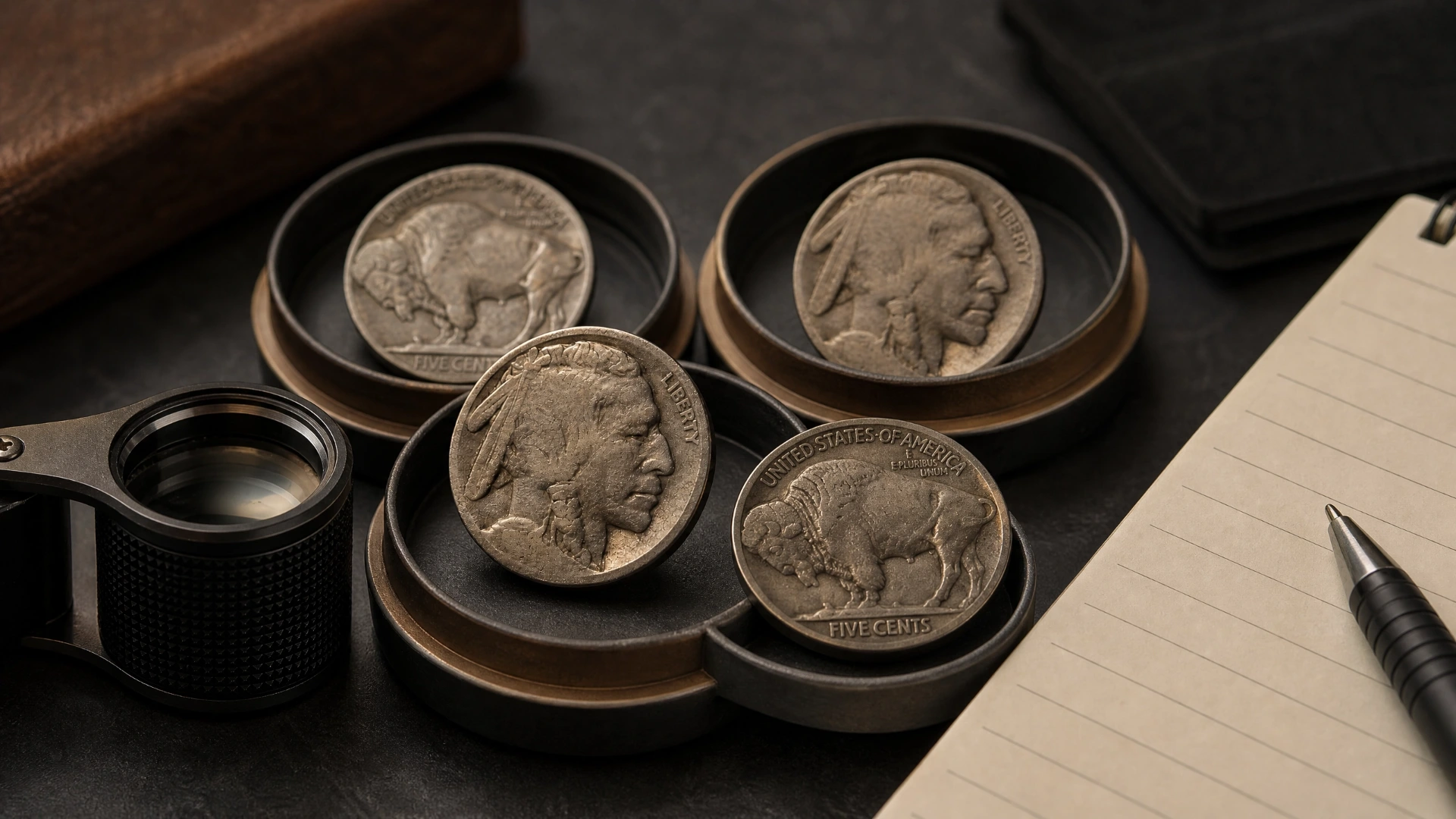
Four regular-issue Buffalo nickels carry the low mintages that drive the series. The figures below are the mintages and survival estimates published by PCGS CoinFacts, accessed 18 August 2026; survival estimates are the grading service's estimates, not counts.
| Date | Mintage | Est. surviving, all grades | Est. MS65 or better |
|---|---|---|---|
| 1913-S Type 2 | 1,209,000 | ~14,000 | ~250 |
| 1921-S | 1,557,000 | ~8,500 | ~120 |
| 1924-S | 1,437,000 | ~6,000 | ~60 |
| 1926-S | 970,000 | ~11,000 | ~20 |
The 1926-S has the lowest mintage of any regular issue in the series at 970,000 pieces. The PCGS CoinFacts entry for the 1926-S describes it as rare in lower circulated grades and very rare at VF20 or better, and its commentary calls it the rarest non-variety Buffalo nickel in Gem MS65 condition. Note what the table shows: mintage and scarcity are not the same measurement. The 1913-S Type 2 was struck in larger numbers and has more estimated survivors at every level, because first-year coins get saved and mid-run coins get spent.
The three varieties collectors chase
Three Buffalo nickel varieties are collected as issues in their own right alongside the regular dates, and each was created by a different kind of accident at the mint.
The 1916 Doubled Die Obverse. A doubled die is a die that received a misaligned second impression during its manufacture, so every coin struck from it carries the doubling. On this one the doubling shows on the date and on the chief's lips and chin, and PCGS describes it as visible to the naked eye. It came out of a Philadelphia mintage of 63,498,066 for 1916, and the PCGS CoinFacts entry estimates roughly 400 survivors across all grades, with about 10 at MS60 or better.
The 1918/7-D overdate. An overdate happens when a die from one year is repunched with the next year's date, leaving both visible. This one sat unnoticed until 1930 — twelve years after it was struck. PCGS estimates around 7,000 survivors from the full 1918-D mintage of 8,362,000, and notes a specific authentication point: all genuine examples have a mint mark that tilts to the left. In February 2024, a 1918/7-D graded MS65+ by PCGS sold for $511,875 at GreatCollections, which PCGS reported as a record for the variety.
The 1937-D 3 Legs. The bison's front right foreleg is missing except for the hoof. It was not an error in the design but in die maintenance: a die with rust pitting was polished aggressively — lapped — and the leg was ground off in the process. PCGS notes that some experts estimate total production at roughly 20,000 pieces, with survival estimated at about 10,000 across all grades.
How to read a worn date without damaging the coin
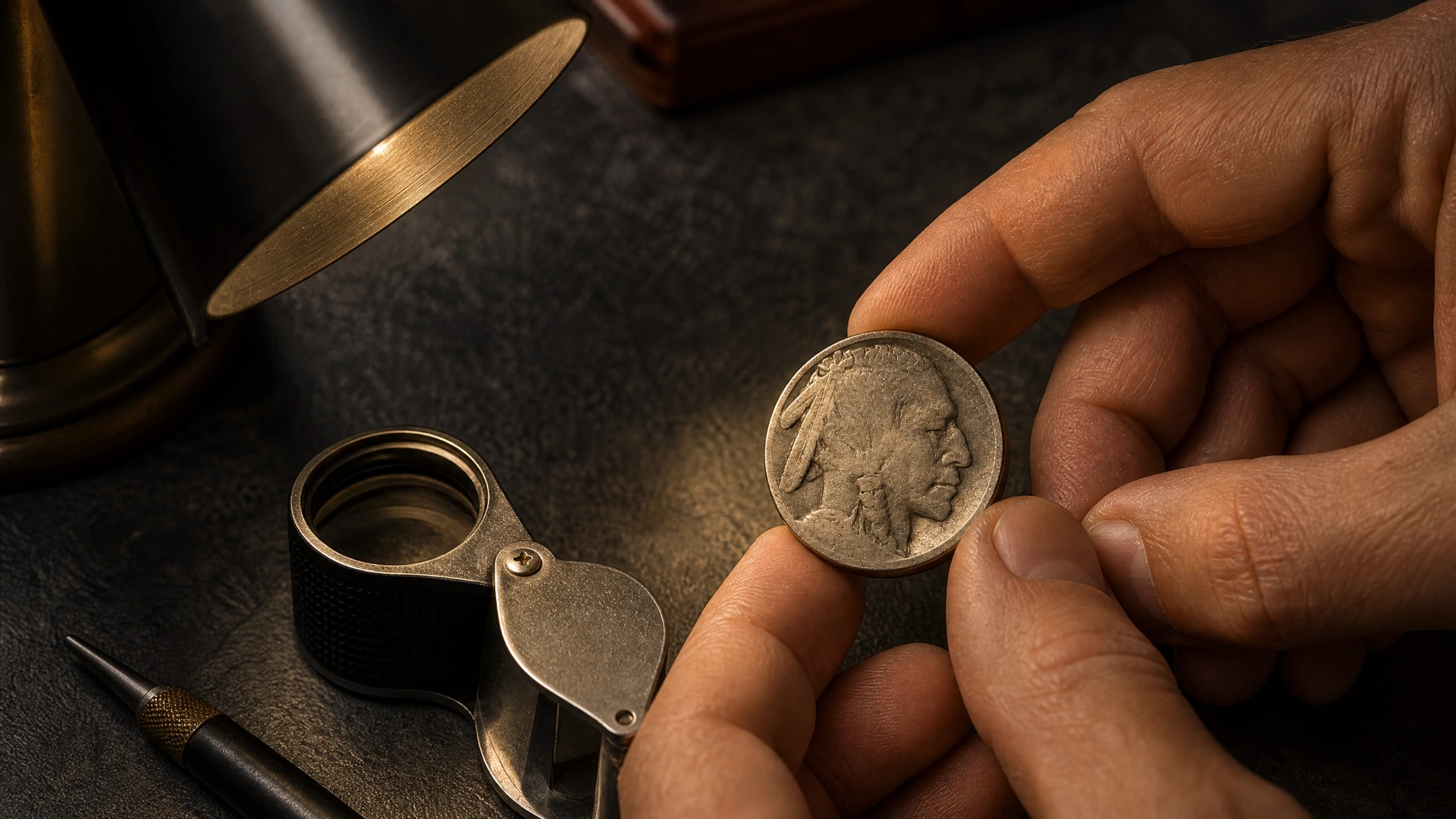
Start with raking light, then use the reverse to narrow what is left. Neither step touches the coin.
Put the coin under a single light source and tilt it slowly at a low angle. A date that has worn flat to the eye often still holds a few thousandths of relief, and low-angle light throws a shadow off what remains. Work on the last two digits — the first two are 19 on every coin in the series.
Then read the reverse. A Type 1 reverse settles the year at 1913 on its own, and a mint mark rules in one facility and rules out the other two. Strike character helps at the margins: a soft strike is more common on branch-mint coins of the late 1910s and 1920s than on Philadelphia issues.
If none of that produces a date, the honest description is a dateless Buffalo nickel. Coins in that condition are traded by weight, by the roll, or as type fillers — coins bought to occupy a slot in a type set where the specific date does not matter — rather than priced by date, and there is nothing wrong with saying so.
Acid-restored dates and why a grading service treats them as altered
Acid restoration makes a worn date legible, and in doing so makes the coin ineligible for a numeric grade. The chemistry is straightforward: the metal that was compressed under the die when the date was struck resists etching slightly differently from the surrounding field, so a mild acid eats the field faster and the date reappears as a dark, sunken outline. The coin now has a readable date and an etched surface.
Grading services will still encapsulate a coin like this, but without a number on the label. PCGS publishes the designations it applies instead of a grade, and they include Altered Surface, Damage and Environmental Damage; a coin returned with one of those is described as receiving a details grade, meaning the service states the coin's condition and the problem but assigns no number.
That matters commercially, because the published price guides for this series quote problem-free, numerically graded coins. The process is also irreversible, which is the part worth knowing before anyone reaches for a bottle.
How Buffalo nickel value is actually set
A value statement for a Buffalo nickel means nothing without four things attached: the date, the mint mark, the grade, and the date the value was quoted. "A Buffalo nickel is worth X" is not a useful sentence about a series that ran twenty-six years across three mints.
Every Buffalo nickel contains five grams of a copper-nickel alloy, which sets a metal floor. Whether a particular coin trades above that floor depends on its date, mint mark, variety and condition. We explain how melt value is calculated separately; it is arithmetic, and it is the same arithmetic for every coin in the series.
Above that floor, numismatic value is the collector premium a coin carries beyond its metal, and it follows the survival columns in the table above rather than the mintage column. Grading is an opinion, not a measurement: the correct phrasing is "graded MS-65 by PCGS," never "is MS-65." Price guides carry a date for the same reason, and the figure you check today is the figure for today.
What we look at when a Buffalo nickel comes across the counter
A Buffalo nickel is worked through in one order: date, mint mark, reverse type, then surfaces. Copper State brings over 40 years of numismatic and bullion experience to the counter, and surfaces are where that experience shows — original wear reads differently from cleaning, and an etched date is visible under magnification once you know what it looks like. We submit coins to PCGS and NGC, and whether certification is worth it depends on the coin rather than on a rule.
One piece of Arizona law is worth knowing before you come in, because it surprises people. Under A.R.S. § 44-1602, an Arizona dealer in precious items must record photo identification from every seller, must deliver a complete list of purchases to local law enforcement at least weekly, must hold purchased items unaltered for ten calendar days after that report is filed, and must pay by check. None of that is shop policy — it is the statute, it binds every Arizona dealer in precious items, and it is why an Arizona coin dealer pays by check rather than cash.
This article is educational and reflects general information about precious metals and collectible coins. It is not investment, tax or legal advice, and Copper State Coin & Bullion is not a registered investment adviser, broker-dealer or tax professional. Metal prices fluctuate and past performance does not indicate future results. Consult a qualified professional about your own situation.
Frequently asked questions
What is the most valuable Buffalo nickel?
A 1918/7-D overdate graded MS65+ by PCGS sold for $511,875 at GreatCollections in February 2024, which PCGS reported as a record for that variety. The 1916 Doubled Die Obverse and the 1937-D 3 Legs are the other two varieties PCGS CoinFacts lists separately from the regular dates.
How do I tell a Type 1 from a Type 2 Buffalo nickel?
Look at the reverse. On the Type 1, the bison stands on a raised mound and FIVE CENTS is in raised lettering. On the Type 2 the bison stands on a flat plain and FIVE CENTS sits in a recess. Only 1913 exists in both types.
Where is the mint mark on a Buffalo nickel?
On the reverse, below FIVE CENTS. D is Denver and S is San Francisco, and a coin with no mint mark was struck in Philadelphia. It sits below the raised FIVE CENTS on a Type 1 reverse and below the recessed FIVE CENTS on a Type 2, which means it survives on many coins whose obverse date has worn away entirely.
What is a dateless Buffalo nickel worth?
What a group is worth depends on quantity and condition rather than on any date, so a dealer quotes on the lot in front of them. One thing worth checking first: a Type 1 reverse identifies the coin as 1913 even with no date at all, so it is worth separating those out before you weigh the rest.
Are Buffalo nickels made of silver?
No. The U.S. Mint struck them in an alloy of 25% nickel with the balance copper, at 5.00 grams and 21.21 mm across, with a plain edge. No circulating US five-cent piece of this design contains silver, and the silver "war nickels" people sometimes have in mind are a later Jefferson issue.
Can you restore the date on a Buffalo nickel?
Chemically, yes, and the result is a coin with an altered surface that will not receive a numeric grade. Acid-dated coins are not hidden in the trade — they are commonly offered and described as acid-dated, and priced as problem coins rather than against the price guide. What you cannot do is undo it, so the decision is one-way.
How much is a 1937-D three-legged Buffalo nickel worth?
It depends entirely on grade, and current figures are published in the PCGS Price Guide with the date they apply to. Two things are worth knowing before you check: the variety is counterfeited and legitimate coins are also imitated by removing the leg from an ordinary 1937-D, so certification by a major grading service is how the market settles authenticity here.
Is it worth getting Buffalo nickels graded?
It depends on the coin, and the cost side is knowable before you commit. Certification costs a fee per coin plus shipping and insurance, and what it buys is an authenticated attribution and a grade on a sealed holder. A common circulated date and a possible 1918/7-D are different decisions, and the grading services publish their fee schedules.
How many Buffalo nickels were made?
The series ran from 1913 to 1938 across Philadelphia, Denver and San Francisco, and individual issue mintages range from under a million to tens of millions. The 1926-S is the lowest regular issue at 970,000 pieces; 1916 Philadelphia alone accounted for 63,498,066.
Why do so many Buffalo nickels look weakly struck?
Nickel is a hard alloy and did not always fill the dies completely. PCGS notes that branch-mint strikings from the 1910s and 1920s frequently show mushy detail even on uncirculated coins, so weak detail is not always evidence of wear.
Where can I sell Buffalo nickels in the Phoenix area?
We buy coins and collections at both of our stores. The Peoria store is at 8360 W. Thunderbird Road C#103, Peoria, AZ 85381, (623) 432-3953; the Phoenix store is at 4550 E Bell Road Suite 188, Phoenix, AZ 85032, (602) 377-1944. Both are open Monday to Friday 9:00–17:00 and Saturday 9:00–16:00, closed Sunday.
Bring Your Buffalo Nickels In, or Start a Set
If you have a folder, a jar or an inherited group of Buffalo nickels, bring them in for a complimentary appraisal. Written insurance appraisal documentation is a separate, chargeable service — one tells you what we would pay, the other is a document for your insurer, so tell us which you need. If you are building a set instead, our numismatic inventory is worth a look, and our staff will work from a want list if there are specific dates you are chasing.
Peoria
Copper State Coin & Bullion
8360 W. Thunderbird Road C#103
Peoria, AZ 85381
(623) 432-3953
Phoenix
Copper State Coin & Bullion
4550 E Bell Road Suite 188
Phoenix, AZ 85032
(602) 377-1944
Hours at both stores: Monday–Friday 9:00–17:00 · Saturday 9:00–16:00 · Sunday closed