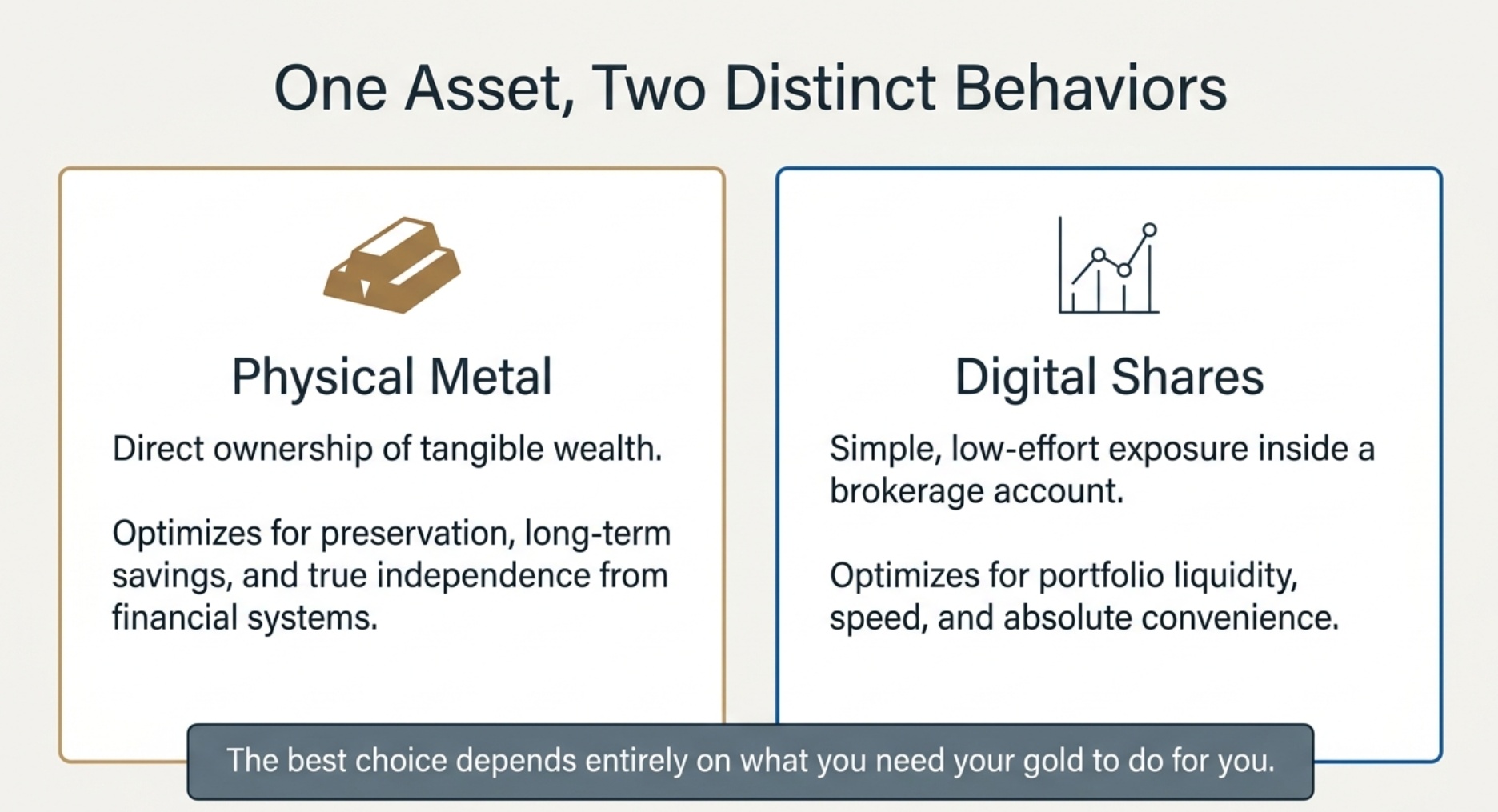
Choosing between physical gold vs gold ETFs is one of the most common questions everyday investors ask when they decide gold should be part of their portfolio. Both can play a valuable role, but they behave differently in the real world, and the best choice depends on what you want your gold to do for you.
Quick Answer for Everyday Investors
If you want simple, low-effort exposure to gold prices inside your brokerage account, a gold ETF or gold fund is usually the easiest place to start. Physical gold coins and bars make more sense if you care about direct ownership, long-term wealth preservation, and holding some assets outside the financial system. For many everyday investors, a blended approach works best: a small gold ETF allocation for liquidity, plus a core of well-known bullion coins for long-term savings and peace of mind.
Key Definitions: Physical Gold, “Paper Gold,” Spot Price & Grading
Before you decide whether to buy gold coins or invest in a gold fund, it helps to get a few key terms straight.
What Counts as Physical Gold?
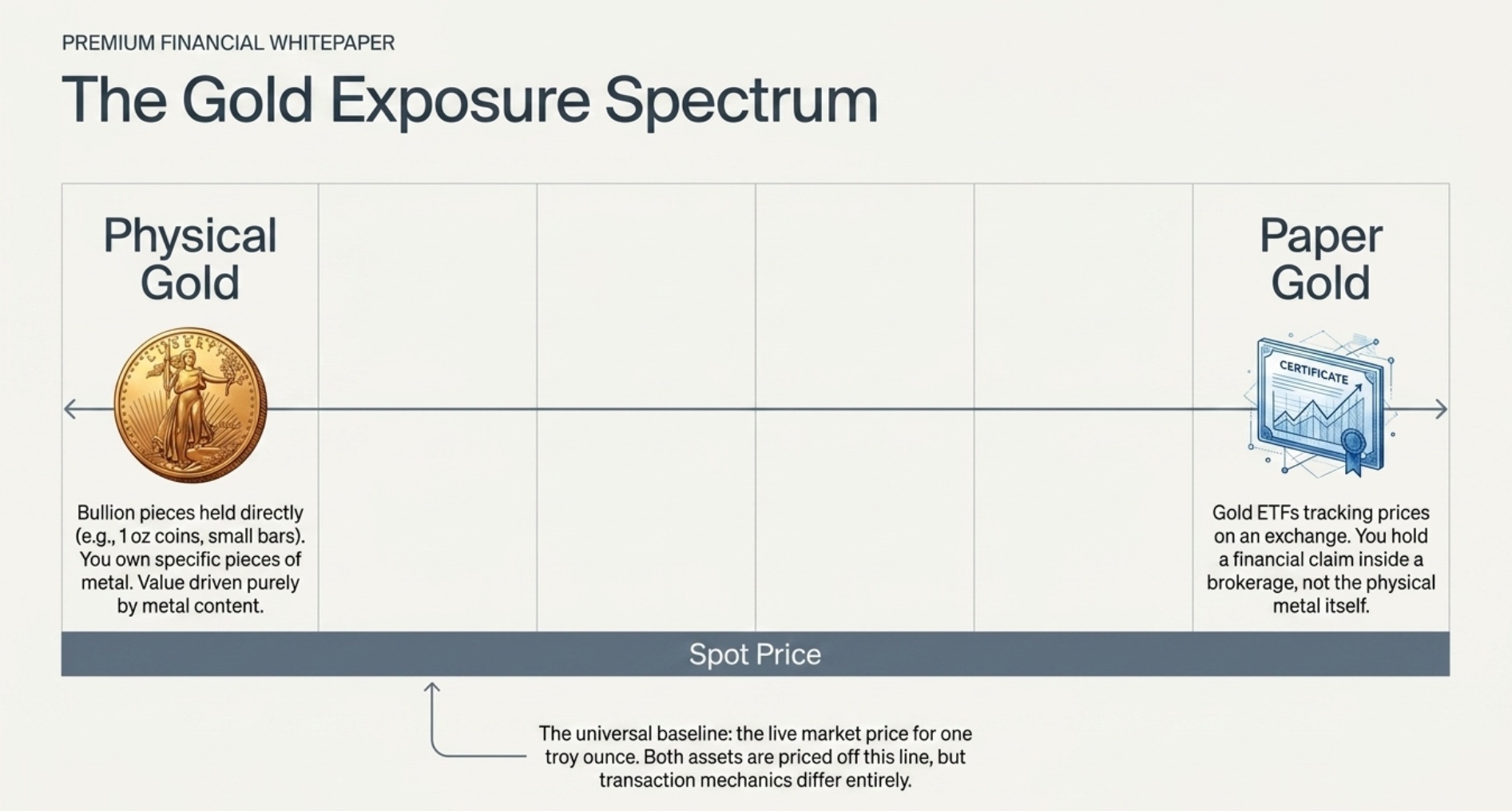
Physical gold is gold you can hold directly—typically bullion coins, bars, or rounds stored at home, in a safe, or in a vault in your name. Everyday investors most often buy:
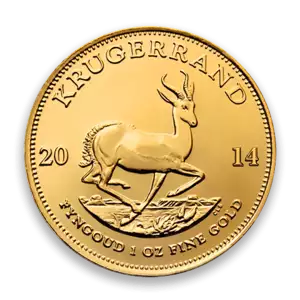
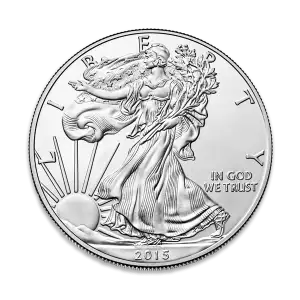
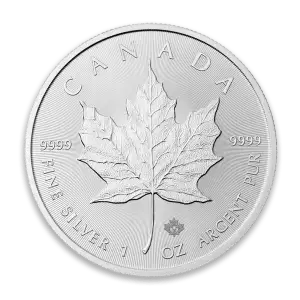
- 1 oz bullion coins like American Gold Eagles, Maple Leafs, or similar
- Small bars (1 g to 1 oz) from recognizable refiners
You own specific pieces of metal, not just an abstract claim on gold.
What Is a Gold ETF or “Paper Gold”?
A gold ETF (exchange-traded fund) is a financial product that tracks the price of gold and trades on a stock exchange, similar to a stock or index fund. When you buy a gold ETF, you hold shares in a fund that typically owns gold (or sometimes uses financial instruments) rather than owning particular coins or bars yourself. This is often called “paper gold” because your exposure is through a financial claim instead of physical metal.
What Is Spot Price and Why It Matters
Spot price is the live market price for one troy ounce of gold for immediate delivery. Both physical gold and gold ETFs are priced off spot, but the prices you actually pay or receive differ:
- Physical gold: spot price plus (or minus) a dealer premium or discount
- Gold ETF: price usually very close to spot, plus small fund fees and trading costs
Knowing spot price helps you understand whether you’re getting a fair deal, regardless of which route you choose.
What Is Coin Grading (and Does It Matter Here)?
Coin grading is the process of assessing a coin’s condition and assigning it a grade on a standardized scale. Higher grades generally mean higher value for collectible (numismatic) coins. For the physical gold vs gold ETFs decision, most everyday investors are looking at bullion coins, where the value is mainly driven by metal content, not numismatic rarity.
Physical Gold vs Gold ETFs at a Glance
Here is a simple side-by-side comparison of physical gold vs gold ETFs for everyday investors.
| Factor | Physical gold (coins/bars) | Gold ETFs / gold funds |
|---|---|---|
| Ownership | Direct ownership of specific coins or bars | Indirect ownership via fund shares |
| Liquidity | Sell through dealers or shops; can take hours to days | Buy/sell in seconds during market hours in your brokerage account |
| Storage & logistics | Requires secure storage and possibly insurance | No physical storage; held in your brokerage account |
| Costs | Premiums over spot, bid/ask spread, storage/insurance | Expense ratio, trading commissions/spread |
| Counterparty risk | Very low (no fund issuer or broker risk) | Exposed to fund structure, custodians, and brokerage infrastructure |
| Minimum investment | Cost of at least one coin/bar | Can often start with small amounts or fractional shares |
| Best suited for | Long-term savings, wealth preservation, “hard asset” bucket | Portfolio diversification, tactical allocation, easy rebalancing |
Both have pros and cons; the key is matching the vehicle to your goals and comfort level.
Reasons Some Investors Prefer Physical Gold Coins
For many people, especially those thinking long-term, there are specific reasons to own physical gold instead of (or in addition to) a gold ETF.
Direct Ownership and No Counterparty Risk
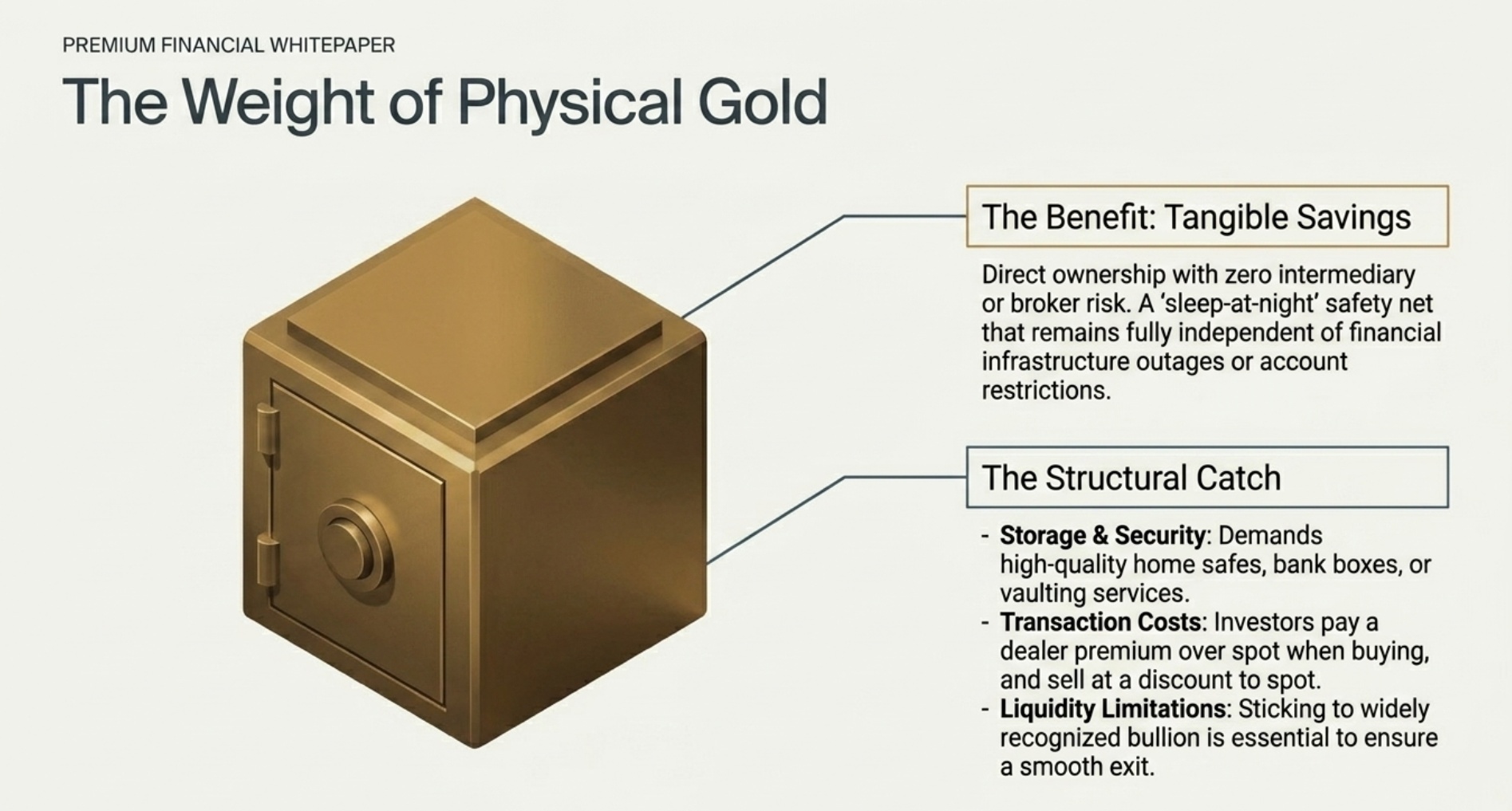
When you hold coins or bars, you are not depending on a fund manager, custodian, or brokerage platform. There is no intermediary between you and your metal. This direct ownership is a major reason some investors prefer gold coins over ETFs, especially as part of a “sleep-at-night” safety net.
Tangible Savings You Can Actually Hold
Physical gold fits naturally into a long-term savings plan as a tangible store of value that isn’t just another line in an online account. Many everyday investors:
- Build a small “hard asset bucket” alongside cash and investments
- Accumulate a few bullion coins per year, almost like an annual savings ritual
- Value the psychological benefit of holding something real, not just digital numbers
Flexibility in a Wide Range of Situations
Physical gold can be stored, moved, or passed down regardless of brokerage outages, fund changes, or account restrictions. That doesn’t mean you expect systemic collapse—it simply means part of your wealth is independent of financial infrastructure. For some investors, that independence is part of the appeal.
When a Gold ETF Might Make More Sense
Not everyone needs or wants physical gold. For many everyday investors, “paper gold” via a gold ETF is the more practical starting point.
Liquidity and Ease of Trading
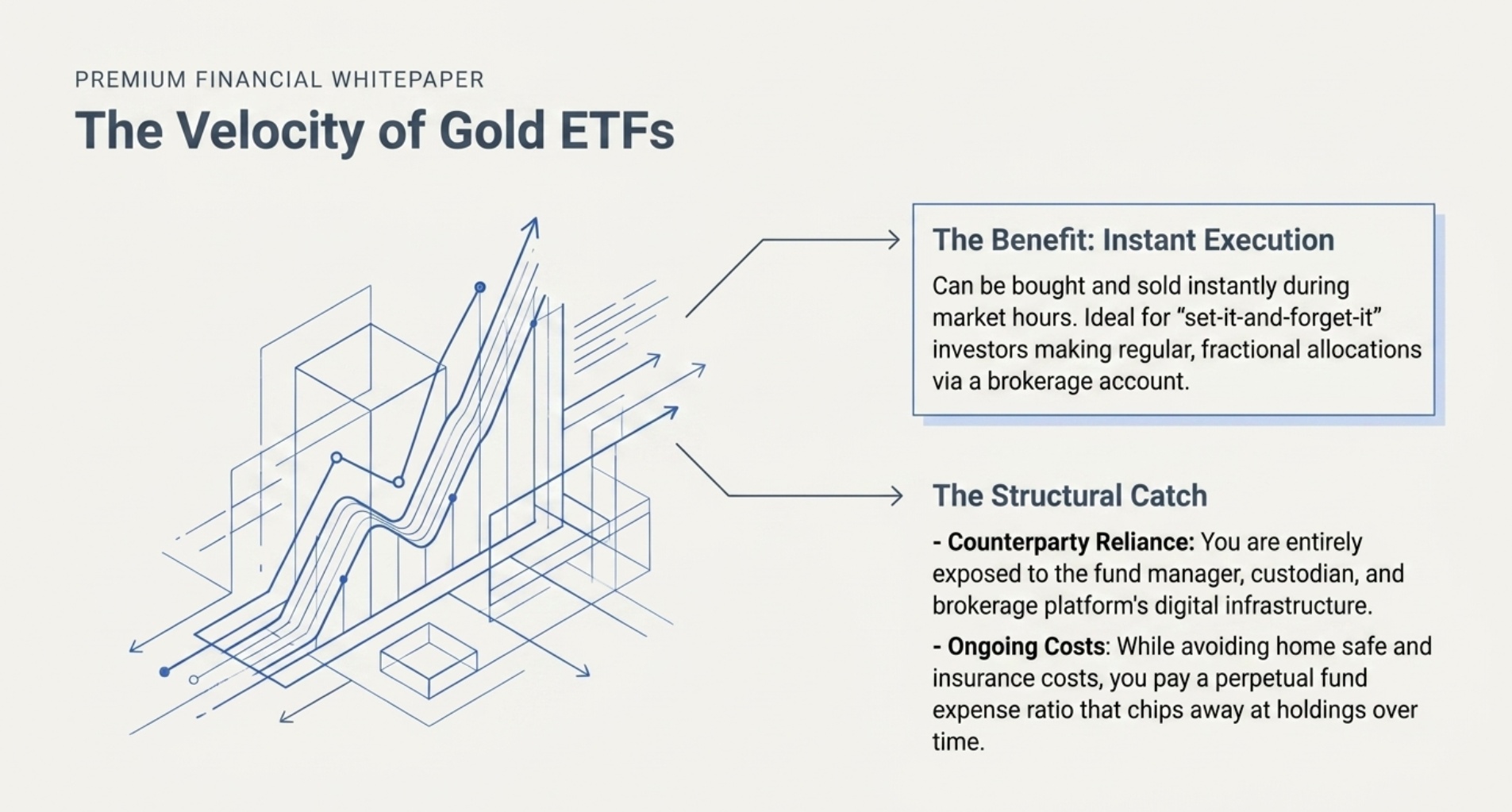
Gold ETFs can be bought and sold instantly during market hours in any regular brokerage account. You don’t need to find a dealer, move metal, or worry about storage. If you see gold as just another asset class in your portfolio to rebalance periodically, ETFs are hard to beat on convenience.
Small, Regular Allocations
If you plan to invest very small amounts—say 50–100 dollars at a time—it may be easier to do that with an ETF or gold fund than saving up for a full bullion coin. Automatic contributions, dividend reinvestment, and fractional shares make ETFs a good fit for “set-it-and-forget-it” investors.
When Storage Is a Dealbreaker
Some investors simply don’t want the responsibility of securely storing and insuring physical metal. For them, paying a modest fund expense ratio in exchange for avoiding home safes and insurance entirely can be a smart trade-off.
How Easy Is It to Buy and Sell Physical Gold vs a Gold ETF?
Understanding the real-world logistics of getting in and out matters as much as theoretical returns.
If you’re in Phoenix or Peoria and want a step-by-step walk‑through of real‑world options, read our local guide to selling coins and bullion.
Buying and Selling Physical Gold
Buying:
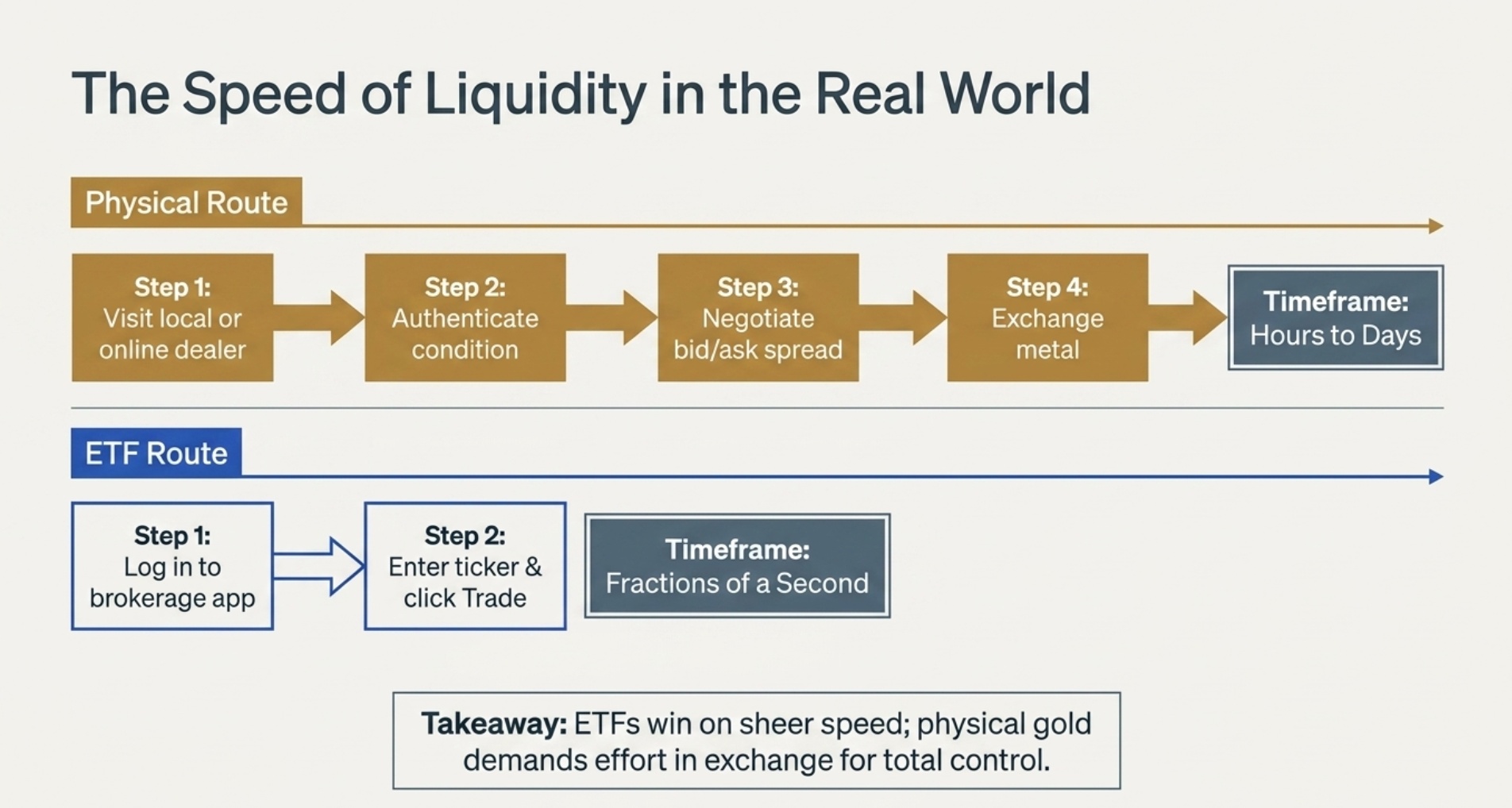
- Visit a reputable local dealer or trusted online dealer
- Choose well-known bullion coins or bars
- Pay a premium above spot (which covers minting, distribution, and dealer margin)
Selling:
- Bring coins/bars to a dealer or shop
- The dealer verifies authenticity and condition
- You receive an offer, typically at or below spot depending on the product and market conditions
This process can take anywhere from a few minutes to a couple of days, but for everyday investors, physical gold is usually “liquid enough” as long as you stick with widely recognized products and good dealers.
Buying and Selling a Gold ETF
Buying/selling a gold ETF is just like trading any liquid stock:
- Log in to your brokerage
- Enter the ETF ticker and trade size
- Click buy or sell during market hours
Your order is filled almost instantly, and the trade settles in the usual timeframe. This speed and simplicity is the main reason gold ETFs are favored by investors who want gold to behave like any other portfolio asset.
Real-World Liquidity: What Everyday Investors Experience
Gold ETFs clearly win on speed and ease. Physical gold requires a little more effort but offers something ETFs never can: direct, independent ownership. The right choice depends on whether you value ultimate convenience or that extra layer of control and tangibility.
Risks to Consider Before Buying Physical Gold
Physical gold is not risk-free. Before you go all-in on coins, understand what you’re signing up for.
Storage, Security, and Insurance
Physical gold must be stored securely. Options include:
- A high-quality home safe
- A bank safe deposit box
- A professional vaulting service
Each comes with costs (hardware, rental fees, insurance) and trade-offs in accessibility and privacy. Neglecting storage and insurance can turn a smart hedge into a security liability.
Premiums, Spreads, and Transaction Costs
With physical gold, you don’t pay a management fee, but you do pay:
- A premium over spot when you buy
- A lower price (relative to spot) when you sell
These buy/sell spreads are real costs. They’re often higher for small pieces or obscure products and lower for common bullion coins and bars. For ETFs, you face lower trading costs but pay an ongoing expense ratio.
Liquidity and “Wrong Product” Risk
If you buy highly collectible or obscure coins without understanding the market, they may be harder or slower to sell. Everyday investors who care about liquidity should usually stick to mainstream bullion coins from reputable mints and dealers.
How Gold Coins Fit Into a Long-Term Savings Plan
Physical gold can be more than a speculative trade; it can be part of a structured, long-term savings plan.
Role of Physical Gold in a Balanced Plan
For many everyday investors, physical gold coins serve as:
- A long-term store of value
- A hedge against inflation and currency risk
- A “wealth insurance” bucket separate from stocks, bonds, and cash
The exact allocation depends on your risk tolerance and situation, but even a modest amount of physical gold can add diversification and psychological comfort.
Example Strategies for Everyday Investors
If you are buying for diversification:
- Use a gold ETF for flexible, liquid exposure inside your portfolio
- Add a modest core of physical bullion coins to hold for the long run
If you inherited coins:
- Get them evaluated by a reputable dealer
- Consider keeping key bullion or easily recognizable pieces as part of your long-term savings
- Use proceeds from less desirable items to simplify and strengthen your physical gold position
Combining Physical Gold and Gold ETFs: A Simple Framework
A practical approach for everyday investors is a “core-satellite” structure:
- Core: physical gold coins and bars held long-term as wealth insurance
- Satellite: gold ETFs used for incremental allocation, tactical moves, or small, regular contributions
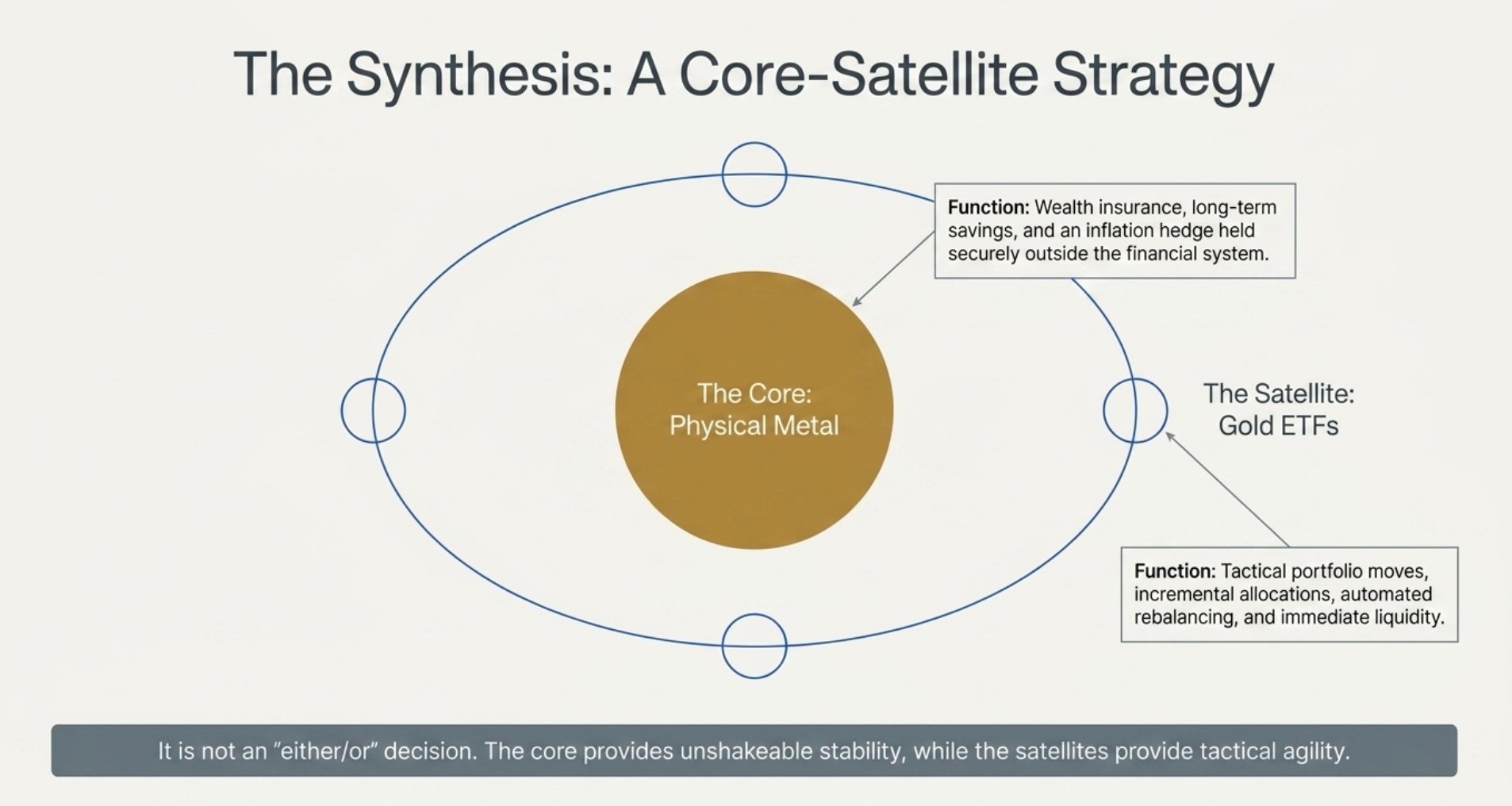
This gives you the best of both worlds—tangible savings plus convenient, tradable exposure.
Quick Scenarios: Which Option Fits You Better?
Sometimes the easiest way to choose between physical gold vs gold ETFs is to see yourself in a scenario.
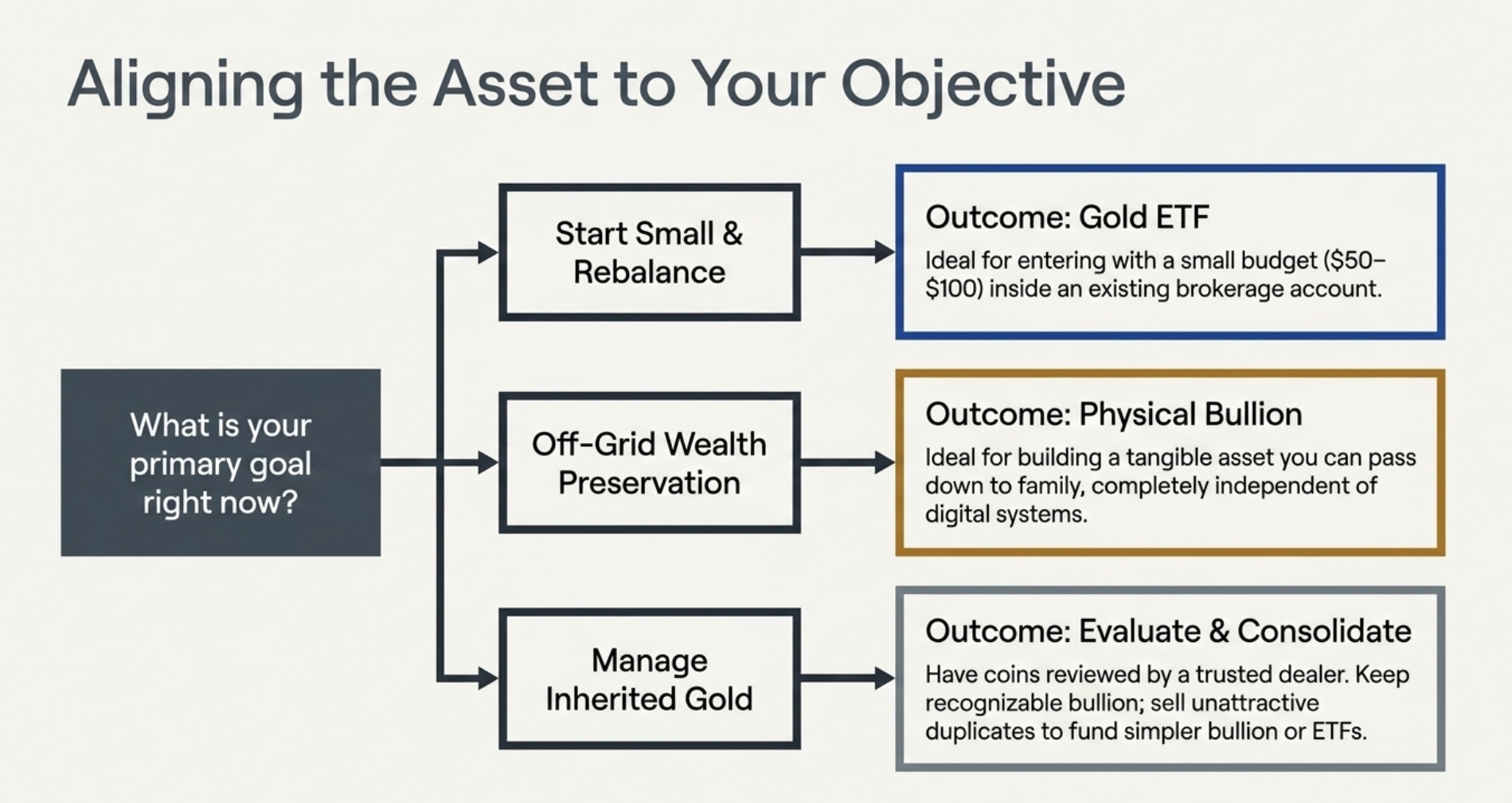
If You Are Buying Your First Gold with a Small Budget
You might favor a gold ETF if:
- You want to start with very small amounts (e.g., $50–$100 at a time)
- You’re already comfortable with your brokerage account
Alternatively, you might decide to save until you can buy a single bullion coin from a reputable dealer, using that coin as the foundation of your physical gold stack.
If You Are Focused on Long-Term Wealth Preservation
Physical gold coins often make more sense if your priority is:
- Long-term savings you can hold outside the financial system
- A tangible asset you can pass down to family
You can still complement this with a modest gold ETF allocation for liquidity and flexibility.
If You Inherited Coins and Already Own Some Physical Gold
If you already have physical gold, especially from an inheritance:
- Have the coins and bars reviewed by a trusted dealer
- Decide which pieces to keep as part of your long-term savings plan
- Consider selling duplicates or unattractive items and reinvesting into simpler, more liquid bullion products that fit your strategy better
FAQ: Physical Gold vs Gold ETFs for Everyday Investors
Is physical gold or a gold ETF better for everyday investors?
There is no one-size-fits-all answer. Gold ETFs are better for investors who want easy, low-effort exposure inside a brokerage account, while physical gold coins suit those who value direct ownership, independence from the financial system, and long-term wealth preservation. Many people use a mix of both.
How easy is it to sell physical gold compared to a gold ETF?
Gold ETFs can be sold in seconds during market hours with a few clicks. Physical gold usually requires visiting a dealer or mailing coins to a buyer, which takes more time but is straightforward if you stick with well-known bullion products and reputable shops. For most everyday needs, both are reasonably liquid, but ETFs are faster.
What are the main differences between owning physical gold and paper gold?
Physical gold means you own specific coins or bars directly, must store them securely, and deal with premiums and spreads. Paper gold (gold ETFs or funds) gives you price exposure through a financial product with tight spreads and easy trading, but you don’t control the underlying metal and rely on the fund and brokerage infrastructure.
What risks should I consider before buying physical gold?
Key risks include secure storage, potential theft or loss, insurance costs, and the impact of premiums and spreads when buying or selling. There is also “product risk” if you buy obscure or highly collectible items that may be harder to resell. Sticking with popular bullion coins and trusted dealers reduces many of these risks.
How do gold coins fit into a long-term savings plan?
Gold coins can act as a long-term store of value and a hedge against inflation and financial shocks. Many everyday investors treat them as a small but important “hard asset” bucket alongside traditional investments, adding coins gradually over time and planning to hold them for many years rather than trading frequently.
Can I own both physical gold and a gold ETF?
Yes—and for many investors, that’s the most balanced approach. Physical gold provides direct, tangible wealth insurance, while a gold ETF offers convenient, low-friction exposure that’s easy to adjust as your portfolio evolves. Using both lets you align different parts of your gold allocation with different goals.
Are gold ETFs safer than holding coins at home?
Gold ETFs avoid home-storage and theft risk because the gold (or gold exposure) is held within the fund structure and your brokerage account. However, they introduce their own risks: fund, custodian, and brokerage dependence. Holding coins at home or in a vault removes those financial intermediaries but adds physical security and storage responsibilities. The “safer” option depends on which set of risks you’re more comfortable managing.

If you’re considering gold for your long-term savings, a smart next step is to clarify your goals, decide how much you want in tangible metal vs “paper” gold, and speak with a reputable bullion dealer who can help you choose the right coins - or complement your existing ETF exposure - with clear, straightforward guidance.