Territorial and pioneer gold coins are pieces struck by private firms, local assay offices and territorial governments in places where federal coinage had not yet arrived. They were made because gold was coming out of the ground hundreds or thousands of miles from the nearest United States Mint, and someone had to turn dust and nuggets into something that could be spent. They circulated as money, they were struck to their makers' own standards rather than the government's, and the whole era was over inside about thirty-five years.
They are among the most historically dense coins an American collector can hold, and among the most misunderstood — partly because "value" for a territorial piece depends on variables that do not apply to a regular federal issue. This is what they are, who made them, and what actually determines what one is worth.
Why private coins existed at all
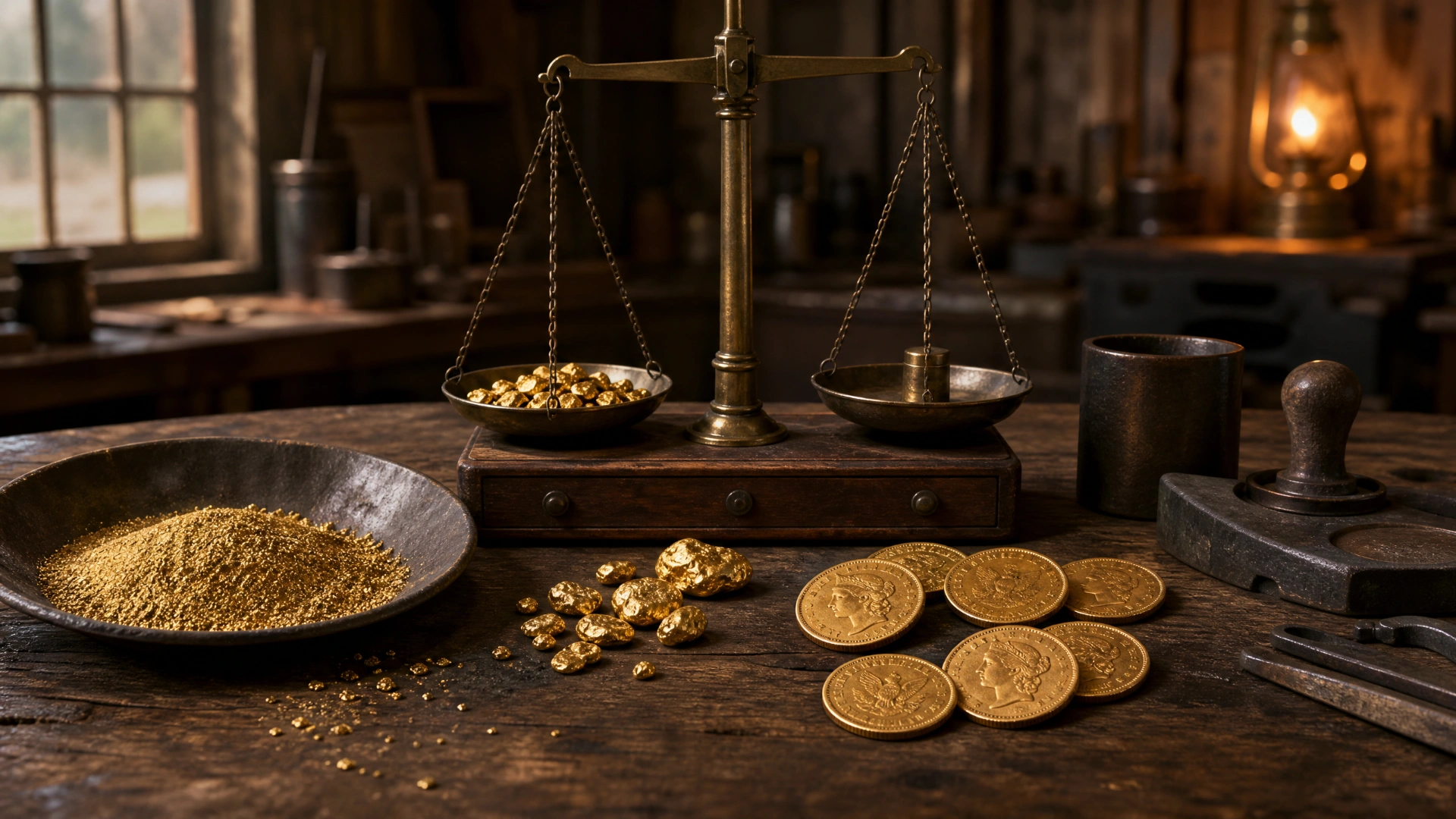
Until the middle of the nineteenth century the United States Mint meant Philadelphia. Gold found in Georgia, North Carolina, California, Oregon, Utah or Colorado had to physically travel there to become coin — a journey the US Mint's own history describes as "long and dangerous". In the meantime, miners paid for goods in raw gold by weight, which meant every transaction involved a scale, an argument about purity, and a merchant's discount.
A struck coin solved that. It carried a stated weight and fineness and a maker's name, and it could be handed over without being weighed. The firms that struck them were assayers, bankers, jewelers and goldsmiths who were already in the business of handling metal. Their coins were not counterfeits of federal issues — most made a point of looking nothing like them — and they were not illegal at the time. They were a private answer to a public shortage — a parallel track running alongside the federal gold coinage of the same decades.
Before California: territorial gold in Georgia and North Carolina
The first American private gold coinage predates the California rush by nearly twenty years, and came out of the southern Appalachian gold fields.
Templeton Reid struck gold in Georgia in July 1830, in denominations of $2.50, $5 and $10. The Smithsonian's National Numismatic Collection records him as a watchmaker and gunsmith who responded to the impracticality of shipping gold to Philadelphia by striking his own, and notes that "he put slightly more gold into his products than the federal government did into its coins, just to be on the safe side." It did him no good. A newspaper campaign questioning the coins' content closed the operation within months.
Christopher Bechtler, a German immigrant goldsmith, began striking at Rutherfordton, North Carolina in the summer of 1831, and the family business continued for two decades. The Smithsonian describes coins that were "simple affairs" but "of honest weight and good quality", made on dies, punches and presses Bechtler built himself. Their 1834 five-dollar piece is inscribed with the gold's origin and its rating — "CAROLINA GOLD" and a carat figure — rather than with any national device. And the Bechtlers hold a genuine first: the Smithsonian credits them with "issuing the first gold dollars", noting that "the federal government didn't get around to striking the denomination until 1849."
1849: California and the assay office
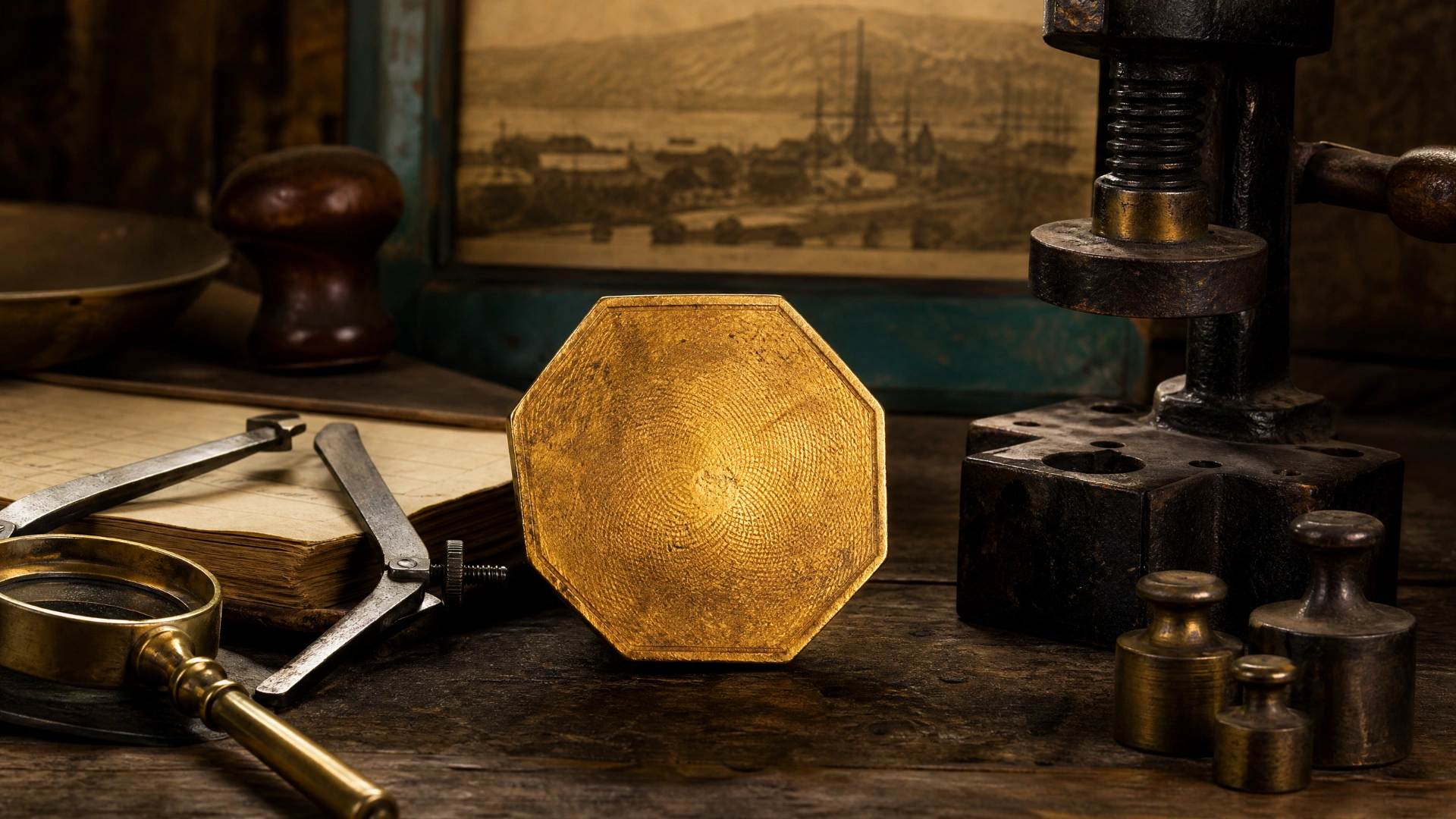
The California discovery turned a regional inconvenience into a national one. Congress did not authorize a branch mint in California until 1852, and the San Francisco Mint opened to accept deposits from miners on 3 April 1854. In the intervening years private firms filled the gap: Moffat & Co., Norris, Gregg & Norris, Baldwin & Co., Wass, Molitor & Co., the Miners' Bank and others struck gold in San Francisco and Sacramento, largely in $5, $10 and $20 denominations.
The federal response before the mint was an intermediate institution: the United States Assay Office of Gold, with Augustus Humbert as United States Assayer. Its most famous product is the octagonal fifty-dollar piece — the "slug" — struck by Moffat & Co. under the Assay Office's authority. The Smithsonian's example of the 1851 fifty dollars is marked at 887 thousandths fine, carries a spread-winged eagle on the obverse and an engine-turned spiral on the reverse, and is lettered on the edge "Augustus Humbert United States Assayer of Gold California 1851".
These sit in an interesting middle category. They are not regular federal coinage, and they are not purely private either — which is one reason the terminology in this field is inconsistent, and why "territorial", "pioneer" and "private" get used loosely for overlapping groups.
Beyond California: Oregon, Utah and Colorado
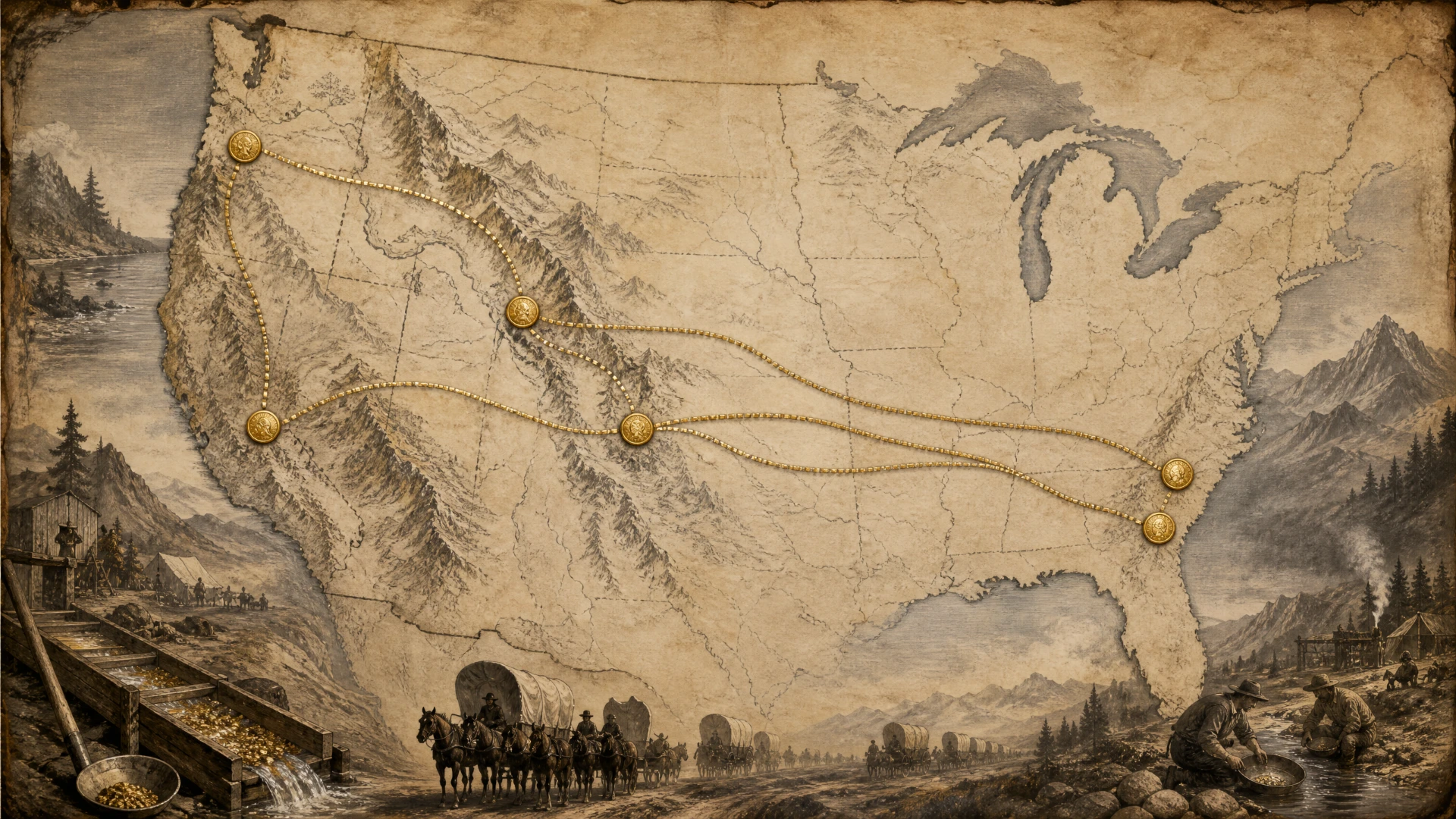
Oregon. The Oregon Exchange Company struck $5 and $10 gold pieces in 1849, known to collectors as Beaver coins for the animal on the obverse. They were made by a group of Oregon City businessmen, and the operation was short-lived.
Utah. The Mormon mint at Salt Lake City struck gold in 1849 in $2.50, $5, $10 and $20 denominations under Brigham Young's direction. The pieces carry the legend HOLINESS TO THE LORD around a Phrygian crown above an all-seeing eye, and clasped hands with "G. S. L. C. P. G. / TWENTY DOLLARS / 1849" on the reverse. The Smithsonian notes of its 1849 twenty-dollar piece that it "was among the first double eagles ever struck and circulated in the United States". The federal double eagle had been authorized only months earlier, in March 1849, and was not struck for circulation until 1850; a single 1849 specimen is known to survive, in the Smithsonian's National Numismatic Collection.
Colorado. The Pike's Peak rush produced the last significant chapter. The US Mint's own history of the Denver Mint records that "from 1860 to 1862 there were three firms, namely, Clark, Gruber & Co., John Parsons & Co., and John Conway & Co., who manufactured $5 and $10 gold pieces", with Clark, Gruber & Co. by far the largest. The federal government then bought the operation outright — the Treasury's offer is dated 25 November 1862, at $25,000. The Denver Branch Mint opened in 1863, but not as a coining facility: its operations were "confined to the melting, refining, assaying, and stamping of bullion". Denver would not strike coins until 1906.
How the territorial era ended
Two things closed it. The first was infrastructure: once branch mints and assay offices existed in the West, the commercial reason for private coinage disappeared. The second was law. Making or passing coins of gold, silver or other metal intended for use as current money — whether resembling US coins, foreign coins, or of entirely original design — is now prohibited under 18 U.S.C. § 486, carrying a fine or up to five years' imprisonment.
Most of what was struck did not survive — these were working coins made of gold at a time when gold coin was routinely melted and recoined, and the certified populations reflect it. For many issues the PCGS and NGC population reports run to dozens or low hundreds of certified examples, and the catalog rarity ratings say the same thing in R-numbers. Check the census, its date, and the specific issuer, denomination and Kagin number before treating any of it as a figure.
What determines the value of a pioneer gold coin
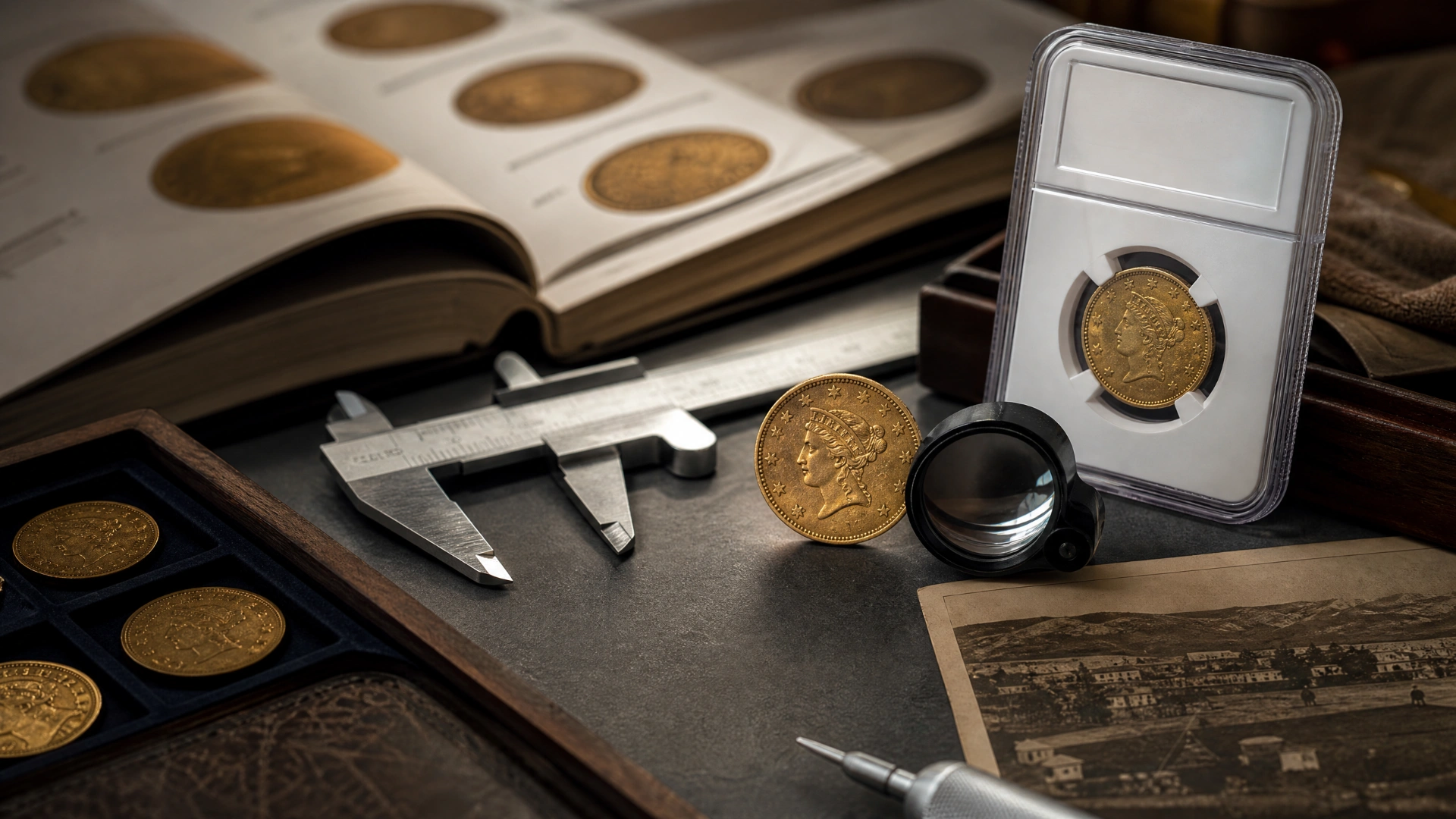
Territorial gold is not priced the way a common federal issue is priced, and a single "what is it worth" figure is close to meaningless without the following. These are the variables a dealer or an auction cataloger works through, roughly in order of weight:
- Issuer and denomination. A Bechtler five, a Mormon twenty and a Clark, Gruber ten are three different markets. Some issuers are far more available than others.
- Variety. Territorial issues are cataloged by Kagin numbers — a lot description reading "K-4" identifies a specific die variety, and varieties within one issuer and denomination can differ enormously in availability.
- Rarity rating. Catalogue rarity ratings, written as R-numbers, estimate how many examples are believed to exist. They are estimates and they get revised.
- Certified grade. Grading is an opinion rendered by a service, expressed on the 70-point scale — a coin is described as graded AU-53 by PCGS, not as being AU-53.
- Population. The PCGS and NGC census reports show how many examples each service has certified at each grade, and how many finer. On territorial issues those counts are small, and they carry a date — read both.
- Provenance. A documented chain of ownership through named collections and cabinets adds to a piece in this field more than in almost any other.
- Originality. Cleaning, repairs, tooling, mounting and jewelry damage all bear on the outcome, and are common on coins that spent decades outside collections.
Because those variables move independently, current prices come from dated sources rather than from memory: the grading services' price guides, and the published archives of the major auction houses, where each record carries the coin's variety, its certified grade, the sale and the date. Any figure without those four things attached is not a valuation.
Authentication comes first
Territorial gold has been counterfeited since the nineteenth century, and the field still attracts it. Alongside outright fakes there are contemporary imitations, later souvenir copies, and modern replicas — some struck in gold, some not, some sold honestly as copies and then separated from that description by a subsequent owner. The small "California gold" charms and tokens that turn up in jewelry boxes are a distinct thing again, and are usually not what their owner hopes.
The practical rule is that an uncertified territorial piece is an unanswered question, whatever it looks like. Certification by a recognized grading service is the ordinary route to an answer, and the population reports above exist because of it.
This article is educational and reflects general information about precious metals and collectible coins. It is not investment, tax or legal advice, and Copper State Coin & Bullion is not a registered investment adviser, broker-dealer or tax professional. Metal prices fluctuate and past performance does not indicate future results. Consult a qualified professional about your own situation.
If you have one, or want one
Copper State Coin & Bullion has over 40 years of numismatic and bullion experience, and territorial coins sit within the numismatic side of what we handle, alongside rare US coins by denomination, commemoratives, colonials, patterns and paper currency.
We submit coins to PCGS and NGC, and we run a want list — if you are looking for a specific issuer or denomination, tell us and we will watch for it.
If you are on the selling side, we offer a complimentary appraisal — and there is a piece of Arizona law worth knowing in advance, because it is routinely explained backwards. Under A.R.S. § 44-1602, a dealer buying precious items must see photo identification and record the seller's name, current address, date of birth, signature, ID serial number and a physical description; must keep those records for six months; must deliver a complete list of purchases to local law enforcement at least weekly; must hold the purchased item unaltered for ten calendar days after that report is filed; and must pay by check rather than cash.
But the statute's own definitions section, A.R.S. § 44-1601, defines a precious item as secondhand gold, silver and platinum jewelry, flatware, holloware, stones and pearls — and then states expressly that "precious item does not include coins". So the same counter is governed differently depending on what is put on it: a scrap gold chain falls inside § 44-1602, and a Bechtler five does not. That is a real, checkable distinction that most write-ups of Arizona dealer law get wrong, and it is worth asking any dealer to explain before you sell. Our sell to us page covers what to bring.
Frequently asked questions
What is the difference between territorial, pioneer and private gold?
The terms overlap and are used loosely. "Private gold" is the broadest — anything struck by a non-federal maker. "Territorial" is often used for issues from areas organised as territories, such as Utah and Colorado. "Pioneer gold" is the most general, covering the whole American private-coinage era from Georgia in 1830 to Colorado in the 1860s. Auction catalogs use all three, sometimes for the same coin.
Were these coins legal?
They were not counterfeits, and at the time there was no general federal prohibition on striking private gold pieces that did not imitate United States coinage. That is no longer the case: 18 U.S.C. § 486 now prohibits making or passing coins of any metal intended for use as current money, including designs entirely of the maker's own invention.
How can I tell if a territorial gold coin is genuine?
Not reliably by eye, and not by weight alone — the field has been counterfeited for well over a century, and some fakes are struck in gold of about the right fineness. Certification by a recognized grading service is the standard answer, and it also establishes the variety, which is what a valuation actually depends on. Do not clean the coin first; cleaning is itself a defect and it is not reversible.
What is a Kagin number?
It is the standard reference number for a territorial gold variety, written as K- followed by a number, from the specialist catalog of private gold coinage. Lot descriptions at the major auction houses use it because "1849 Mormon $20" describes several different die varieties with different rarities. If you are comparing prices, compare the same K-number.
Is territorial gold worth more than its gold content?
Usually, though only a specific record answers it: published auction results for identifiable examples have generally realized more than metal value, and any figure only means something with the issuer, the Kagin number, the certified grade, the sale and its date attached. Compare like for like in the auction archives and the grading services' price guides. That is also why authentication comes first: the whole difference between metal value and collector value rests on the piece being what it appears to be.
Come and talk to us about it
Whether you have inherited something you cannot identify or you are building toward a specific issuer, bring it in or send us a note. Both stores are open six days a week.
Peoria
Copper State Coin & Bullion
8360 W. Thunderbird Road C#103
Peoria, AZ 85381
(623) 432-3953
Monday–Friday 9:00 a.m. – 5:00 p.m. · Saturday 9:00 a.m. – 4:00 p.m. · Sunday closed
Peoria store
Phoenix
Copper State Coin & Bullion
4550 E Bell Road Suite 188
Phoenix, AZ 85032
(602) 377-1944
Monday–Friday 9:00 a.m. – 5:00 p.m. · Saturday 9:00 a.m. – 4:00 p.m. · Sunday closed
Phoenix store